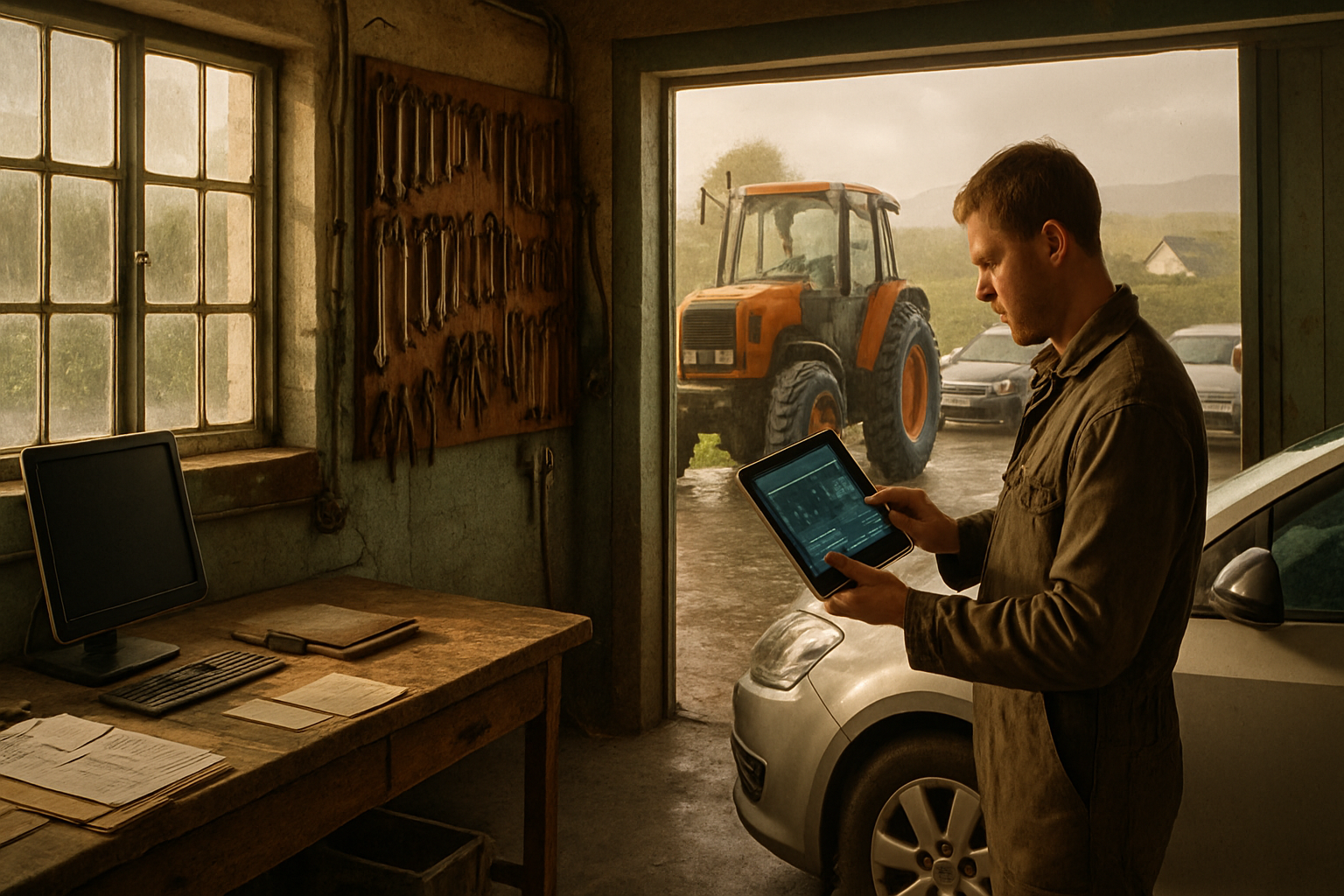
The Irish Garage in 2026: Tradition Meets Technology
If you're running a garage anywhere from the hills of Connemara to the busy streets of Cork, you'll know the game has changed dramatically over the past few years. Brexit has flooded our market with second-hand UK imports, customers expect professional documentation instead of handwritten receipts, and the Revenue Commissioners are getting increasingly strict about VAT compliance. Yet at the heart of it all, the Irish garage remains what it's always been — the backbone of our communities, keeping everything from farmers' tractors to Dublin commuters' cars running smoothly.
But here's the thing: while we're brilliant with spanners and diagnostics, the admin side is eating into our time. Between tracking NCT dates for hundreds of customers, calculating split VAT rates, and trying to compete with the likes of Halfords Autocentre expanding across Ireland, it's no wonder many of us feel like we're drowning in paperwork rather than focusing on what we do best.
The good news? Technology has finally caught up with the unique needs of Irish garages, and it's not as complicated as you might think.
NCT Reminders: Your Secret Weapon for Customer Retention
Let's start with something that should be every Irish garage owner's bread and butter: NCT reminders. Think about it — every car owner in Ireland needs their NCT done every two years (or annually once it hits ten years), and they're all dreading that phone call to book it in. But what if, instead of them scrambling to find a garage at the last minute, you were the one reaching out to them?
Here's how it works: thirty days before their NCT expires, your customer gets a friendly text message saying something like, "Hi Mary, your Honda Civic's NCT expires on March 15th. Give us a ring to book your pre-NCT check — we'll make sure she passes first time!" Suddenly, you're not just another garage competing for business; you're the proactive professional who's looking out for them.
The Psychology Behind NCT Reminders
Irish customers are loyal by nature — we like doing business with people we trust. But memory is fallible, and when someone's NCT is due, they often just ring the first garage they can think of or the one that answers the phone. NCT reminders ensure you're the first garage they think of when the time comes.
"Since we started sending NCT reminder texts, our repeat business has increased by 40%. Customers appreciate that we're thinking of them, and it saves them the stress of remembering dates." — Tommy O'Sullivan, O'Sullivan Motors, Kilkenny
The same principle applies to CVRT reminders for commercial vehicles. If you're servicing vans and trucks around Galway or Limerick, those fleet managers are juggling dozens of test dates. Being the garage that keeps track of everything for them? That's relationship gold.
Split VAT: The Revenue Headache Every Irish Garage Knows
Now, let's talk about everyone's favourite topic — VAT. If you've ever sat up until midnight trying to work out whether something should be charged at 13.5% or 23%, you're not alone. The split VAT system in Ireland is particularly brutal for garages because we're constantly switching between services (13.5%) and goods (23%) on the same invoice.
The Manual Invoicing Trap
Picture this scenario: you're fixing a car that needs new brake pads (23% VAT on the parts) and brake fluid service (13.5% VAT on labour). If you're calculating this manually, there's a decent chance you'll get it wrong — especially when you're rushing to get the customer out the door. And getting it wrong isn't just embarrassing; it can trigger a Revenue audit that'll have you pulling your hair out for weeks.
| Service Type | VAT Rate | Examples |
|---|---|---|
| Labour/Services | 13.5% | Diagnostics, repairs, NCT prep, fitting |
| Parts/Goods | 23% | Brake pads, oil, filters, tyres |
| Mixed Jobs | Both rates | Service with parts replacement |
Modern garage management software automatically calculates split VAT per line item. Labour gets 13.5%, parts get 23%, and your invoice is Revenue-compliant without you having to think about it. It's like having an accountant built into your system.
Revenue Compliance: Better Safe Than Sorry
The Revenue Commissioners have been cracking down on VAT compliance across all sectors, and garages aren't exempt. Proper documentation isn't just about looking professional anymore — it's about protecting your business. Digital invoicing creates an audit trail that satisfies Revenue requirements and gives you peace of mind.
The Brexit Effect: Second-Hand UK Imports Everywhere
Drive around any town in Ireland these days, and you'll spot them immediately — right-hand drive cars with distinctive UK number plates that have been re-registered here. Brexit has created a massive market for second-hand UK imports, and it's transformed how Irish garages work.
The Challenge of Unknown Specifications
When a customer rolls up in a 2018 Ford Focus imported from Manchester, you're often working blind. What engine variant is it? What's the service interval? Which brake pad specification does it need? In the old days, you'd be spending twenty minutes on the phone with parts suppliers trying to figure it out.
Vehicle lookup systems solve this instantly. Punch in the VIN or registration, and you get the full specification — engine code, transmission type, brake specifications, service requirements, the lot. It's transformed how quickly we can diagnose and quote for jobs on unfamiliar vehicles.
DoneDeal.ie and the Import Market
Anyone who's browsed DoneDeal.ie recently will have noticed the shift. The site is flooded with UK imports, many selling for thousands less than their Irish-market equivalents. For customers, it's great value. For garages, it means we're seeing a much wider variety of vehicles, often with unfamiliar service histories.
The smart garage owners are embracing this change. Instead of complaining about it, they're positioning themselves as the experts who can service these imports properly, with proper documentation and competitive pricing in euros, not pounds.
Rural Ireland: Where Personal Service Still Matters
From the Ring of Kerry to the back roads of Donegal, rural Irish garages remain the lifeline of their communities. You're not just fixing cars — you're the person who gets the local teacher mobile again, who keeps the postman's van running, who makes sure the parish priest can get to Sunday mass in nearby towns.
But even in rural Ireland, expectations have changed. Customers who might once have been happy with a handwritten receipt now expect proper invoices they can claim back through their business or submit for tax relief. They want text updates instead of playing phone tag. They appreciate professionalism alongside the personal touch.
WhatsApp and Text Updates: Modern Communication
Irish customers are increasingly comfortable with digital communication, but they want it to feel personal. A WhatsApp message saying "Hi Paddy, your Passat is ready for collection — she's running like a dream now!" hits the sweet spot between professional service and personal touch.
This is particularly valuable in rural areas where customers might be driving from Waterford to collect their car. A quick text when the job's done means they're not making unnecessary trips or sitting by the phone waiting for updates.
Fighting Back Against the Chains
Let's address the elephant in the room — fast-fit chains are expanding aggressively in Ireland. Halfords Autocentre, Kwik Fit, and others are targeting Irish cities with slick marketing and standardised pricing. For independent garages, this feels like David versus Goliath.
But here's what the chains can't replicate: the personal relationship you have with your customers. They know your name, you know their cars' histories, and you care about getting the job done right, not just fast. The key is combining that personal service with professional tools that match what the chains offer.
Professional Documentation: Levelling the Playing Field
When a customer gets their service from Halfords, they receive a professional invoice with clear breakdown of costs, VAT calculated correctly, and digital payment options. If you're still writing receipts by hand, you're immediately at a disadvantage. But when you can provide the same level of professional documentation while maintaining your personal touch, you've got the best of both worlds.
"The chains might be fast, but they don't know that Mrs Murphy's Micra needs gentle handling because she's ninety-two and it's her pride and joy. That's where we win." — Seamus Kelly, Kelly's Motors, Galway
RSA Compliance and Documentation Protection
The Road Safety Authority (RSA) takes vehicle safety seriously, and rightly so. When you're working on brakes, steering, or any safety-critical system, proper documentation isn't just good practice — it's your protection if something goes wrong.
Digital service records create a complete audit trail. If there's ever a question about work you've done, you can instantly pull up the exact parts used, procedures followed, and tests completed. This level of documentation protects both you and your customer, and it demonstrates the professional standards that keep Irish roads safe.
The Legal Protection Angle
Consider this scenario: six months after you service someone's brakes, they have an accident. The insurance company starts asking questions about recent maintenance. With proper digital records, you can immediately provide evidence of the work completed, parts used (with part numbers), and any recommendations made to the customer. Without proper documentation, you're relying on memory and handwritten notes that might not stand up to scrutiny.
The Economics of Going Digital
Let's talk numbers, because that's what matters for any business. The average Irish garage owner spends roughly 8-10 hours per week on administrative tasks — invoicing, chasing payments, tracking service dates, ordering parts. At an hourly rate of €50 (what you could be earning on the tools), that's €400-500 per week of lost productive time.
Return on Investment
Modern garage management software typically costs between €50-100 per month. If it saves you just two hours per week of admin time, it's paid for itself. But the real value comes from the additional business it generates through NCT reminders, professional customer communication, and improved efficiency.
- NCT reminder texts can increase repeat business by 20-40%
- Professional invoicing improves payment times and reduces disputes
- Automated VAT calculations eliminate costly mistakes
- Vehicle lookup reduces diagnostic time and improves accuracy
- Digital communication improves customer satisfaction and loyalty
Making the Change: Easier Than You Think
The biggest barrier to modernising Irish garage operations isn't cost or complexity — it's the fear of change. Many garage owners worry that digital systems will be too complicated, that they'll lose the personal touch that makes their business special, or that their customers won't adapt.
The reality is quite different. Modern garage management software is designed to be intuitive, and Irish customers are more digitally savvy than ever. They're already using online banking, shopping apps, and WhatsApp. Extending that to their garage experience feels natural.
The Gradual Approach
You don't have to transform everything overnight. Start with one area — perhaps NCT reminders or digital invoicing — and gradually add features as you become comfortable. Most systems are designed to integrate smoothly with existing processes, not replace them entirely.
The key is choosing a system designed for Irish garages, with Irish VAT rates, NCT/CVRT tracking, and euro pricing built in from the start. Generic international solutions often struggle with the specifics of Irish compliance requirements.
Your Next Steps Forward
The Irish garage industry is at a crossroads. The garages that embrace professional tools while maintaining their personal touch will thrive. Those that stick rigidly to old ways of working will find themselves gradually losing ground to better-organised competitors.
The good news is that modernising doesn't mean losing your identity. You can still be the friendly local garage that knows every customer's name and every car's quirks. You'll just be doing it with better tools, more professional documentation, and systems that help you focus on what you do best — fixing cars and serving your community.
Whether you're running a one-person operation in rural Cork or a busy workshop in Dublin, the principles are the same. Professional tools, personal service, and the confidence that comes from knowing you're compliant with Revenue requirements and RSA standards.
If you're curious about how modern garage management could work for your business, why not give it a go? Most systems offer free trials, so you can explore the features without commitment. Sure, what have you got to lose? At worst, you'll gain a better understanding of what's available. At best, you might discover tools that transform how you run your garage.
The Irish garage tradition of quality workmanship and personal service isn't going anywhere. We're just adding some professional polish to make sure it continues thriving for generations to come.