English
 Español
 Deutsch
 FI
FI
 FR
FR
 AR
AR
 ZH
ZH
The Spring Rush That Catches Everyone Off Guard
Every March, Dave Henderson's workshop in Brisbane starts getting the calls. "Mate, I need an RWC for my Commodore—can you fit me in this week?" By April, his phone's ringing non-stop. Winter's been hard on Queensland's roads, and suddenly everyone's selling their car before the next registration's due.
"First year I owned the workshop, I thought I was going mental," Dave tells me, leaning against his hoist. "Couldn't figure out why we went from normal workload to completely slammed in a fortnight. Now I know—spring RWC season is as predictable as the sunrise."
Dave's workshop in Wynnum now processes 40-50 Roadworthy Certificates each week during peak season, compared to maybe 10-12 in winter. The difference? He stopped treating RWCs like an interruption and started treating them like the high-margin, predictable revenue stream they actually are.
Understanding Your State's RWC Requirements (Because They're All Different)
Here's what catches workshops out: every state has different rules, and the devil's in the details. Sarah Mitchell runs a workshop in Ballarat, Victoria, and learned this the hard way when she moved from NSW.
"In NSW, I was used to the old pink slip system—pretty straightforward safety check," Sarah explains. "Victorian RWCs are more comprehensive. Took me three failed inspections before I realised I wasn't checking emissions properly."
The Big Three State Differences:
- Queensland: Safety Certificate covers 70+ inspection points, including emissions for petrol vehicles over 4.5 tonnes. Valid for 2 months or 2,000km, whichever comes first
- Victoria: Roadworthy Certificate is more comprehensive—covers safety, emissions, and some structural elements. No expiry once issued, but strict liability on the certifying mechanic
- NSW: Pink slip (safety check) plus separate emissions test for older petrol vehicles. Valid for 6 months
The common failure points vary by state too. In Queensland, Sarah's seeing heaps of failures on:
- Tyre tread depth (1.5mm minimum—stricter than the national 1.6mm)
- Windscreen chips and cracks (zero tolerance in driver's vision area)
- Brake pad thickness (minimum 3mm)
- Steering and suspension wear
- Light operation and alignment
"I keep a checklist for each state's specific requirements. Sounds basic, but when you're processing 8-10 RWCs a day, it's easy to miss something stupid and have to re-inspect for free." - Sarah Mitchell, Ballarat workshop owner
Setting Up a Batch-Testing System That Actually Works
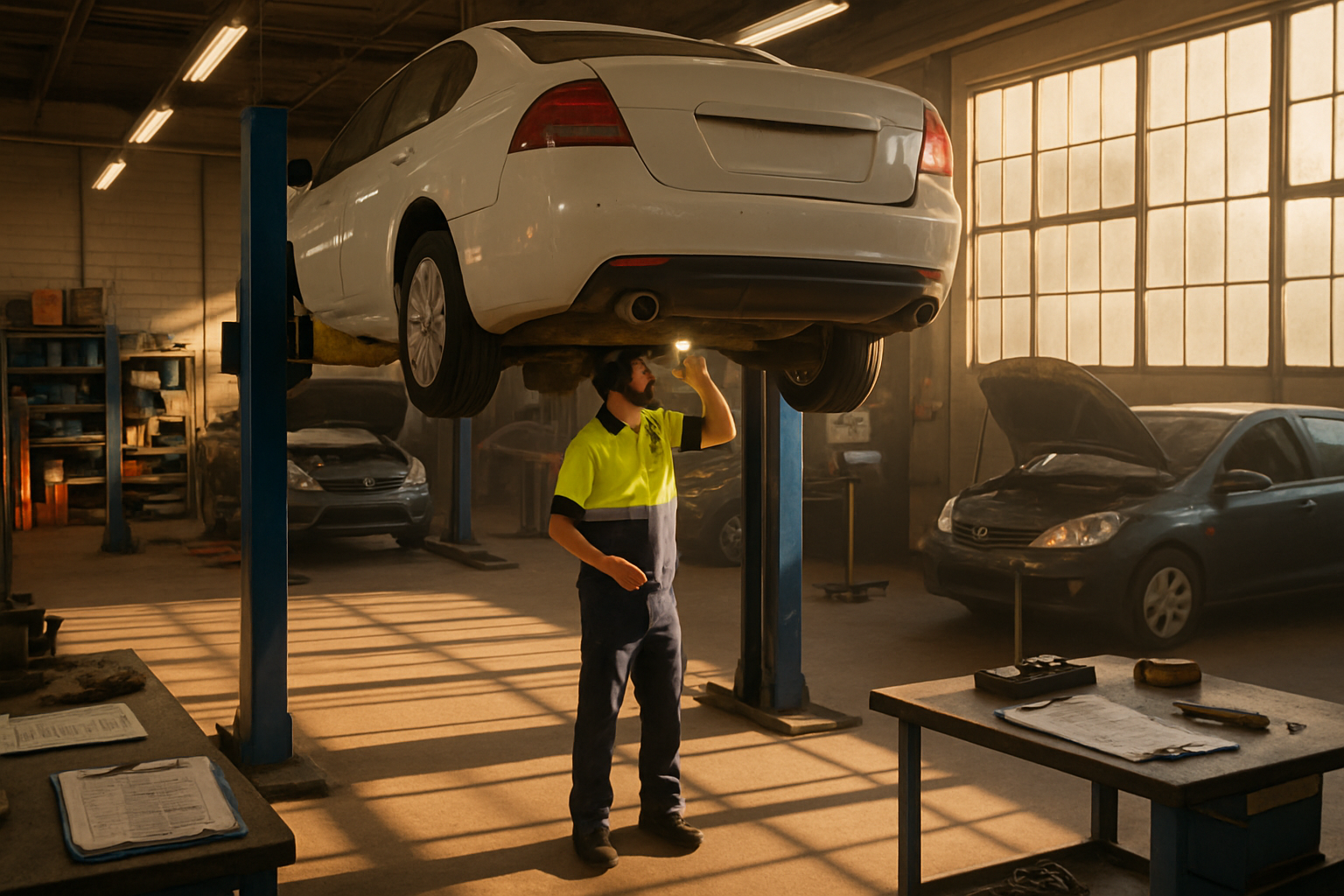
The smart workshops don't fit RWCs around their regular work—they dedicate specific time blocks. Tony Nguyen's workshop in Campbelltown, NSW, runs what he calls "RWC mornings."
"Tuesday and Thursday mornings, 7:30 to 11:30, we do nothing but RWCs," Tony explains. "Got one hoist dedicated to it, all the testing equipment staged, and junior mechanic Jake knows exactly what to do. We can knock out 6-8 certificates without touching our service bookings."
Tony's system works because:
- Dedicated bay: Hoist stays configured with brake testing equipment, emission analyser nearby
- Batch scheduling: Customers book 45-minute slots, arrive back-to-back
- Streamlined process: Visual inspection, brake test, emissions (if required), paperwork—same sequence every time
- Junior staff deployment: Jake handles routine inspections while senior techs focus on repairs
"The beauty is predictability," Tony adds. "Customer knows they'll wait maximum 45 minutes. We know exactly what revenue we're generating those mornings. And our afternoon service work doesn't get interrupted by someone wanting a quick RWC."
The Equipment Investment
To run batched RWCs efficiently, you need the right kit staged and ready:
| Equipment | Purpose | Cost Range (AUD) |
|---|---|---|
| Brake testing gear | Pedal effort, brake balance | A$2,500-5,000 |
| Emissions analyser | Required for older petrol vehicles | A$3,000-8,000 |
| Headlight tester | Beam pattern and intensity | A$1,500-3,000 |
| Suspension checker | Play in joints, shock absorption | A$800-1,500 |
Pricing RWCs Properly (Most Workshops Get This Wrong)
Here's where most workshops leave money on the table. Marcus Webb's workshop in Fremantle was charging A$120 for RWCs—same as everyone else in the area. Problem was, he was barely breaking even.
"I sat down with my accountant and actually costed it out," Marcus tells me. "Inspection takes 30-40 minutes, paperwork takes another 10. Then there's liability insurance, equipment depreciation, admin time if they fail and need re-inspection. I was losing money at $120."
Marcus now charges A$185 for RWCs, and he's fully booked. Why? Because he finally understood something critical: people selling cars are price-insensitive if you can deliver quickly and professionally.
The Real Cost Breakdown:
- Direct labour: 45 minutes @ A$80/hour = A$60
- Bay time: Opportunity cost of other work = A$30
- Insurance and liability: A$15 per certificate
- Equipment depreciation: A$10 per certificate
- Admin and paperwork: A$15
- Re-inspection risk: 20% of jobs need follow-up = A$20
Total real cost: A$150
"At A$185, I'm making reasonable margin and can afford to do the job properly," Marcus explains. "Customer selling a A$15,000 Hilux doesn't blink at paying an extra A$65 to avoid delaying the sale by a week."
"The bloke selling his ute to upgrade wants it done fast and right. He's not shopping around for the cheapest RWC—he wants the workshop that can fit him in this week and won't find phantom problems." - Marcus Webb, Fremantle
Using Workshop Software for RWC Management
The paperwork side of RWCs is where smaller workshops often stumble. Jenny Harrison's workshop in Geelong processes about 200 RWCs during peak season, and she swears by having proper systems.
"Before we got organised digitally, we had RWC certificates scattered everywhere, no proper tracking of who passed or failed, and I'd spend hours each week chasing up compliance paperwork," Jenny explains.
Now Jenny's team uses workshop management software that handles:
- Compliance tracking: Digital record of every inspection point, automatically timestamped
- Failure documentation: Photos and notes for any defects found
- Re-inspection scheduling: Automatic booking system for customers returning after repairs
- Certificate management: Digital copies stored with customer records
- Revenue reporting: Track RWC income separately from service work
"The software pays for itself just in the time I save on paperwork," Jenny adds. "But the real value is compliance. If someone challenges an RWC I issued six months ago, I can pull up every detail in 30 seconds—photos, measurements, who did the inspection, what time of day."
Critical Software Features for RWC Management:
- Digital inspection forms: Pre-loaded with your state's requirements
- Photo integration: Camera directly in the app for defect documentation
- Customer communication: SMS reminders, failure notifications
- Scheduling integration: RWC slots separate from service bookings
- Compliance reporting: Export data for insurance or regulatory requirements
Training Junior Staff for Efficient RWC Inspections
The workshops making serious money from RWCs aren't having their most expensive technicians do routine inspections. Jake at Tony's Campbelltown workshop started as an apprentice two years ago—now he's the dedicated RWC inspector during peak season.
"Tony spent three weeks training me properly," Jake explains. "Now I can spot worn brake pads from across the workshop, and I know exactly which suspension bushes fail first on Commodores versus Falcons."
The key is systematic training, not just throwing junior staff at the work:
Jake's Training Protocol:
- Shadow experienced tech: 20 RWCs watching every step
- Documented checklist: State-specific inspection sequence
- Common failure patterns: What typically fails on popular models
- Customer communication: How to explain failures professionally
- Equipment proficiency: Proper use of brake testers, emission analysers
"The trick is teaching them to be thorough but efficient," Tony adds. "Jake's not diagnosing complex problems—he's following a systematic inspection process. But he's fast because he knows exactly what to look for and where problems usually hide."
"Best part about doing RWCs is you learn heaps about different cars quickly. I've seen more suspension setups in six months than most apprentices see in two years." - Jake, junior technician
Managing Customer Expectations Around Failures
Here's what separates professional workshops from the dodgy operators: honest communication about failures. Customers hate surprises, especially when they're trying to sell a car.
Lisa Chen's workshop in Box Hill, Melbourne, has built a reputation for fair RWC inspections. Her secret? She explains potential issues upfront.
"When someone books an RWC, I ask how old the car is, when it was last serviced, any known issues," Lisa explains. "If they mention grinding brakes or worn tyres, I tell them straight up—'There's a good chance this won't pass first time, here's what we typically see.'"
Lisa's pre-inspection conversation covers:
- Common failure points: "Cars this age often fail on brake pads or tyre tread"
- Re-inspection costs: "If it fails, re-inspection is A$85 after repairs"
- Repair options: "We can fix most issues here, or you can take it elsewhere"
- Timeline expectations: "Simple fixes same day, bigger jobs might be next week"
"Honest upfront conversation saves heaps of arguments later," Lisa adds. "Customer appreciates knowing what they might face, and they trust that we're not making up problems to generate work."
The Failure Conversation Script
When Lisa has to fail an RWC, she follows a simple script:
"I've completed your safety certificate inspection, and unfortunately the vehicle didn't pass. The main issues are [specific problems]. Here's what needs to be fixed: [detailed list]. We can handle these repairs here for [quoted price], or you're welcome to take it elsewhere and come back for re-inspection. The re-inspection fee will be A$85, and you'll need to have it done within [state timeframe]. Any questions about what needs to be fixed?"
Why RWCs Are Actually High-Margin Gold
Most workshop owners see RWCs as low-value work because they're thinking about it wrong. Dave Henderson's Brisbane workshop makes more profit margin on RWCs than almost any other service.
"Think about it," Dave explains. "Forty-five minutes of work, minimal materials, A$185 revenue. Compare that to a service where I might charge A$400 but have A$150 in parts costs, plus warranty exposure if something goes wrong later."
The numbers tell the story:
- RWC profit margin: 65-70% after all costs
- Average service profit margin: 45-50%
- Diagnostic work profit margin: 60-65%
"Plus there's no comeback risk with RWCs," Dave adds. "I'm not replacing parts that might fail, I'm just inspecting what's there. Customer's happy because they get their certificate, I'm happy because it's clean money."
Planning for Next Season (Start in January)
The workshops that handle spring RWC season smoothly aren't scrambling in March—they're planning in January. Tony Nguyen starts his prep three months out:
- January: Service all testing equipment, order spare parts for common failure items
- February: Schedule extra RWC training for junior staff, update pricing for the new year
- March: Switch to extended RWC hours, communicate availability to regular customers
"By the time the rush hits, we're ready," Tony explains. "Equipment's calibrated, staff know their roles, booking system's configured. We can handle double our normal RWC volume without breaking a sweat."
The workshop owners making real money from RWC season understand something simple: it's not about being the cheapest—it's about being reliable, professional, and available when customers need you most.
As Dave Henderson puts it: "Customer selling his car doesn't want to hear 'we might fit you in next week.' He wants to hear 'bring it in Thursday morning, certificate ready by lunch.' That convenience is worth paying for."