English
 FR
FR
The CA$15,000 Wake-Up Call
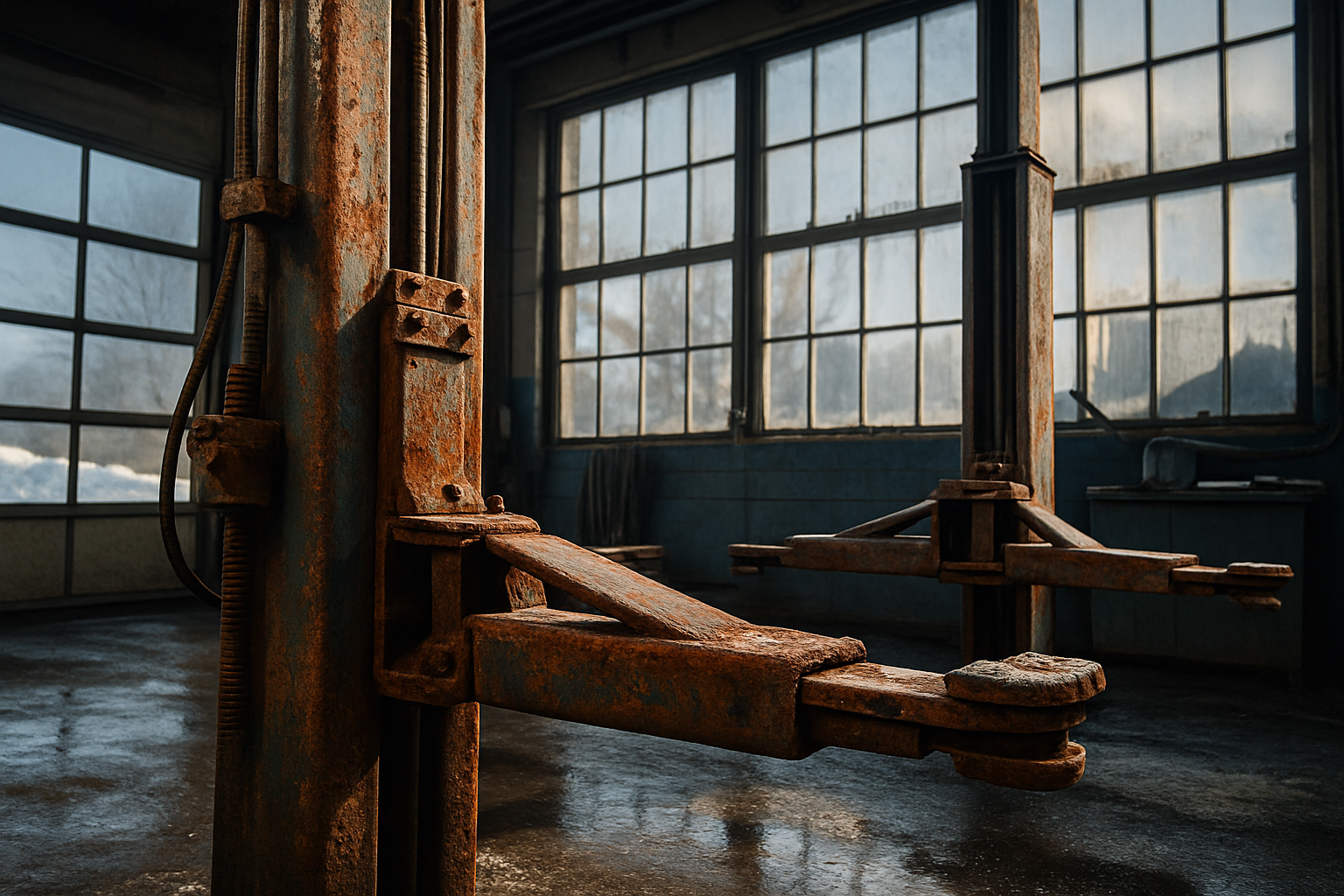
Dave Marchand thought he was having a good morning at his Calgary auto shop until the two-post lift started making that grinding noise. "I figured maybe it just needed some grease," he told me over coffee last month. "Then the safety lock seized completely with a customer's F-150 eight feet in the air."
Three hours later, a lift technician delivered the news: the entire locking mechanism was corroded beyond repair from road salt residue. Total replacement cost? CA$15,000, plus two days of lost revenue while waiting for parts.
"I never thought about salt getting into the lift mechanics," Dave said. "Cars come in covered in the stuff all winter, but I figured it just washed off eventually."
Dave's experience isn't unique. Across Canada, from the Maritimes to British Columbia, auto shop owners are discovering that our brutal winters come with a hidden tax: equipment deterioration from road salt exposure that can cost thousands in unexpected repairs and replacements.
Why Canadian Shops Face Unique Challenges
Unlike shops in warmer climates, Canadian garages deal with a perfect storm of corrosive conditions. Road salt doesn't just disappear when spring arrives—it lingers in crevices, on undercarriages, and in shop drainage systems for months.
"We use about 5 million tonnes of road salt across Canada every winter," explains Maria Santos, who runs a busy shop in Toronto's east end. "Every vehicle that rolls into our bays brings some of that with them. Over five years, it adds up to serious money."
"I've seen shops in Ontario replace their entire compressed air system because salt ate through the lines. That's CA$8,000 they didn't budget for." — Jim Rodriguez, equipment technician, Hamilton
Spotting the Early Warning Signs
The key to avoiding Dave's CA$15,000 surprise is catching rust before it becomes a safety hazard. Here's what to look for during your spring equipment check:
Two-Post and Four-Post Lifts
- Cable assemblies: Look for fraying or brown residue on cables. Salt accelerates cable wear dramatically
- Safety lock mechanisms: Test engagement smoothly—any grinding or hesitation signals internal corrosion
- Hydraulic cylinders: Check for pitting on exposed chrome rods, especially near seals
- Base anchor points: Examine where the lift meets the floor for rust bubbling or flaking paint
- Chain assemblies: On four-post lifts, inspect each link for surface rust or stiffness
Jack Stands and Floor Equipment
Tom Wheeler learned this lesson the hard way at his Vancouver shop. "I had a set of six-tonne stands that looked fine from a distance," he recalls. "But when I really examined the adjustment mechanisms, three of them had salt corrosion in the teeth. One actually slipped during a brake job."
For jack stands and floor equipment, focus on:
- Adjustment ratchets and pawls—salt loves to hide in these mechanisms
- Wheel assemblies on floor jacks and creepers
- Any steel surfaces that show white or orange residue buildup
- Hydraulic seals on floor jacks (salt causes premature seal failure)
Tool Storage and Organization Systems
Lisa Chen runs a three-bay shop in Montreal and learned that tool storage takes a beating too. "My mechanics were tracking salt water onto their tools all winter," she says. "By March, I had drawer slides that barely opened and socket rails covered in surface rust."
| Equipment Type | Common Salt Damage | Inspection Frequency | Replacement Cost (CAD) |
|---|---|---|---|
| Two-post lift | Cable fraying, lock mechanism seizure | Monthly in winter | CA$12,000-18,000 |
| Floor jack | Seal failure, wheel corrosion | Weekly during salt season | CA$400-800 |
| Jack stands (set of 4) | Ratchet mechanism failure | Before each use | CA$200-500 |
| Tool chest | Drawer slide corrosion | Monthly | CA$800-2,500 |
The Real Cost of Doing Nothing
When I spoke with shop owners across the country, the numbers were eye-opening. Marc Dubois, who operates two locations in Quebec, tracks his salt-related equipment costs religiously.
"Last year, we spent CA$4,200 on what I call 'salt repairs,'" he told me. "New hydraulic seals, replacement tool chest hardware, and refinishing work on our alignment rack. That's money I could have spent on productive equipment instead."
But the hidden costs go deeper than replacement parts:
- Downtime: Dave's seized lift cost him two full days of productivity
- Safety liability: Corroded equipment increases workplace injury risks
- Customer perception: Rusty, failing equipment doesn't inspire confidence
- Emergency repairs: Rush orders for critical parts often cost 40-60% more
Your Shop's Floors Are Taking a Beating Too
Here's something most shop owners don't consider: salt residue from customer vehicles is slowly destroying your concrete floors and drainage systems.
"We had to completely re-pour the floor around our wash bay last spring," says Kevin Park, who runs a busy shop in Winnipeg. "The salt had eaten away at the concrete to the point where we had chunks falling into the drain. Total cost was CA$3,800."
Floor and Drainage Protection Strategies
- Daily washing: Rinse work areas with fresh water at the end of each day during salt season
- Floor sealers: Apply concrete sealer annually—it costs CA$200-400 but prevents thousands in damage
- Drain maintenance: Flush floor drains weekly with hot water to prevent salt buildup
- Entrance mats: Heavy-duty mats catch salt before it spreads through your shop
Affordable Prevention That Actually Works
The good news? Preventing salt damage doesn't require a massive budget. Here are the products and practices that Canadian shop owners swear by:
Protective Coatings
"I started using Corrosion-X on all my lift mechanisms three years ago," says Sarah Kim, who operates a shop in Edmonton. "It's about CA$45 per can, and I use maybe four cans per winter. Compare that to what I was spending on repairs—it's a no-brainer."
Recommended products for different applications:
- Fluid Film: Excellent for lift cables and chains (CA$35-50 per aerosol)
- CRC Heavy Duty Corrosion Inhibitor: Good for tool storage hardware (CA$28-40)
- Boeshield T-9: Perfect for precision tools and small mechanisms (CA$22-35)
Application Timing Matters
The most successful shops follow a strict seasonal schedule:
- October: Apply protective coatings before first snowfall
- January: Mid-winter inspection and touch-up applications
- April: Complete spring cleaning and fresh protective coatings
- July: Annual deep maintenance on all lifting equipment
Creating Your Spring Equipment Audit
Every Canadian shop needs a systematic approach to post-winter equipment inspection. Here's the checklist that's saved shops thousands:
Week 1: Lifting Equipment
- Photograph all equipment before cleaning (for insurance/warranty claims)
- Power-wash lift bases and columns with degreaser
- Inspect and lubricate all cables, chains, and pivot points
- Test all safety mechanisms under no-load conditions
- Check hydraulic fluid levels and condition
Week 2: Hand Tools and Storage
- Empty and inspect all tool storage drawers
- Clean and lubricate drawer slides and locking mechanisms
- Inventory tools for rust damage or pitting
- Apply protective coating to susceptible items
- Test all pneumatic and electrical connections
Week 3: Facility Infrastructure
- Inspect floor drains for salt buildup or corrosion
- Check concrete for spalling or deterioration
- Test electrical connections in wet areas
- Examine compressed air lines for internal corrosion
- Document any issues requiring professional attention
Why Prairie and Ontario Shops Are Losing More
Geography matters when it comes to salt damage. "We see the worst corrosion issues in shops from southern Ontario through the prairie provinces," explains Derek Thompson, a lift technician who services equipment across Western Canada.
The reason? These regions use more road salt per kilometer than anywhere else in Canada, and they experience the most freeze-thaw cycles—the perfect combination for accelerated corrosion.
"A shop in Regina will see twice the salt-related equipment damage compared to one in Victoria. They need to budget accordingly." — Derek Thompson, lift technician
Shop owners in these regions should budget an additional 15-20% annually for salt-related equipment maintenance and replacement costs.
The Smart Money Approach
The most successful Canadian shop owners treat salt damage prevention like insurance—a small, predictable expense that prevents large, unexpected ones.
"I budget CA$2,000 annually for salt prevention and maintenance," says Roberto Silva, who runs a successful four-bay operation in Ottawa. "Last year, that budget covered protective coatings, extra cleaning supplies, and some minor seal replacements. My competitor down the street spent CA$8,000 replacing a corroded alignment rack because he never maintained it."
Monthly Budget Breakdown for Average Shop
- Protective coatings: CA$50-80/month during winter
- Extra cleaning supplies: CA$30-50/month
- Preventive maintenance: CA$100-200/month
- Professional inspections: CA$300-500 annually
Making Prevention Part of Your Culture
The shops that successfully manage salt damage make it part of their daily routine, not an annual crisis response.
"We rinse everything down at the end of each day during salt season," explains Jennifer Walsh, whose Hamilton shop has operated for fifteen years without a major salt-related equipment failure. "It takes ten minutes, but it's saved us thousands over the years."
Her approach includes:
- Daily rinse-down of lift areas and floor drains
- Weekly inspection of lift safety mechanisms
- Monthly application of protective coatings during winter
- Annual professional equipment inspection
The investment in time and materials? Less than CA$2,000 annually. The savings compared to emergency replacements? Potentially tens of thousands.
Canadian winters aren't getting any milder, and road salt isn't disappearing anytime soon. The shops that thrive are the ones that plan for salt damage instead of reacting to it. Your equipment—and your bottom line—will thank you for the proactive approach.