English
 Español
 Deutsch
 FI
FI
 PT
PT
 BR
BR
 FR
FR
 AR
AR
 ZH
ZH
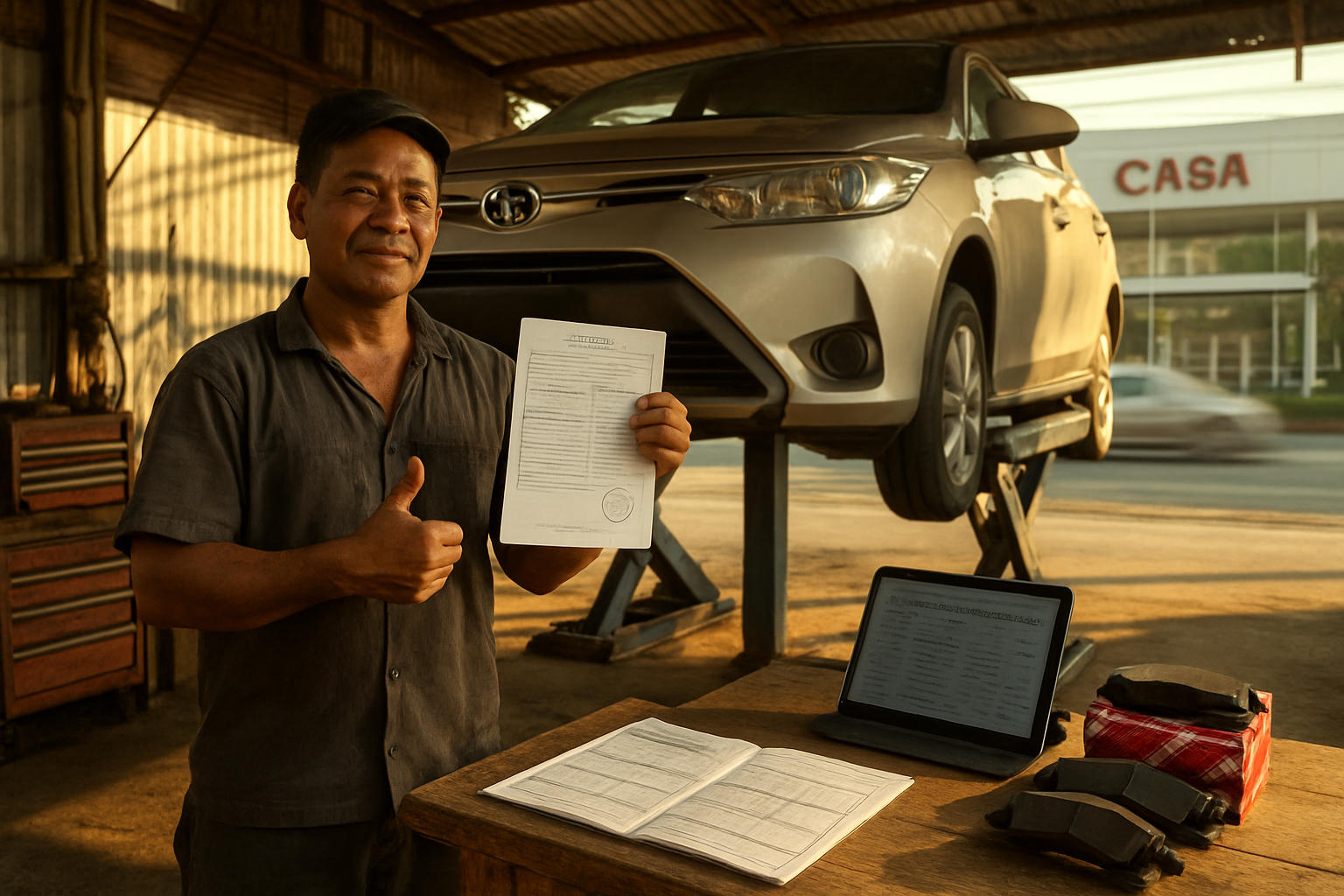
"Dun ka sa casa, mas safe." How many times have you heard this? A customer chooses the Toyota dealer service centre over your talyer — even though you charge half the price and do the same quality work. Why? Because casa gives them something you do not: paper.
A stamped service booklet. Printed invoices with part numbers. Digital records they can show when selling the car. Warranty that means something because it is backed by a corporation. That is what customers pay 2–3x more for. Not better work — better DOCUMENTATION.
The Casa Price Reality
Let us compare real prices in Metro Manila:
| Service | Casa Price | Talyer Price | Difference |
|---|---|---|---|
| Oil change (Vios) | ₱4,500–6,000 | ₱1,500–2,500 | 2–3x |
| Brake pads (front) | ₱8,000–12,000 | ₱3,000–5,000 | 2–3x |
| AC recharge | ₱6,000–10,000 | ₱3,000–5,000 | 2x |
| Timing belt | ₱15,000–25,000 | ₱8,000–12,000 | 2x |
| 60,000 km service | ₱20,000–35,000 | ₱8,000–15,000 | 2–3x |
The customer who goes to casa for their Vios spends ₱30,000–50,000 per year on maintenance. The same services at a good talyer cost ₱12,000–20,000. The customer saves ₱18,000–30,000 per year — if they trust the talyer enough to switch.
What Casa Has That You Do Not (Yet)
Casa wins on three things:
- Records: Every service logged in a computer system. Customer can call and ask "when was my last oil change?" and get an answer in 10 seconds.
- Professional invoices: Typed, itemised, with part numbers, labour hours, and total. Looks official. Can be used for insurance claims, resale, and expense tracking.
- Service reminders: "Your 40,000 km service is due. Book now." The customer does not have to remember — casa reminds them.
Notice something? None of these require expensive equipment or dealer certification. They require a SYSTEM. A way to record, invoice, and remind. That is it.
Becoming a Casa-Killer
Here is the formula: Casa Quality Work + Casa-Level Documentation + Talyer Pricing = customers never go back to the dealer.
Step 1 — Record everything: Customer name, car model, plate number, mileage, what you did, what parts you used, what you charged. Every single visit.
Step 2 — Professional invoices: Not handwritten. Typed, itemised, with your talyer name and contact. Send via Viber or text. The customer saves it on their phone — permanent record.
Step 3 — Send reminders: "Sir, your Vios is due for oil change at 35,000 km. Based on your driving, that is approximately next week. Book na po?" The customer is impressed — "Parang casa lang pero mas mura!"
Step 4 — Service history: When the customer wants to sell their car on Facebook Marketplace or Carousell, you provide a complete service history. "Maintained by [your talyer name] since 2023. Full records available." The car sells faster and for more money.
The Trust Builder
The biggest barrier is trust. The customer thinks: "What if the talyer uses fake parts? What if they break something else? At least with casa I know what I am getting."
You break this barrier with transparency:
- Show the customer the old part you removed. Let them see it is worn.
- Show them the new part before installing. Let them see the brand.
- Take before/after photos. Send them via Viber.
- Put everything on the invoice — part brand, quantity, unit price.
When a customer can verify everything you did, trust builds fast. And once they trust you, they never go back to paying 2–3x at casa.
Your Free Casa-Level System
Mekavo gives you everything casa has — records, invoices, reminders — for free. Not ₱5,000/month like dealer systems. Not ₱2,000/month like cloud software. Free. Zero. Walang bayad.
Works on any Android or iPhone. Create a job in 30 seconds. Generate an invoice in 10 seconds. Send a reminder with one tap. Your customer gets casa-level service at talyer pricing.
The casa vs talyer war is not about skill — Filipino mechanics are among the best in the world. It is about presentation. Present yourself like a professional, and customers will treat you like one.