English
 Español
 Deutsch
 FI
FI
 FR
FR
 AR
AR
 ZH
ZH
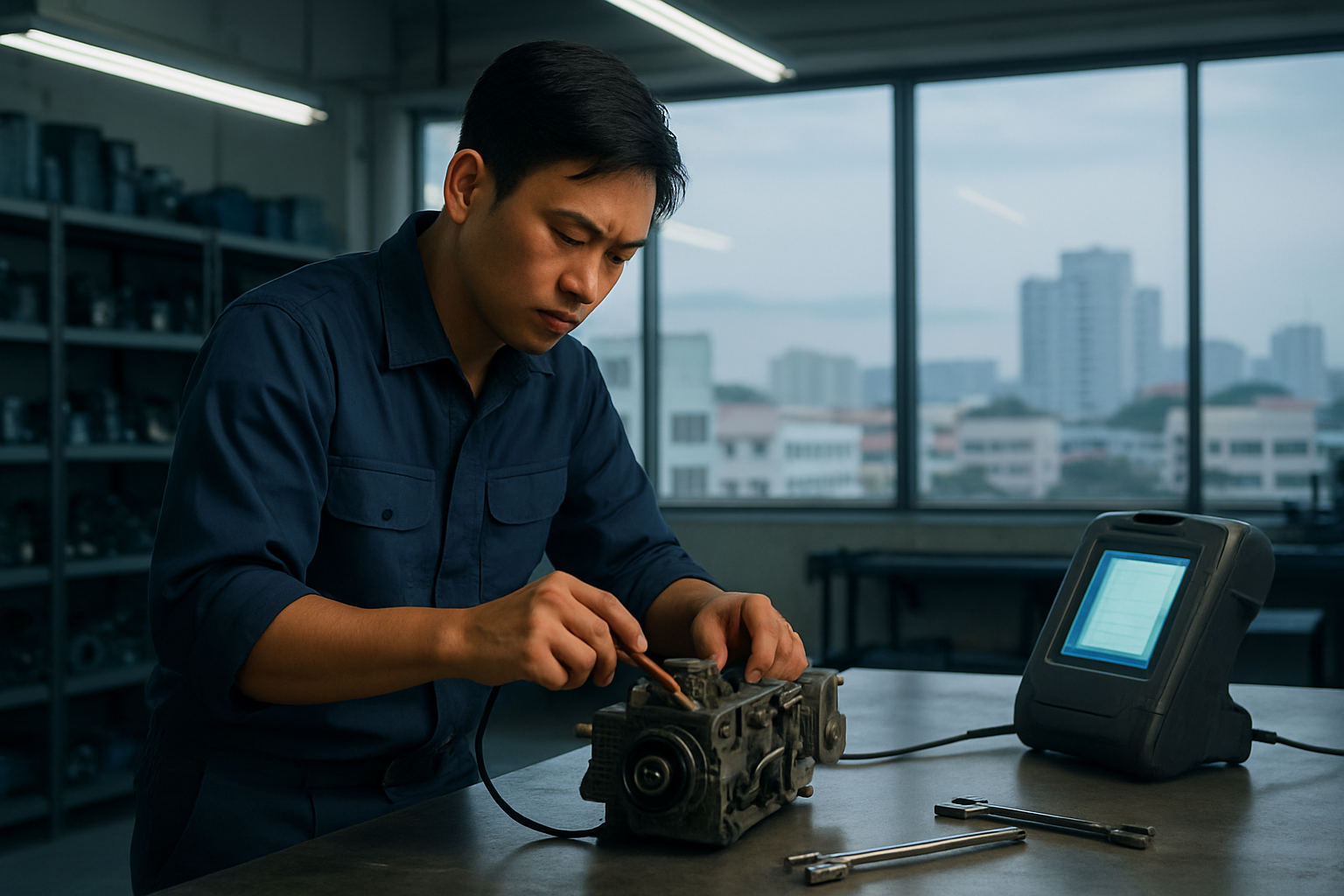
The Great Technician Exodus: What's Really Happening in Sin Ming and Kaki Bukit
Last month, Vincent Lim watched his best diagnostic technician clear out his toolbox at his Ubi workshop. "Eight years with us," Vincent told me, shaking his head. "I thought he was happy. Good salary, steady work. Then suddenly he's gone to a dealership in Jurong for barely S$200 more per month."
Vincent's story isn't unique. Across Singapore's automotive belt — from the industrial estates of Sin Ming to the workshop clusters in Kaki Bukit — skilled technicians are disappearing faster than workshop owners can replace them. The numbers paint a stark picture: industry insiders estimate that 30% of experienced technicians have left the trade in the past three years, with many more eyeing the exits.
But here's what most workshop owners get wrong: it's rarely just about the money.
Why Singapore's Best Mechanics Are Walking Away
Tommy Chen spent fifteen years under the hood before he traded his wrenches for a hard hat. Now he's pulling cables for an electrical contractor in Woodlands, earning about the same as he did as a senior technician — but with something he never had in automotive: respect for his expertise.
"Every diagnosis I made, the boss would question it," Tommy explains over coffee near his old workshop in Kaki Bukit. "Customer complains about the bill? Must be the mechanic's fault. Job takes longer than expected? Mechanic's being lazy. You get tired of being blamed for everything."
The Wage Ceiling Reality
The harsh truth about Singapore's automotive industry is that most technicians hit a salary ceiling around S$3,500-4,000 per month, regardless of experience. Meanwhile, dealership service advisors — who might know less about actual repairs — start at S$4,000 with commission potential reaching S$6,000 or more.
Marcus Wong, who runs a Subaru specialist in Sin Ming, lost two technicians to dealerships last year. "They weren't just chasing money," he realized. "They wanted to see a path forward. In my workshop, senior tech and junior tech were only S$500 apart in salary. Where's the motivation to improve?"
"I loved working on cars, but after ten years, I was making the same as a fresh graduate in an office. My back was shot, my hands were permanently dirty, and my wife kept asking when I'd get a 'real job' with prospects." — Former technician, now insurance adjuster
The Physical Toll Without Recognition
Singapore's automotive technicians face unique challenges. The humidity makes working conditions brutal. The constant influx of European and Japanese vehicles with increasingly complex systems demands continuous learning — often on the technician's own time and expense. Yet society still sees them as "just mechanics."
"My daughter's friend asked what her father does for work," recalls David Tan, a master technician with 20 years' experience. "She said, 'Oh, he fixes cars,' like it was something to be ashamed of. That hurt more than any low paycheck."
The Real Cost of Losing a Skilled Technician
Workshop owners often underestimate the financial impact of technician turnover. Let me walk you through what it actually costs when someone like Tommy or David walks out your door.
Direct Replacement Costs
Finding a skilled technician in Singapore's tight labor market isn't cheap. Recruitment agencies charge 1-2 months' salary as placement fees — that's S$3,000-8,000 upfront. Then there's the opportunity cost of your time spent interviewing candidates, many of whom won't have the specific experience you need.
James Loh, who owns three workshops across Singapore, learned this the hard way. "We spent four months trying to replace our transmission specialist. Posted on SGCarMart jobs, contacted three agencies, interviewed maybe twenty people. Most couldn't even identify a CVT from a traditional automatic. The recruitment fees alone cost us S$12,000 before we found someone decent."
Training and Ramp-Up Period
Even experienced technicians need time to learn your workshop's procedures, customer base, and equipment quirks. Conservative estimates suggest 3-6 months before a new technician reaches full productivity. During this period, jobs take longer, comeback rates increase, and your senior staff spend time mentoring instead of generating revenue.
"Every new guy needs hand-holding for at least three months," explains Sarah Kim, who manages a German car specialist in Ubi. "That's three months where my lead technician is doing half the billable hours because he's explaining our diagnostic procedures, showing where tools are kept, introducing the new guy to regular customers who trust him with their cars."
Lost Productivity and Customer Relationships
The hidden costs multiply quickly. Regular customers who trusted your departed technician might take their business elsewhere. Diagnostic accuracy often drops temporarily. Job completion times increase. The numbers add up:
- Recruitment and placement fees: S$3,000-8,000
- Training time cost: S$4,000-6,000 (based on senior tech mentoring hours)
- Productivity loss during ramp-up: S$5,000-10,000
- Lost customer relationships: S$3,000-6,000 annually
Total typical cost: S$15,000-30,000 per skilled technician lost
"When our BMW specialist left, three of his regular customers followed him to his new workshop. That was S$15,000 in annual revenue, gone. The replacement we hired was technically competent, but those customers had built trust over years of reliable service. You can't replace that overnight." — Workshop owner, Kaki Bukit
What Technicians Actually Want (Not What HR Manuals Say)
After talking to dozens of technicians who stayed, left, and came back to the industry, clear patterns emerge. Most workshop owners focus on salary bumps and generic benefits, missing what actually motivates skilled professionals to stay long-term.
Transparent Earning Potential
Technicians want to see a clear connection between their skills, productivity, and paycheck. The most successful workshops have moved beyond flat salaries to performance-based compensation that rewards efficiency and expertise.
Consider how Richard Ng restructured pay at his workshop in Sin Ming. Instead of paying flat rates, he introduced a hybrid system: base salary plus commission on diagnostic fees and efficiency bonuses for jobs completed under standard time without comebacks.
"My diagnostic guy now earns S$5,200 in a good month," Richard explains. "He's motivated to be accurate the first time, explain problems clearly to customers, and work efficiently. Before, he had no incentive to be anything more than adequate."
| Traditional Flat Rate | Performance-Based Structure |
|---|---|
| Senior Technician: S$3,800/month | Base: S$3,200 + Performance: S$800-2,000 |
| No incentive for efficiency | Bonus for under-time completion |
| Same pay regardless of accuracy | Commission on diagnostic accuracy |
| No reward for customer satisfaction | Retention bonuses for customer feedback |
Tools and Equipment That Actually Work
Nothing frustrates a skilled technician more than being asked to deliver professional results with amateur equipment. Broken lifts, outdated diagnostic tools, and missing specialty equipment don't just slow down work — they signal that the workshop doesn't respect the craft.
"I left my previous workshop because the lift had been 'temporarily' broken for eight months," says Alex Chua, now working at a well-equipped independent in Ubi. "Every brake job became a nightmare, crawling under cars on creepers, working in awkward positions. My back was killing me, and the boss kept saying he'd fix it 'next month.'"
The workshops that retain top talent invest in professional-grade equipment:
- Modern diagnostic scanners: Not just basic OBD readers, but brand-specific tools that can handle complex European and Japanese systems
- Properly maintained lifts: Regular servicing, backup equipment, safety certifications up to date
- Specialty tools: Budget for technician-requested tools that improve efficiency and accuracy
- Clean, organized workspace: Proper lighting, ventilation, tool organization systems
Respect for Professional Expertise
Skilled technicians are professionals who take pride in accurate diagnosis and quality work. The workshops that keep them understand this and create environments where expertise is valued, not questioned.
"Best decision I made was stopping second-guessing my lead technician," admits Kevin Tan, who runs a multi-brand workshop in Kaki Bukit. "Customer complained about a S$800 repair? Instead of immediately assuming the tech was wrong, I started asking questions: 'Walk me through your diagnosis. What did you find? What were the symptoms?'"
This shift in approach had immediate effects. Diagnostic accuracy improved because technicians felt supported in thorough investigation. Customer trust increased because technicians explained repairs with confidence. Comeback rates dropped because there was no pressure to cut corners or avoid necessary work.
Clear Career Progression
The automotive industry has traditionally been flat — you're either a junior tech or a senior tech, with little in between. Progressive workshops are creating advancement paths that keep ambitious technicians engaged.
Rachel Lim's workshop in Sin Ming now has five distinct technician levels:
- Apprentice Technician: S$2,200 (learning basic maintenance)
- General Technician: S$2,800 (routine repairs, basic diagnostics)
- Specialist Technician: S$3,500 (advanced diagnostics, complex repairs)
- Lead Technician: S$4,200 (mentoring, difficult cases, customer interaction)
- Master Technician: S$5,000+ (training others, process improvement, technical leadership)
"Guys can see where they're going now," Rachel explains. "It's not just about time served — they have to demonstrate skills, complete training, show leadership. But there's a path forward that doesn't involve leaving the tools behind."
The Financial Case for Paying Above Market
Smart workshop owners are discovering that paying 10-15% above market rate for top technicians delivers significant ROI through reduced turnover costs and improved productivity.
The Retention Mathematics
Consider the numbers: if losing a skilled technician costs S$20,000 on average, paying that technician an extra S$3,000 annually (S$250/month) to stay is incredibly cost-effective. You break even in less than four months, and everything after that is profit.
But the benefits multiply beyond simple retention:
- Faster job completion: Experienced technicians work more efficiently
- Higher diagnostic accuracy: Fewer comebacks, less warranty work
- Better customer relationships: Consistency builds trust and repeat business
- Reduced training costs: Less time spent bringing new hires up to speed
- Improved workshop reputation: Quality work leads to positive reviews and referrals
"I used to think paying S$4,500 for a senior technician was expensive. Then I calculated what I spent on recruitment, training, and lost productivity last year — over S$35,000 for two departures. Now my best guys earn S$4,800, and I haven't had a resignation in eighteen months. Best investment I ever made." — Workshop owner, Ubi
Customer Satisfaction and Revenue Impact
Stable, experienced technician teams deliver better customer experiences, which translates directly to revenue. Customers develop relationships with specific technicians they trust. When that technician leaves, the customer often follows — taking their annual S$3,000-8,000 in service revenue with them.
Michael Chen's data from his Kaki Bukit workshop shows the impact clearly: customers served by technicians with 3+ years at the workshop have 85% retention rates and spend 40% more annually than those served by newer staff. The revenue impact of keeping his senior team stable justified the higher labor costs within six months.
How Workshop Management Software Supports Retention
Modern workshop management systems contribute to technician retention in ways that aren't immediately obvious — by creating transparent, blame-free environments where skilled professionals can demonstrate their value.
Eliminating the Blame Culture
Traditional workshops often operate on assumptions and finger-pointing when things go wrong. Digital job tracking changes this dynamic entirely by creating objective records of work performed, time spent, and decisions made.
"Before our management system, everything was he-said-she-said," explains Jennifer Wong, whose Ubi workshop implemented comprehensive job tracking two years ago. "Customer complained? Must be the mechanic's fault. Job took longer than quoted? Mechanic must be slow. Now we have data. We can see exactly what happened, when, and why."
This transparency protects technicians from unfair blame while helping workshop owners identify real issues: unrealistic time estimates, incomplete customer information, or parts supply problems that affect job completion.
Productivity Visibility and Professional Pride
Skilled technicians take pride in their work and efficiency. Management software that tracks and displays productivity metrics allows them to demonstrate their value objectively.
"My diagnostic guy loves showing me his accuracy rate — 94% first-time-fix on complex electrical problems," says Robert Tan. "He's earned bragging rights, and I have the data to justify his premium salary. Win-win."
Key metrics that boost technician satisfaction include:
- Diagnostic accuracy rates: Percentage of problems correctly identified on first inspection
- Job completion efficiency: Actual time versus estimated time for repairs
- Customer satisfaction scores: Direct feedback on technician performance
- Comeback rates: How often work needs to be redone
Reducing Administrative Burden
Technicians didn't enter the field to do paperwork. Every minute spent on job cards, inventory tracking, and administrative tasks is time away from the work they actually enjoy. Streamlined digital systems reduce this burden significantly.
"Used to spend an hour each day on paperwork — writing up jobs, tracking parts, updating customer records," explains Marcus Lim, a technician in Sin Ming. "Now it's maybe fifteen minutes. I scan a barcode, tap a few options on the tablet, and I'm back to actual repair work. Makes a huge difference in job satisfaction."
Warning Signs: Your Workshop Is About to Lose Key Staff
Experienced workshop owners learn to recognize the warning signs before a valuable technician walks out the door. By the time someone hands in notice, it's usually too late — they've already mentally checked out and possibly accepted another offer.
Early Warning Indicators
The signs are subtle but consistent across workshops:
Increasing Sick Days and Time Off: When a previously reliable technician starts calling in sick more frequently or taking extended lunch breaks, they're often interviewing elsewhere or have lost motivation.
Declining Diagnostic Performance: If your best diagnostic tech suddenly becomes less thorough or takes longer to identify problems, they may have mentally disengaged.
Negative Attitude Towards Customers or Management: Complaints about "impossible customers" or "unfair management" that weren't there before often signal broader dissatisfaction.
Questions About Competitors: Casual inquiries about what other workshops pay or how they operate aren't usually casual at all.
Reduced Initiative: When a technician stops suggesting improvements, asking for new tools, or volunteering for challenging jobs, they're probably planning their exit.
"I should have seen it coming with Danny. Started taking longer lunches, stopped chatting with the other guys, quit asking about training opportunities. I thought he was just having a rough patch. Three weeks later, he gave notice — already had another job lined up. I could have saved the situation if I'd acted earlier." — Workshop manager, Kaki Bukit
The Exit Interview Reality
Most exit interviews reveal the same pattern: the decision to leave wasn't about a single incident but accumulated frustrations over months or years. By the time these conversations happen, the damage is done.
"They always say it's about money in the exit interview," observes Linda Ng, who's managed automotive workshops for over a decade. "But when you dig deeper, it's usually about feeling undervalued, lacking growth opportunities, or being tired of working with inadequate tools. Money is just the socially acceptable reason to give."
The Organization Advantage: Why Better Systems Beat Higher Wages
Here's the insight most workshop owners miss: technicians often leave well-paying workshops for slightly better-organized ones, even at similar or lower wages. The reason is simple — better organization makes their professional lives easier and more satisfying.
What "Better Organized" Actually Means
It's not about having the fanciest workshop or most expensive equipment. Organized workshops have:
- Predictable workflows: Jobs follow logical sequences without constant interruptions
- Reliable information: Customer history, previous repairs, and technical specs are easily accessible
- Adequate parts inventory: Common components are in stock, special orders are tracked properly
- Clear communication: Customer requirements, time constraints, and quality expectations are communicated upfront
- Fair scheduling: Realistic time allocations, buffer time for complex jobs, no impossible deadlines
"I took a S$300 pay cut to join this workshop because everything just works better here," explains Alan Teo, who moved between two Ubi workshops last year. "Previous place paid more but was complete chaos — customers changing requirements mid-job, parts orders getting lost, no proper diagnostic history on repeat customers. Here, I can focus on actual repair work instead of fighting the system."
The Cascade Effect of Good Organization
Well-organized workshops create positive cycles that benefit everyone:
Technicians work more efficiently → Jobs complete on time → Customers are satisfied → More repeat business → Stable revenue allows for better wages and equipment → Attracts and retains better technicians
Conversely, disorganized workshops create negative cycles that drive away talent regardless of pay rates:
Poor systems cause delays → Customer complaints → Pressure on technicians → Job dissatisfaction → Higher turnover → Less experienced staff → More problems and delays
Building a Retention-Focused Workshop Culture
The workshops that successfully retain skilled technicians share common cultural characteristics that go beyond compensation packages or benefit programs.
Continuous Learning and Development
The automotive industry evolves rapidly, with new diagnostic systems, hybrid technologies, and repair techniques emerging constantly. Workshops that invest in ongoing technician education see higher retention rates and better performance.
"We budget S$2,000 per technician annually for training," explains David Wong, whose Sin Ming workshop has had zero turnover in three years. "Not just mandatory safety courses — advanced diagnostics, hybrid system training, even management courses for guys who show leadership potential. They see we're investing in their futures, not just extracting value from their current skills."
Recognition and Professional Status
Simple recognition programs can have dramatic effects on technician satisfaction and retention. This doesn't mean employee-of-the-month certificates — skilled professionals respond to recognition of their expertise and contributions.
Successful recognition strategies include:
- Customer feedback sharing: When customers praise a technician's work, make sure they hear about it
- Technical achievement recognition: Acknowledge successful diagnosis of difficult problems or innovative repair solutions
- Peer respect building: Create opportunities for experienced technicians to share knowledge and mentor others
- Professional development support: Sponsor certifications, conference attendance, or specialized training
"The day a customer wrote to thank me personally for diagnosing an intermittent electrical problem that three other workshops couldn't fix — and my boss framed that letter and hung it in the customer waiting area — that's when I knew I was staying long-term. It wasn't about the money anymore; it was about being recognized as a professional." — Master technician, 15 years' experience
The Long-Term Strategic View
Workshop owners who successfully navigate Singapore's technician shortage think beyond immediate staffing needs to build sustainable, attractive workplaces that naturally retain talent.
Investment in Infrastructure
Modern workshops require modern infrastructure to attract and keep skilled technicians. This means regular equipment upgrades, facility improvements, and technology investments that make work easier and more efficient.
"Every major equipment purchase, I ask my lead technicians for input," says Patricia Lim, whose Kaki Bukit workshop expanded from 3 to 8 technicians over the past two years. "They're the ones using the tools daily. They know what would improve efficiency, safety, and job satisfaction. This involvement makes them feel valued and ensures we buy the right equipment."
Building Technician Leadership Paths
The most successful workshops create advancement opportunities that don't require leaving technical work behind. Senior technician roles that combine hands-on work with mentoring, process improvement, and customer interaction appeal to ambitious professionals who love the technical aspects of automotive repair.
These hybrid roles might include:
- Technical trainer: Teaching new hires while handling complex diagnostics
- Quality control specialist: Final inspection of all work while performing premium repairs
- Customer technical advisor: Explaining complex repairs to customers while doing the work
- Equipment specialist: Maintaining and upgrading shop tools while using them daily
Conclusion: The Real Retention Formula
Singapore's technician shortage isn't going away anytime soon. The workshops that thrive will be those that understand what skilled automotive professionals actually want: respect for their expertise, adequate tools to do quality work, transparent earning potential, and career paths that don't require abandoning their technical skills.
The irony is that retaining good technicians costs less than constantly replacing them — but requires workshop owners to think strategically about compensation, culture, and professional development rather than just filling positions as cheaply as possible.
"My labor costs are about 15% higher than my competitors," admits Steven Tan, whose multi-brand workshop in Ubi has maintained the same core team for four years. "But my overall costs are lower because I'm not constantly recruiting, training, and dealing with the productivity losses that come with turnover. Plus, my customers trust my team, which means more repeat business and referrals. Higher wages for better technicians isn't an expense — it's the best investment I make."
The choice is simple: pay the cost of retention upfront, or pay the much higher cost of constant replacement. In Singapore's competitive labor market, the workshops that understand this distinction will have their pick of skilled technicians while their competitors struggle with empty bays and unhappy customers.
The technician shortage is real, but it's not insurmountable. The solution requires workshop owners to see skilled technicians as the professionals they are, create environments where expertise is valued, and build systems that support rather than hinder quality work. Get this right, and the best technicians will choose to stay — not because they have to, but because they want to.