English
 Español
 Deutsch
 FI
FI
 FR
FR
 AR
AR
 ZH
ZH
The S$3,000 WhatsApp Mistake That Changed Everything
Vincent Lim from Ubi Avenue 3 still remembers the customer who walked out without paying. What started as a simple brake pad replacement on a Honda Civic escalated into a three-week nightmare that cost his workshop S$3,200 and nearly landed him in the Small Claims Tribunal.
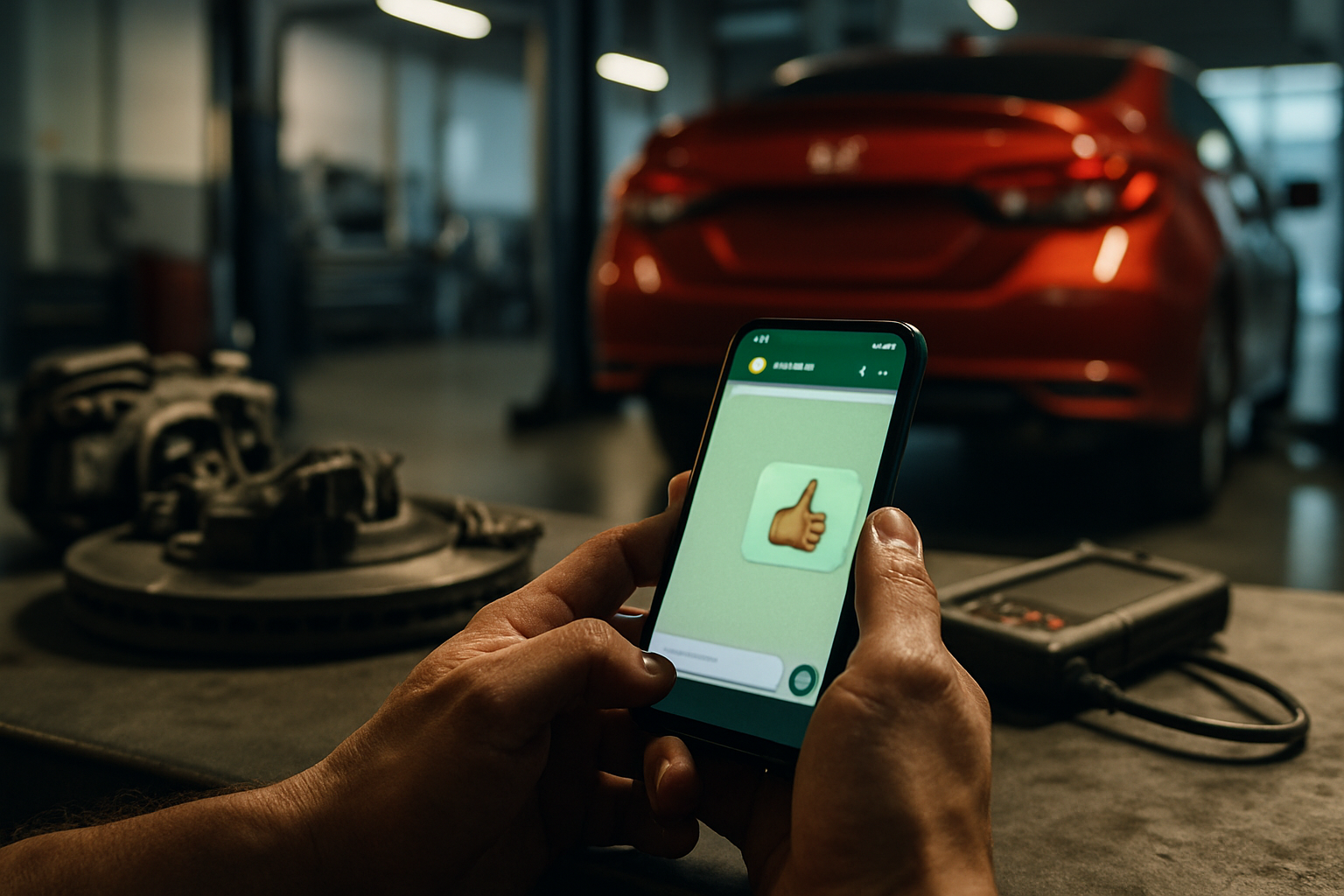
"Customer sent me a WhatsApp asking for brake service. I quoted S$280 for pads, he said 'okay can'. Simple, right?" Vincent shakes his head. "Then we found his rotors were warped. I sent another message saying we need to replace rotors too, another S$450. He replied with a thumbs up emoji. I thought that meant yes."
The problems started when the customer returned. He insisted he'd only agreed to brake pads, not rotors. Vincent scrolled through their WhatsApp chat – dozens of messages mixed with photos of worn parts, price discussions, and appointment changes. The "thumbs up" emoji could mean anything.
"No proper documentation, no signed estimate, just a mess of WhatsApp messages. Customer claimed I never properly explained the additional cost. Without a clear paper trail, I had to eat the rotor cost to avoid a tribunal case."
Vincent's story isn't unique. Across Singapore's industrial estates – from Sin Ming to Kaki Bukit – workshops are discovering that treating customer communication like casual messaging is costing them serious money.
The Real Problems Hidden in Your WhatsApp Threads
Walk into any workshop in Singapore and you'll see the same scene: technicians juggling spanners in one hand, phones in the other, frantically replying to customer WhatsApp messages between jobs. What looks like efficient communication is actually a expensive operational drain.
Lost in Translation: When "Can" Doesn't Mean "Confirmed"
Richard Tan operates a small workshop near Kaki Bukit Industrial Estate. He learned the hard way that WhatsApp's informal nature creates expensive misunderstandings.
"Customer WhatsApp me: 'How much to fix aircon?' I reply: 'Depends on problem, could be S$150-400.' He says: 'Can, when I can come?' I give him a time slot. He shows up expecting S$150 maximum, I find his compressor is dead – S$400 job. Now he's angry, says I quoted S$150."
The issue isn't just language barriers – it's the platform itself. WhatsApp conversations lack structure. Prices, approvals, and job scopes get buried in chat threads filled with appointment scheduling, casual banter, and random photos.
The 2 AM Customer Service Trap
Mary Chen runs a family workshop in Ubi. She thought WhatsApp would improve customer service until it started controlling her life.
"Customers think because they can WhatsApp, they can message anytime. Sunday 11pm: 'Sis, my car making noise, can check tomorrow?' Monday 6am: 'You open already?' Tuesday midnight: 'How's my car progress?'"
Without clear boundaries, workshops become 24/7 customer service operations. Staff feel pressured to respond immediately, leading to rushed, unclear answers that create more problems later.
The Context Switching Tax
Studies show that switching between tasks costs an average of 23 minutes to fully refocus. For mechanics juggling WhatsApp messages while working, this "context switching tax" is devastating.
Jason Wong tracks his day at a Jurong workshop: "Check WhatsApp, reply to customer about parts. Back to engine. WhatsApp notification – different customer asking about appointment. Reply. Back to engine, lose my place, have to restart diagnostic sequence. Another WhatsApp ping..."
By lunch, Jason had been interrupted 17 times. Simple jobs stretched into half-day marathons not because of mechanical complexity, but communication chaos.
Singapore's Regulatory Landmines: Why WhatsApp Puts You at Risk
Beyond operational headaches, workshops using WhatsApp for business communication face serious compliance risks specific to Singapore's regulatory environment.
IRAS and the Missing Paper Trail
Singapore's Inland Revenue Authority of Singapore (IRAS) requires businesses maintain proper records for GST purposes. WhatsApp conversations, especially those discussing pricing and job scope, constitute business records.
Tax consultant Angela Wee explains: "Workshop sends quote via WhatsApp, customer agrees, job gets done. Where's your audit trail? WhatsApp messages aren't formal invoicing. IRAS audit comes, they want to see proper documentation linking your quoted prices to actual billing. Screenshots of chat conversations won't cut it."
Workshops have been caught during IRAS audits unable to justify pricing discrepancies between WhatsApp quotes and final invoices. The informal nature of messaging platforms makes it nearly impossible to maintain the structured records IRAS expects.
Personal Data Protection Act (PDPA) Violations
Singapore's Personal Data Protection Commission takes data handling seriously. Workshops using WhatsApp for customer communication often unknowingly violate PDPA requirements.
Privacy lawyer David Lim notes: "Workshop staff use personal WhatsApp accounts for business communication. Customer data – names, phone numbers, vehicle details, service histories – gets mixed with personal contacts. Staff leaves, takes customer data with them. That's a PDPA breach waiting to happen."
The risks multiply when workshops create WhatsApp groups for different purposes. Customer data gets shared with unauthorized personnel, conversations include sensitive information, and there's no control over who saves or forwards messages.
Dispute Resolution Nightmares
Singapore's Small Claims Tribunal sees increasing numbers of workshop-customer disputes where the main evidence is WhatsApp conversations. The informal platform creates problems for both parties.
"Customer claims workshop quoted S$200, workshop insists they said 'around S$200 depending on parts needed'. WhatsApp shows both messages, but context is unclear," explains tribunal clerk Jennifer Ng. "Professional businesses have structured quotes with clear terms. WhatsApp conversations are interpretive nightmares."
The S$1,000+ Mistakes: Real Singapore Workshop Horror Stories
These aren't theoretical problems. Singapore workshops are losing thousands of dollars to WhatsApp miscommunications.
The Clutch Confusion at Sin Ming
Peter Huang's workshop in Sin Ming handles mainly continental cars. Last year, a Mercedes B200 clutch job nearly bankrupted him.
"Customer WhatsApp asking clutch replacement cost. I check parts price, quote S$1,800. He says 'proceed'. I order parts from supplier – S$900 cost price. Customer comes to collect, suddenly he's questioning every item on the bill."
The WhatsApp trail showed the quote, but not the breakdown. Customer assumed S$1,800 was total cost including labor. Peter had assumed customer understood that was parts cost only, labor additional.
"Customer refused to pay labor charges. Said I was cheating him. My quote wasn't clear, his understanding was different. I had to complete the job at a loss – S$1,200 gone just to avoid bad reviews on SGCarMart."
The Timing Belt Disaster in Ubi
Susan Lau's workshop specializes in Japanese vehicles. A timing belt job on a Toyota Camry turned into a legal nightmare due to WhatsApp miscommunication.
"Customer asked for timing belt replacement. I quoted S$650. Standard procedure includes checking water pump, tensioners – if they need replacement, I always recommend doing it together since we're already inside the engine."
During the job, Susan discovered the water pump was leaking. She WhatsApped the customer: "Water pump also needs changing, recommend to do together, save labor cost later." Customer replied: "How much more?" She answered: "S$180 for pump plus coolant."
The customer's next message: "Okay lah" seemed like approval. Susan completed both jobs.
"Customer collected car, saw bill for S$830 total, went ballistic. Claimed he never agreed to water pump replacement. Said 'okay lah' was acknowledging my message, not approving additional work. We ended up in tribunal – he won S$180 compensation because I couldn't prove explicit approval."
Death by a Thousand Pings: The Hidden Time Costs
Beyond major financial losses, WhatsApp creates a constant drain on workshop productivity that most owners don't measure but definitely feel.
The Appointment Juggling Act
Tommy Ng runs a small workshop near Bendemeer Road. He tracks how much time he spends managing appointments via WhatsApp.
"Customer WhatsApp: 'Can I come Thursday 2pm?' I check schedule, reply 'Thursday full, how about Friday 10am?' Customer: 'Friday cannot, Thursday 4pm can?' I check again – Thursday 4pm got another booking. Back and forth, back and forth."
A simple appointment that should take one phone call becomes a 15-message WhatsApp thread spread over two days. Multiply this by 20-30 customers per week, and Tommy spends nearly 8 hours weekly just scheduling appointments.
"Phone call takes 2 minutes: I check calendar while talking, confirm immediately. WhatsApp takes hours because conversation happens in fragments."
The Photo Documentation Problem
Modern workshops rely heavily on photos to show customers issues and justify repairs. WhatsApp seems perfect for this – until you try to organize hundreds of vehicle photos.
Henry Tay at a Kaki Bukit workshop explains: "Customer brings car, I find brake disc cracked. Take photo, WhatsApp to customer. Next day, different customer, same issue. Take photo, WhatsApp. End of month, I need to find that first customer's brake photo for insurance claim. Good luck finding it in my phone's camera roll mixed with 500 other workshop photos."
WhatsApp doesn't organize photos by customer or job. Everything gets jumbled in chat threads and device storage, making it nearly impossible to retrieve specific documentation when needed.
What Professional Workshop Communication Actually Looks Like
After three months of WhatsApp disasters, Vincent from Ubi invested in proper workshop management software. The difference was immediate.
"Customer calls about brake noise. I create a job card in the system, document his complaint, upload photos of his brake pads, generate a formal estimate. Customer approves estimate digitally – clear record of what he agreed to pay. Parts ordered through system, labor time tracked, final invoice matches approved estimate exactly."
Structured vs. Chaotic: A Day-by-Day Comparison
| WhatsApp Workshop | Professional System |
|---|---|
| Customer messages at 11pm about car noise | Customer submits service request through portal |
| Staff scrambles to respond immediately | System queues request for next business day |
| Quote buried in chat thread | Formal estimate with itemized costs |
| "Thumbs up" constitutes approval | Digital signature required for authorization |
| Parts order placed manually | Parts auto-ordered when estimate approved |
| Customer calls asking "how's my car?" | Customer checks job status online anytime |
| Handwritten bill, manual calculation | Invoice auto-generated from approved estimate |
The Parts Approval Workflow Revolution
Sarah Kim's workshop in Ang Mo Kio implemented a structured parts approval system after losing S$2,800 to unauthorized repairs.
"Now when we find additional issues, system generates a supplementary estimate. Customer receives email with clear breakdown: labor S$X, parts S$Y, total S$Z. They must digitally approve before we proceed. No more 'I thought you meant...' conversations."
The system timestamps every approval, maintains photo documentation linked to specific job cards, and creates an unbreakable audit trail. When customers question charges, Sarah simply prints the approved estimate with their digital signature.
The Professional Image Factor: Why Perception Matters Money
Singapore car owners increasingly expect professional service experiences. WhatsApp communication sends the wrong signal about your workshop's capabilities.
The SGCarMart Review Reality
Workshop reviews on SGCarMart frequently mention communication quality. Recent reviews reveal telling patterns:
"Very unprofessional. Everything through WhatsApp like buying vegetables from market. No proper quotation, final bill different from what uncle said on phone." - SGCarMart review, 2 stars
"Finally found professional workshop! Clear written estimate, parts approval process, progress updates through their system. Felt like dealing with authorized dealer but better price." - SGCarMart review, 5 stars
The difference isn't just operational – it's reputational. Customers associate professional communication systems with reliable, trustworthy service.
Competing with Authorized Dealers
Singapore's COE system means cars are expensive, long-term investments. Owners expect service experiences that match their vehicle's value.
"Customer paying S$100,000 for COE doesn't want to discuss S$3,000 repair through WhatsApp like ordering prata," observes automotive consultant Robert Liew. "Independent workshops that communicate professionally compete better against authorized dealers."
The ROI Numbers: Why Professional Communication Pays for Itself
Workshop management systems with integrated communication tools typically cost S$100-300 monthly. The ROI calculation is straightforward when you factor in dispute prevention, time savings, and customer retention.
Dispute Prevention Savings
Workshops using structured communication report 90% fewer pricing disputes. Vincent's workshop hasn't had a single tribunal case since implementing proper systems.
"System prevents disputes from happening. Customer approves clear estimate, gets exactly what they approved. No arguments, no tribunal costs, no lost time dealing with complaints."
Average tribunal preparation and attendance costs workshops S$1,500-3,000 in lost time and legal fees. Preventing just one dispute annually pays for the communication system.
Time Recovery Calculations
Tommy's workshop measured time savings after switching from WhatsApp to structured communication:
- Appointment scheduling: 8 hours weekly reduced to 2 hours (6 hours saved)
- Quote generation: 3 hours weekly reduced to 30 minutes (2.5 hours saved)
- Customer updates: 5 hours weekly reduced to 1 hour (4 hours saved)
- Documentation retrieval: 2 hours weekly reduced to 15 minutes (1.75 hours saved)
Total weekly time savings: 14.25 hours. At S$25/hour labor rate, that's S$356 weekly savings – S$18,500+ annually just from improved efficiency.
Customer Lifetime Value Impact
Professional communication increases customer retention significantly. Structured systems make it easier to maintain service relationships over vehicle lifetime.
"Customer brings car for 40,000km service, system reminds them about 60,000km service automatically. With WhatsApp, I'd forget to follow up, customer goes elsewhere for next service," explains mechanic David Chua.
Average customer lifetime value in Singapore workshops ranges from S$3,000-8,000. Improving retention by just 20% through better communication generates substantial revenue increases.
Making the Switch: Implementation Without Disruption
The biggest objection to upgrading from WhatsApp is fear of disrupting existing operations. Successful workshops manage this transition carefully.
The Gradual Migration Strategy
Susan's workshop implemented a two-phase approach:
Phase 1: New customers start with professional system, existing customers continue with WhatsApp but receive formal estimates for any work over S$200.
Phase 2: Gradually move existing customers to new system by explaining benefits: "We're upgrading our service to better track your vehicle's maintenance history and provide clearer documentation."
"Customers actually appreciate the upgrade. Nobody wants unclear quotes or communication confusion. They see professional system as workshop investing in better service."
Staff Training: From Casual to Professional
The biggest challenge isn't technical – it's cultural. Workshop staff must shift from casual WhatsApp messaging to structured communication.
Training focuses on key changes:
- No more instant personal responses – customer communications go through business system during business hours
- Everything documented – no verbal agreements without written confirmation
- Clear approval processes – customer must explicitly approve work before proceeding
- Professional language – structured templates replace casual messaging
The Bottom Line: Operating Like a Business, Not a Food Stall
The root problem isn't WhatsApp itself – it's treating professional automotive service like casual consumer messaging. Singapore workshops compete in a sophisticated market where customers expect transparent, professional service experiences.
Vincent's workshop now handles 40% more customers with the same staff, disputes have virtually disappeared, and his SGCarMart reviews average 4.8 stars. The investment in professional communication tools paid for itself within six weeks.
"I was running my workshop like a food delivery service – everything through WhatsApp, informal agreements, casual communication. Now I operate like a proper business. Customers respect that, staff work more efficiently, and I sleep better knowing every job is properly documented."
The question isn't whether you can afford to upgrade your communication systems – it's whether you can afford not to. Every WhatsApp miscommunication is a potential S$1,000+ loss waiting to happen. In Singapore's expensive automotive market, professional workshops can't afford to communicate like amateur operations.
Your customers are making S$100,000+ investments in their vehicles. They deserve – and increasingly expect – communication that matches the value of their automotive service decisions. The workshops thriving in Singapore's competitive market are those that recognize this reality and adapt accordingly.