English
 Español
 Deutsch
 FI
FI
 FR
FR
 AR
AR
 ZH
ZH
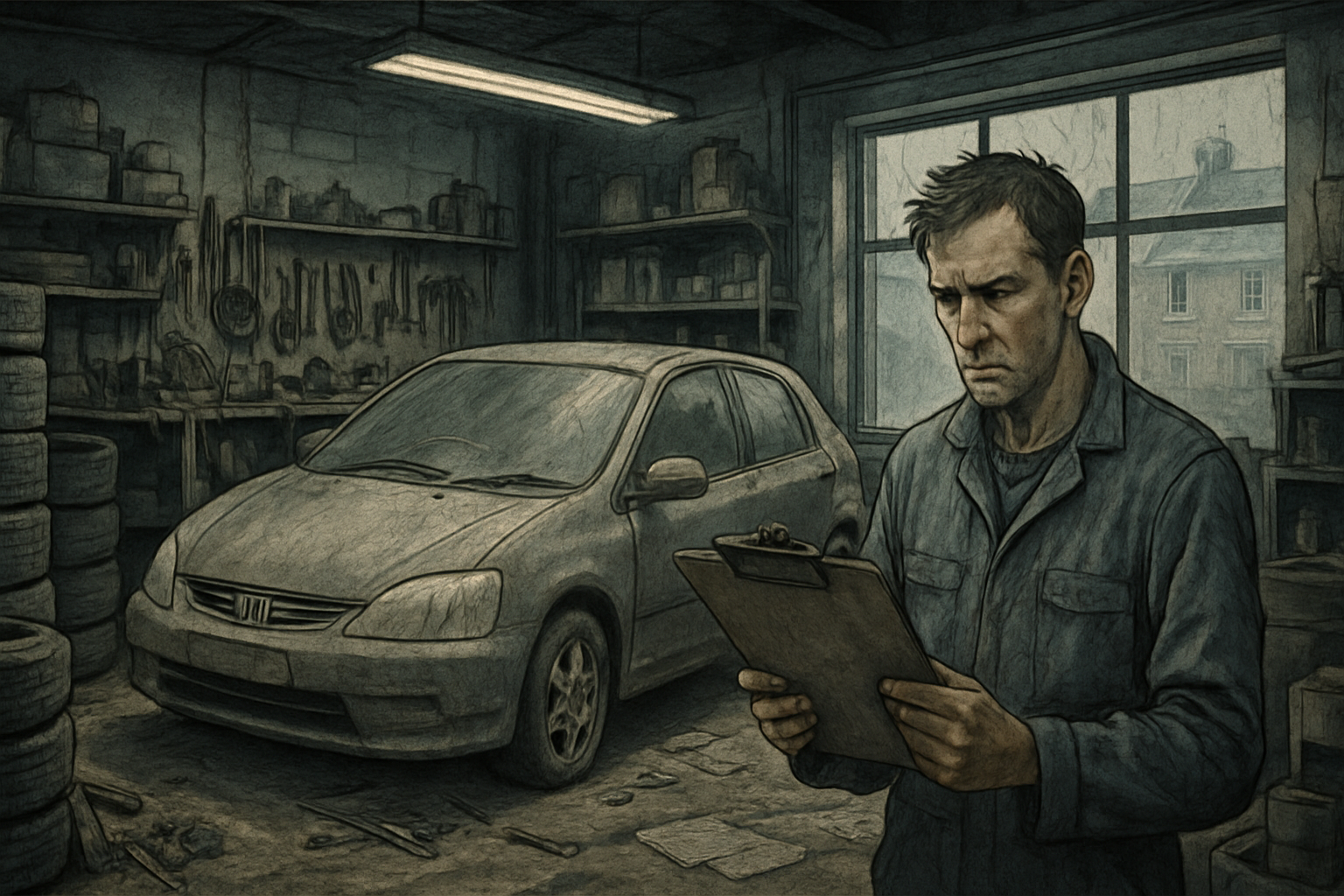
The £15,000 Honda That Nearly Sank Dave's Garage
Dave Henderson runs a three-bay workshop in Coventry, and last March, a customer brought in a Honda Civic for what should have been a straightforward clutch replacement. The bill came to £850, but the customer vanished. For eight months, that Honda sat in Dave's workshop, taking up valuable space whilst costing him money every single day.
"I was turning away MOT bookings because I had no space," Dave tells me. "That one abandoned car probably cost me £3,000 in lost revenue, not counting the storage costs." But here's the twist — by following proper legal procedures, Dave eventually recovered £2,400 from the vehicle through legitimate channels.
Dave's story isn't unique. Across the UK, workshops are struggling with abandoned vehicles that destroy cash flow and eat up precious workshop space. But there are legal ways to protect yourself and recover your costs — you just need to know the proper procedures.
The Real Cost of Abandoned Vehicles in Your Workshop
Before diving into legal remedies, let's calculate what an abandoned car actually costs your business. Sarah Mitchell, who runs a family garage in Leeds, worked this out after three vehicles were left at her shop for over six months.
"I calculated that each bay costs me roughly £15 per day when you factor in rent, insurance, rates, and lost revenue," Sarah explains. "A car sitting for 90 days costs £1,350 just in space. Add the administration time, phone calls, and stress — it's devastating for cash flow."
Here's Sarah's breakdown for a typical two-bay garage:
- Workshop rent allocation: £8 per bay per day
- Business rates allocation: £2 per bay per day
- Insurance premium increase: £1 per bay per day
- Lost revenue opportunity: £25-40 per bay per day
- Administration time: £50 per month chasing customer
"The opportunity cost is massive," Sarah adds. "During MOT season, I'm turning away customers because I've got dead cars taking up space."
UK Legal Framework: Your Rights Under the Torts Act
In the UK, workshops have specific legal rights when it comes to abandoned vehicles, but you must follow the correct procedures. The Torts (Interference with Goods) Act 1977 gives you a legitimate claim, but only if you've done the paperwork properly.
Marcus Webb, a solicitor who specialises in automotive law, explains: "Garages have what's called a 'repairer's lien' — basically, you can hold the vehicle until the bill is paid. But if the customer disappears, you need to follow formal notice procedures before you can dispose of the vehicle."
The 90-Day Notice Rule
Under UK law, you must give the vehicle owner at least 90 days' written notice before disposing of their car. This notice must include:
- Details of the work performed and amount owed
- Daily storage charges from the completion date
- Statement that the vehicle will be sold if payment isn't received
- Clear deadline date (minimum 90 days from notice)
"The notice has to be sent by recorded delivery to the owner's last known address," Marcus emphasises. "Keep copies of everything — the delivery receipt, the letter, all communication attempts. This documentation protects you legally."
Structuring Your Storage Fee Policy
The key to recovering costs legally is having a bulletproof storage policy built into your terms and conditions. Gary Phillips, who owns two workshops in Birmingham, learned this the hard way.
"My first abandoned car situation was a disaster because I had no storage clause in my paperwork," Gary admits. "Now every job sheet clearly states our storage policy, and customers sign to acknowledge it."
Here's Gary's current storage policy structure:
"Vehicles must be collected within 14 days of work completion. After 14 days, storage charges of £15 per day will apply. After 30 days, we reserve the right to move your vehicle to external storage at your expense. After 90 days' written notice, uncollected vehicles may be disposed of to recover our costs."
"The magic is in the progressive penalty structure," Gary explains. "£15 per day sounds reasonable for the first month, but it adds up quickly. Most customers collect their cars within the grace period when they see real money mounting up."
Key Elements of a Defensible Storage Policy
For your storage policy to stand up legally, it must be:
- Clearly displayed: Visible signage in your workshop and written in your terms
- Acknowledged by customer: Signature on work authorisation form
- Reasonable charges: Storage fees must reflect actual costs
- Progressive timeline: Grace period followed by increasing charges
- Clear disposal procedure: Explain what happens after formal notice period
The Notice Process: Step-by-Step Legal Procedure
When a vehicle becomes abandoned, timing is everything. Jenny Roberts, who runs a garage in Bristol, has perfected this process after dealing with six abandoned vehicles over the past two years.
"I start the formal clock ticking the moment a job is complete and the customer doesn't collect," Jenny explains. "Every day counts for storage charges, so you need systems in place."
Day 1: Job Completion
- Mark job as 'Ready for Collection' in your system
- Send completion notification to customer
- Start daily storage charge calculation
- Set 14-day follow-up reminder
Day 14: First Formal Contact
- Phone call to customer
- Email with invoice and storage policy reminder
- Document all contact attempts
- Send letter if no response
Day 30: Escalation Notice
- Formal letter stating vehicle will be moved to external storage
- Calculate total charges owed
- Set 60-day final notice deadline
- Copy letter to DVLA registered keeper (different from customer)
Day 90: Legal Disposal Notice
- Send recorded delivery letter stating intention to dispose
- Allow minimum 90 days from this notice
- Include final calculation of all charges
- State method of disposal (auction, scrap, etc.)
"The paperwork is tedious, but it's your legal protection," Jenny emphasises. "I've never had a customer challenge the process when they see the documented trail."
Workshop Management Software: Automating the Process
Modern garage management systems can automate much of this process, preventing cars from slipping through the cracks. Tom Harrison, who manages a chain of workshops across Manchester, implemented automated tracking after losing track of two abandoned vehicles.
"Our system now flags any vehicle that's been 'Ready for Collection' for more than 30 days," Tom explains. "It automatically generates the letters, calculates storage charges, and tracks the legal timeline. It's transformed how we handle this problem."
Key features your garage management software should include:
- Automatic flagging: Alerts at 30, 60, and 90-day intervals
- Storage calculation: Daily charges added automatically
- Letter generation: Templates for legal notices
- Document storage: Digital copies of all correspondence
- Timeline tracking: Clear view of where each case stands legally
"The software pays for itself with just one recovered vehicle," Tom adds. "We recovered £4,800 from a BMW that sat in our shop for seven months. Without the automated tracking, I probably would have forgotten about it."
Real Recovery Stories: How Shops Got Paid
Let's look at some real examples of workshops that successfully recovered money from abandoned vehicles by following proper procedures.
Case Study 1: The £8,000 Transit Van
Pete Morrison runs a commercial vehicle specialist in Glasgow. Last year, a customer brought in a Transit van for engine work. The repair bill came to £3,200, but the customer's business went into liquidation before collection.
"I followed our standard process — formal notices, recorded delivery letters, the full legal procedure," Pete explains. "After the 90-day notice period, I contacted a local auction house that specialises in commercial vehicles."
The Transit sold at auction for £5,800. After auction fees and legal costs, Pete recovered £4,900 — more than covering his original bill plus eight months of storage charges.
Case Study 2: The Flood-Damaged BMW
Rachel Green's garage in Leicester dealt with a more complex situation — a customer brought in a flood-damaged BMW 3 Series, then disappeared when the estimate came back at £12,000.
"The car was only worth about £8,000 before the damage," Rachel explains. "But our storage policy was clear, and we'd documented everything properly."
Rachel contacted the customer's insurance company, as flood damage suggested a potential claim. After negotiations and proof of proper legal procedures, the insurer settled for £6,500 to clear the vehicle and associated costs.
Case Study 3: The Classic Car Surprise
Sometimes abandoned vehicles turn out to be more valuable than expected. Alan Cooper's workshop in Wales had a 1990s Ford Escort sitting for nearly a year after the customer stopped returning calls.
"It looked like any old Escort, but when we researched it properly for the auction, it turned out to be a rare RS variant," Alan explains. "Following proper legal procedures meant we could dispose of it legitimately."
The car sold for £18,500 at a classic car auction. After all costs and fees, Alan's workshop recovered £14,200 — far exceeding the original £850 repair bill.
When to Involve Authorities vs. Private Sales
Not every abandoned vehicle should go to auction. Understanding when to involve local authorities, scrap dealers, or private sales can maximise your recovery whilst staying within the law.
Contact DVLA When:
- Vehicle has no MOT or tax
- Suspected stolen vehicle (check with police)
- Owner deceased (requires different legal procedures)
- Vehicle registered to a business that's been dissolved
Use Scrap Dealers When:
- Vehicle value less than storage charges owed
- Extensive damage makes repair uneconomical
- Age and condition suggest scrap value only
- No MOT and would cost more to restore than vehicle worth
Consider Auction When:
- Vehicle worth more than charges owed
- Classic, rare, or specialist vehicle
- Low mileage or good condition despite age
- Commercial vehicle with trade value
"The key is being realistic about vehicle value versus what you're owed," explains automotive auctioneer James Wright. "A £500 repair bill on a car worth £800 might justify auction fees. A £2,000 bill on a car worth £300 should probably go to scrap."
Protecting Yourself: Insurance and Liability Issues
One aspect many workshops overlook is insurance liability for long-term vehicle storage. Claire Davidson's garage learned this lesson when an abandoned car suffered vandalism damage while on their premises.
"Our insurance company questioned why we were storing a vehicle for six months without payment," Claire explains. "Thankfully, our documented legal process showed we were following proper procedures to dispose of it."
Key insurance considerations:
- Notify your insurer: Inform them about your storage policy and procedures
- Document security measures: CCTV, locked premises, regular checks
- Review liability coverage: Ensure abandoned vehicles are covered
- Consider storage exclusions: Some policies exclude vehicles over certain periods
Reducing Your Risk
Smart workshops take steps to minimise their exposure to abandoned vehicle problems:
- Payment upfront: Require deposit before starting expensive work
- Credit checks: For commercial customers or large jobs
- Clear communication: Regular updates during repair process
- Flexible payment: Offer payment plans to prevent abandonment
The Technology Solution: Automated Tracking Systems
Modern garage management software has transformed how workshops handle abandoned vehicles. Instead of relying on manual tracking and hoping nothing falls through the cracks, automated systems ensure every vehicle is monitored from completion to collection.
Mark Stevens, who operates four workshops across the West Midlands, implemented comprehensive tracking after struggling with abandoned vehicles at multiple locations.
"The software integration changed everything," Mark explains. "When a job is marked complete, the system automatically starts a countdown timer. At day 14, it emails the customer and flags the vehicle for our attention. At day 30, it generates the formal notice letter. By day 60, we're already preparing for the legal disposal process."
The system also calculates storage charges automatically, adding them to the customer account daily. "Customers see their bill growing every day they delay collection," Mark notes. "It's amazing how quickly people find time to pick up their cars when they see real money adding up."
Key Software Features That Prevent Problems
When evaluating garage management software, look for these abandoned vehicle prevention features:
- Automatic status tracking: Flags vehicles ready for collection
- Progressive alerts: Escalating notifications at 14, 30, 60, and 90 days
- Storage charge calculation: Daily fees added automatically
- Letter templates: Legal notices generated with proper formatting
- Document management: Stores copies of all correspondence
- Reporting dashboards: Overview of all vehicles approaching abandonment
- Customer communication: Automated emails and SMS reminders
- Legal timeline tracking: Clear view of disposal eligibility
International Considerations: When Customers Cross Borders
With increasing mobility, UK workshops occasionally deal with vehicles owned by EU residents or temporary visitors. Brexit has complicated some procedures, but the fundamental principles remain the same.
"We had a German tourist's car abandoned after a breakdown repair," explains Michelle Roberts, whose garage near Heathrow serves international customers. "The legal process was the same, but we had to ensure our notices were translated and sent to the German address."
For international cases:
- Send notices in English and the customer's language if possible
- Use international tracked delivery services
- Allow extra time for international mail delivery
- Consider involving the relevant embassy for high-value vehicles
- Check if the vehicle is hired/leased rather than owned
Calculating Your Real Storage Costs
To make your storage policy legally defensible, you need to prove your charges reflect actual costs. Here's how successful workshops calculate their daily storage rates:
| Cost Category | Monthly Total | Per Bay/Day |
|---|---|---|
| Workshop Rent | £2,400 | £8.00 |
| Business Rates | £600 | £2.00 |
| Insurance Premium | £300 | £1.00 |
| Utilities Allocation | £450 | £1.50 |
| Security/Maintenance | £150 | £0.50 |
| Total Direct Costs | £3,900 | £13.00 |
"I charge £15 per day for storage, which covers my direct costs plus a small margin for administration," explains workshop owner David Chen from Cardiff. "It's defensible because I can prove every penny with invoices and receipts."
Building Customer Relationships to Prevent Abandonment
Prevention is always better than legal action. The most successful workshops have developed systems that virtually eliminate abandoned vehicles through better customer communication.
"We send progress photos during repairs, call with updates, and always confirm collection arrangements before finishing work," says Amanda Price, whose family garage in Plymouth hasn't had an abandoned vehicle in three years. "Good communication prevents most problems before they start."
Amanda's prevention strategy includes:
- Upfront estimates: Clear written quotes before starting work
- Progress updates: Photos and calls during complex repairs
- Payment plans: Flexible options for unexpected large bills
- Collection confirmation: Always arrange pickup before completing work
- Relationship building: Personal service that makes customers want to return
Legal Documentation: What Records to Keep
If you ever need to defend your actions in court, proper documentation is essential. Here's what successful workshops maintain for every potential abandonment case:
- Original work authorisation: Signed by customer with storage policy acknowledged
- Completion notification: Proof you told customer work was finished
- All communication attempts: Phone logs, emails, text messages
- Formal notices: Copies of all letters with delivery confirmations
- Cost calculations: Breakdown of storage charges and method used
- Photos: Condition of vehicle throughout storage period
- Disposal documentation: Auction receipts, scrap certificates, or sale records
"The paperwork is your protection," emphasises legal expert Marcus Webb. "Courts want to see you followed proper procedures and gave the customer every reasonable opportunity to collect their vehicle. Good documentation proves you acted fairly and legally."
The Bottom Line: Protecting Your Cash Flow
Abandoned vehicles don't have to destroy your workshop's cash flow. By implementing proper storage policies, following legal procedures, and using technology to automate the process, you can protect your business and even profit from difficult situations.
The workshops that handle this best share common characteristics:
- Clear, legally sound storage policies built into every job
- Systematic approach to tracking and communication
- Technology that prevents vehicles falling through the cracks
- Understanding of legal rights and proper procedures
- Realistic approach to vehicle values and disposal options
"Abandoned cars used to be a nightmare that kept me awake at night," reflects Dave Henderson, the Coventry garage owner we met at the start. "Now they're just another business process. I know my rights, I follow the procedures, and my workshop space stays productive. That abandoned Honda taught me an expensive lesson, but it was worth it in the long run."
Remember, every day an abandoned vehicle sits in your workshop costs you money. But with the right policies, procedures, and technology, you can turn this common problem into a manageable part of your business — and sometimes even a profitable one.