English
 AR
AR
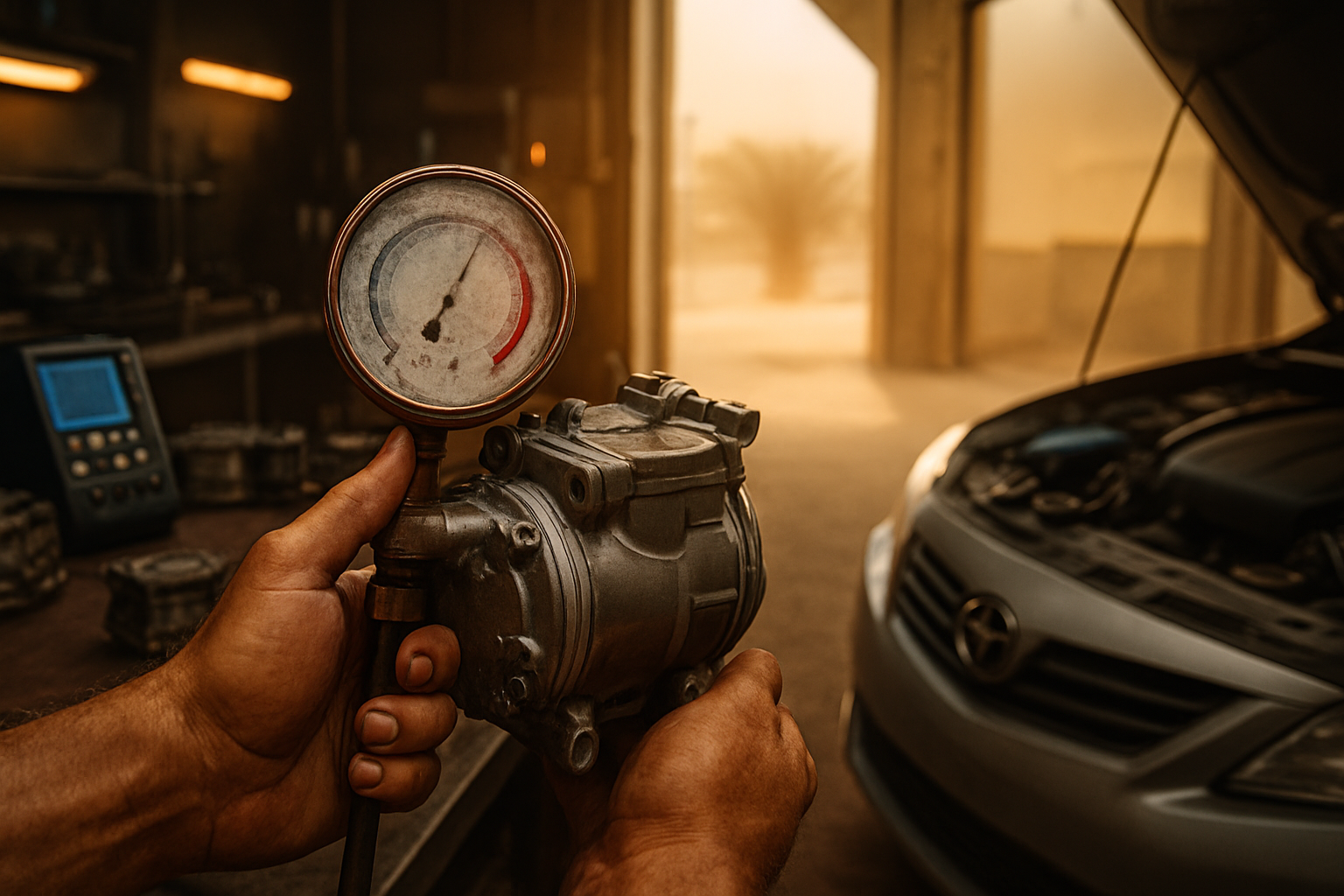
The 40-Degree Problem That Kills Your Reputation
Ahmad's workshop in Sitra was booked solid last April. Customers were lining up before Ramadan, desperate to fix their A/C systems before the brutal summer heat arrived. But by June, half of them had gone to the dealerships instead.
The problem? Ahmad was diagnosing every weak A/C system as a "compressor failure" and quoting 800–1,200 BHD for replacements. Meanwhile, his competitor down the street was fixing 60% of the same symptoms with simple refrigerant recharges costing customers 40–80 BHD.
"I thought I was being thorough," Ahmad told me when I visited his shop last month. "But customers started saying I was trying to rip them off. They'd get a second opinion, find out it was just low refrigerant, then never come back."
This story plays out in workshops across Bahrain every spring. The rush to prepare for summer leads to rushed diagnoses, and rushed diagnoses cost you customers—and serious money.
The Three Culprits: Why 60% of Shops Get It Wrong
Most A/C problems in Bahrain fall into three categories, but they share similar symptoms. Here's where workshops go wrong:
Low Refrigerant vs. Compressor Seizure
What shops see: Weak cooling, compressor not engaging consistently
Wrong diagnosis: "Your compressor is dead, needs replacement"
Reality: Low refrigerant triggers the low-pressure switch, preventing compressor engagement to protect the system
Khalid at Gulf Auto Services in Manama learned this the hard way. "I had a customer with a 2019 Patrol that barely cooled. I quoted him 950 BHD for a compressor replacement. He went to the dealer, they found a small leak in the condenser, recharged the system for 65 BHD, and it worked perfectly."
The difference? The dealer checked system pressures first. Khalid assumed.
Condenser Blockage: The Silent Killer
Bahrain's combination of desert sand and Persian Gulf humidity creates a deadly mix for condensers. Salt air accelerates corrosion while sand blocks airflow, but the symptoms mimic compressor failure:
- System runs but doesn't cool effectively
- High-side pressure readings elevated
- Compressor cycling rapidly
- Condenser fan running constantly
"I see this constantly near the causeway," says Mahmood, who runs a shop in Muharraq. "Cars coming from Saudi get sandblasted condensers, but the compressor takes the blame when cooling drops off."
A blocked condenser costs 120–200 BHD to replace. A compressor? 800–1,200 BHD plus labor.
Compressor Clutch vs. Complete Compressor Failure
The most expensive mistake: replacing entire compressors when only the clutch has failed. In Bahrain's heat, clutch coils burn out frequently, but the compressor itself remains functional.
Symptoms of clutch failure:
- No engagement when A/C is turned on
- Clicking sounds from compressor area
- Clutch plate doesn't rotate with engine running
"I spent six months replacing whole compressors before I learned to test the clutch separately," admits Rashid from a workshop in Hamad Town. "A 80 BHD clutch replacement vs. 900 BHD compressor job—customers were not happy when they found out."
The Gulf Environment: Why Your Textbook Knowledge Fails Here
Bahrain's climate destroys A/C systems in ways that training manuals don't cover. The combination of 95% humidity and temperatures hitting 47°C creates unique failure patterns.
Salt Air Corrosion
Living 15 minutes from the Persian Gulf means every vehicle breathes salt air. This accelerates:
- Condenser fin corrosion (reducing heat exchange efficiency)
- Refrigerant line corrosion (creating micro-leaks)
- Electrical connection corrosion (causing intermittent compressor operation)
"I started cleaning condensers with fresh water and mild detergent before every diagnosis," says Fatima, who runs one of the few female-owned workshops in Isa Town. "Just removing the salt buildup improved cooling in 30% of cases without any parts replacement."
Heat Stress on Components
When ambient temperatures exceed 45°C—which happens regularly from May through September—A/C systems work overtime. Components that would last 8 years in cooler climates fail in 4–5 years here.
The most vulnerable:
- Compressor clutch coils (heat degrades insulation)
- Expansion valves (thermal cycling causes failure)
- Condenser fans (motors overheat from continuous operation)
"Before I understood our climate, I was using standard diagnostic procedures from my training in Lebanon. Here, I learned to factor in our environment first, then follow standard procedures." — Omar, 15-year veteran mechanic
The Right Way: Diagnostic Steps That Save Your Reputation
Here's the systematic approach that separates professional workshops from parts-changers:
Step 1: Visual Inspection (5 Minutes, Saves Hours)
Before connecting any gauges:
- Check condenser for blockage, corrosion, or damage
- Inspect refrigerant lines for obvious leaks or corrosion
- Examine compressor clutch for wear or damage
- Test condenser fan operation
Step 2: Pressure Testing (The Make-or-Break Moment)
Connect manifold gauges with engine running, A/C on maximum:
| Condition | Low Side Pressure | High Side Pressure | Likely Cause |
|---|---|---|---|
| Normal Operation | 25-40 PSI | 200-250 PSI | System OK |
| Low Refrigerant | 10-20 PSI | 100-150 PSI | Leak/undercharge |
| Blocked Condenser | 40-60 PSI | 300+ PSI | Airflow restriction |
| Compressor Failure | Equal pressures | No pressure difference | No compression |
Step 3: Temperature Verification
Use an infrared thermometer to check:
- Vent temperature (should be 15-20°C below ambient)
- Condenser inlet/outlet temperature difference
- Compressor surface temperature under load
"Temperature readings tell the real story," explains Hassan, who specializes in luxury vehicle A/C systems in Riffa. "Pressure alone can lie—temperature doesn't."
Stocking Strategy: Beat the April Rush
Smart workshops prepare inventory in March, before demand peaks. Here's what moves fast:
Fast-Moving A/C Components
- R134a refrigerant: Stock 200+ cans (popular vehicles need 800-1200g)
- Compressor clutches: Focus on Toyota (Camry, Land Cruiser), Nissan (Patrol), Chevrolet (Tahoe)
- Condenser fans: Universal 12V fans for older vehicles
- Expansion valves: Common sizes for fleet vehicles
- Desiccant filters: Mandatory replacement with any major repair
The Economics of Proper Stocking
Yasmin runs a successful workshop near the Formula 1 circuit. Her April-through-August A/C revenue strategy:
- Purchase R134a in bulk during winter (30% cost savings)
- Stock compressor clutches for top 10 vehicle models in Bahrain
- Maintain relationships with suppliers for next-day delivery of major components
"I make more profit on proper diagnosis and small repairs than my competitors make on unnecessary compressor replacements," she says. "Customers trust me because I fix what's actually broken."
Documentation: Your Defense Against Customer Complaints
In Bahrain's competitive market, customers get multiple quotes. Your diagnosis needs to be bulletproof.
Essential Documentation
Create a standard A/C diagnostic sheet that includes:
- Ambient temperature and humidity at time of test
- System pressure readings (before and after)
- Vent temperature measurements
- Visual inspection findings with photos
- Recommended repairs with cost breakdown
Customer Education Script
Mohammed from a workshop in Sitra shares his approach: "I show customers the pressure readings and explain what they mean. I take a photo of a blocked condenser or corroded lines. When they see the evidence, they trust the diagnosis."
"The customer who understands why their A/C failed becomes your customer for life. The one who feels tricked never returns." — Ahmed, workshop owner with 20+ years experience
The Competitive Advantage: Winning the Summer Rush
Workshops that master A/C diagnosis gain several advantages:
Higher Customer Retention
Accurate diagnosis builds trust. Customers return for other services and recommend you to friends. In Bahrain's close-knit communities, word-of-mouth reputation is everything.
Better Profit Margins
Instead of competing on price for expensive compressor replacements, you compete on expertise for proper diagnosis. A correctly diagnosed refrigerant recharge has higher profit margins than a questionably necessary compressor replacement.
Reduced Warranty Claims
When you fix the actual problem, repairs last. When you replace working compressors due to misdiagnosis, customers return with the same symptoms—and expect free fixes.
The Bottom Line: Trust Beats Price Every Time
By the time you read this, March is probably approaching, and customers are starting to think about their A/C systems. The workshops that will dominate the profitable summer season are those that diagnose correctly, document thoroughly, and educate customers honestly.
Ahmad's workshop is doing better now. He invested in proper gauges, trained his technicians on systematic diagnosis, and created documentation procedures. "Last summer, I fixed twice as many A/C systems with half the customer complaints," he reports. "And my average ticket was actually higher because customers trusted my recommendations for preventive maintenance."
The choice is yours: continue guessing and losing customers to dealerships, or master proper diagnosis and own your local A/C market. In a country where functioning air conditioning isn't a luxury—it's survival—customers will pay well for workshops they trust to get it right the first time.