English
 AR
AR
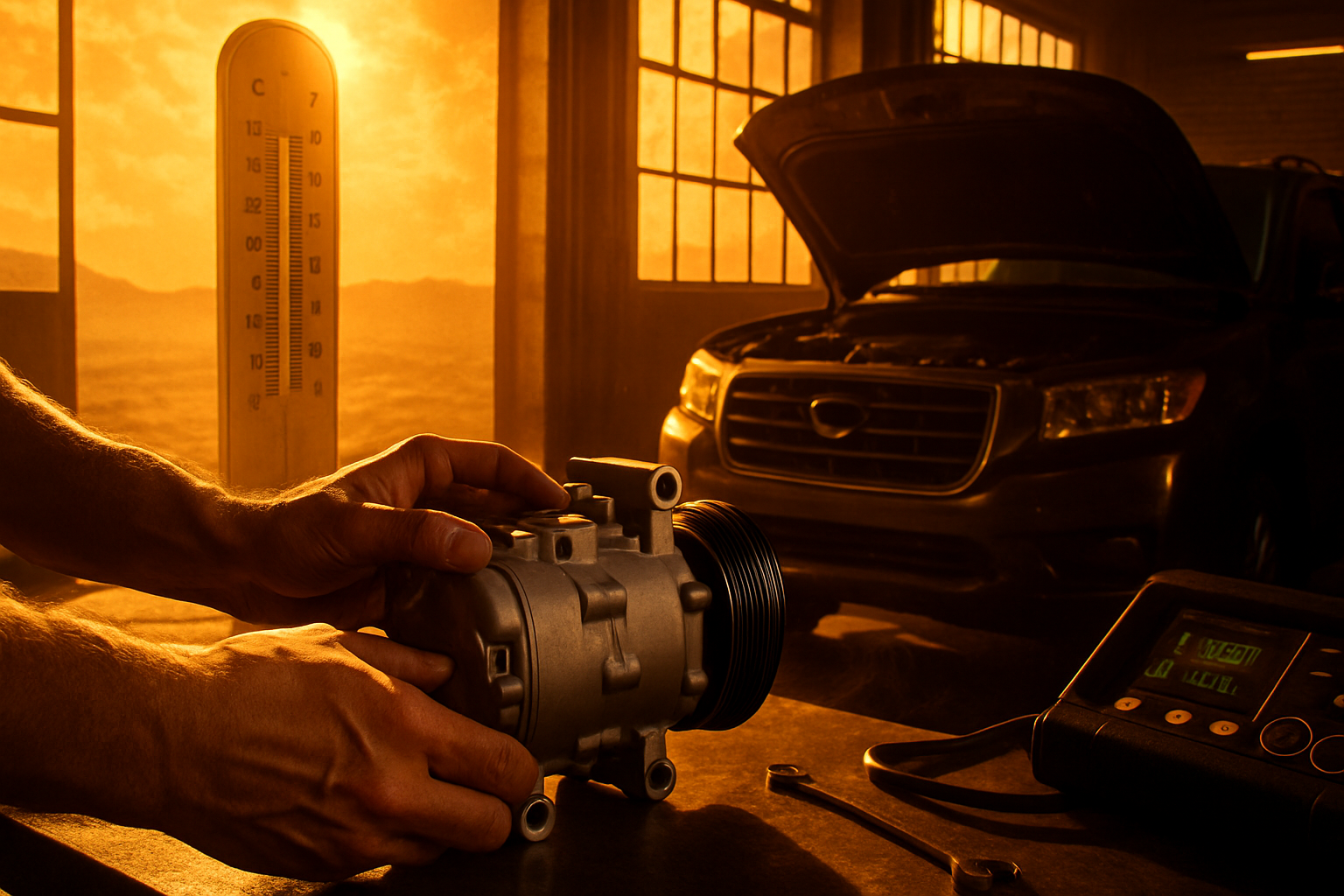
Saudi summer is unlike anywhere else cars are built for. Riyadh regularly hits 48-50°C. The Empty Quarter pushes higher. Jeddah coastal humidity adds thermal stress of a different kind. Ground temperatures reach 70°C+ on black tarmac. Cars built for global markets get tested at their thermal limits here — and things fail.
The good news: most summer failures are predictable. AC compressors, radiators, batteries (yes — heat kills batteries faster than cold), tyres, coolant. They fail in the same ways every June and July.
Spend an hour and a few hundred Riyals in March-April and you drive through the heatwave without incident. Skip it, and you join the Asir highway roadside-assistance queue with a steaming radiator at 2pm in July.
1. Air Conditioning — The Non-Negotiable
Not a comfort item in Saudi Arabia. A functioning AC is a safety-critical system. Weak AC in a car that carries children across 500 km of desert in July is genuinely dangerous.
- Symptoms of weak AC: blows cool but not cold, takes too long to cool the cabin, warmer on highway than at city speeds, cycling on and off frequently
- Refrigerant recharge: SR200-SR500 R134a (older cars), SR500-SR1,500 R1234yf (newer cars since 2017)
- If recharging is needed every year: there is a leak. UV dye test (SR100-SR250) finds it. Common leak points: condenser (front of car, takes stone hits), compressor seal, evaporator (in dash, expensive to access)
- Compressor replacement (if the clutch fails or the compressor seizes): SR1,500-SR4,000 fitted depending on vehicle and parts source
- Cabin air filter: under SR100 part, replace annually. Blocked cabin filter halves AC output even when refrigerant is full. Most owners never replace it.
Saudi heat-specific: sustained driving at 120 km/h with AC on max is the cruellest test for any AC system. A car that blows cold on Riyadh city streets but struggles between Riyadh and Dammam on the highway has a marginal system.
2. Cooling System — Radiator, Coolant, Hoses
Engine overheating in Saudi summer is catastrophic. Large-displacement V8s and V6s driving at sustained 110-130 km/h in 45°C ambient temperatures push cooling to the limit.
- Coolant level: check between MIN and MAX cold. If it has dropped since last check, there is a leak — visible as crusty white or coloured deposits on engine, hoses, or under the car
- Coolant condition: should be clear pink, green, blue, or orange depending on type. Brown, rusty, or jelly-like = degraded; flush and replace
- Coolant replacement schedule: typically every 2-3 years in Saudi conditions (faster than European cadence), or per manufacturer. Your owner's manual specifies the exact type — using the wrong coolant causes corrosion and seal damage
- Radiator inspection: bent fins from stone strikes, sediment buildup, external corrosion = reduced cooling. Radiator flush and inspection (SR200-SR600) is cheap insurance
- Hose condition: squeeze each rubber hose with engine cold. Firm but pliable = good; rock-hard or ballooning = imminent failure. Burst hose at 45°C = engine block cracking territory (SR15,000-SR40,000 repair on a Land Cruiser V8)
- Thermostat: stuck closed overheats engine; stuck open keeps engine too cool and wears faster. Replacement SR400-SR1,200 depending on vehicle
- Fan clutch and auxiliary fans: verify they engage when engine is hot. On V8 Land Cruisers, a failed fan clutch = certain overheat in summer traffic
3. Battery — Killed by Heat, Not Cold
Counter-intuitive for anyone coming from northern climates: heat is harder on batteries than cold. Saudi summer evaporates electrolyte, accelerates corrosion, and cuts battery life from a typical European 4-5 years down to often 2-3 years in Riyadh and Dammam.
- Battery age: stamped on the case. Anything 2.5+ years old in Saudi summer deserves a load test
- Free load test: most major parts retailers (Abdul Latif Jameel parts, AutoZone SA, Motorzon) test batteries free. 5-minute test, printed result
- Replacement: SR300-SR800 for a quality battery fitted. Better than SR200+ callout fee PLUS SR500+ emergency replacement at premium prices on a Thursday night
- Terminals: clean any white/green corrosion (baking soda + water, then light petroleum jelly on terminals). Corroded terminals cause hard starts in heat
- Battery type: consider an AGM battery if your vehicle supports it — better heat tolerance, longer life, slightly more expensive upfront
4. Tyres — Pressure, Tread, Age, Sidewall
Saudi tarmac at 60-70°C surface temperature + highway speeds + underinflated tyres = blowout. Every summer, King Fahd Highway and the Riyadh-Dammam route show tyre debris at the shoulder.
- Pressure: check monthly during summer, more often before long trips. Tyre pressure rises with heat — the cold-pressure recommendation on the door sticker accounts for this. Do NOT lower pressure because it has risen during driving; that is normal
- Underinflation is the killer: a tyre 20% below recommended runs much hotter, flexes more, and can blow out at sustained 100+ km/h on hot tarmac
- Tread depth: legal minimum varies; aim for 4mm+ on all four for summer and highway safety
- Tyre age: DOT date code on sidewall (e.g. "2622" = 26th week of 2022). Tyres over 6 years old harden and become unsafe even with tread remaining. Saudi sun ages sidewalls faster than European conditions — visible sidewall cracking is a clear "replace now" signal
- Sidewall inspection: walk around each tyre. Cracks, bulges, deep scuffs from kerb strikes = potential failure. A sidewall bulge is a blowout waiting to happen
- Spare: often neglected, often aged out; check it, and verify you have a working jack and wheel brace
5. Wipers, Washer Fluid, Sun Damage
- Wipers: Saudi UV destroys rubber faster than winter use. Wipers working fine in January may streak and tear by April. Replace if any cracking or juddering. SR40-SR150 a pair, 5 minutes to fit
- Washer fluid: bug splatter in summer + occasional sand/dust storms. Top up monthly
- Headlight oxidation: Saudi sun yellows plastic headlight covers, cutting light output 30-50%. A SR50-SR150 restoration kit + 30 minutes restores them. Worth doing annually
- Interior sun damage: sunshade in windscreen when parked outside. UV cracks dashboards, fades upholstery, kills electronics. A SR30-SR150 sunshade adds years to cabin life
- Paint protection: ceramic coating or paint protection film worth considering for long-term owners in Riyadh — sustained sun exposure damages clearcoat over years
6. Oil — Heat-Stable Viscosity
- Use the right oil for hot climates: many manufacturers specify a heavier viscosity for sustained high-temperature operation (5W-30 instead of 0W-20 in some cases). Check your owner's manual for the hot-climate specification
- Synthetic oil: outperforms conventional in heat. Maintains viscosity at 100°C+ engine-bay temperatures where conventional oil thins. Worth the SR100-SR300 premium per service
- Time it before peak summer: a fresh oil change in March-April means you go through the hottest months on clean lubricant
7. The Long-Distance Summer Kit
If you plan any significant summer driving (Riyadh to Jeddah is 950+ km, Riyadh to Dammam 400+ km, Empty Quarter expeditions), an emergency kit is mandatory:
- Plenty of drinking water (5L per person minimum)
- Sun protection (hat, sunscreen, long sleeves)
- Spare engine coolant (a litre for limp-home in case of slow leak)
- Spare engine oil (1L)
- Tyre repair kit and 12V air compressor (roadside punctures common, especially on rural routes)
- Fully charged jump-start pack OR booster cables
- Basic first aid kit
- Emergency contacts: Najm for minor accident reporting, Absher for tow coordination, 911 for medical emergencies
- Offline maps (mobile coverage drops fast outside major routes in some areas)
- Spare fuel if you plan any serious distance from fuel stations — Saudi has large gaps between stations on some routes
The Honest Cost
Done at home or with a trusted mechanic: SR400-SR800 for the consumables (oil change, AC recharge if mild, washer fluid, wiper blades, coolant top-up).
Done at an authorised dealer with a "summer service" package: SR1,000-SR2,500 depending on vehicle.
The cost of NOT doing it: easily SR3,000-SR20,000 in a single summer breakdown — engine damage from boilover, dead AC compressor in 48°C, blowout on the Riyadh-Dammam expressway, seized battery on a weekend trip to Taif.
Sources & Further Reading
- Ministry of Interior — roadside safety and emergency procedures
- Absher — schedule MVPI, verify Istimara, report traffic incidents
- SASO — Saudi Standards — fuel, tyre and oil specifications
- Ministry of Commerce — consumer rights for auto service disputes
- General Authority for Statistics — Saudi weather and climate statistics for trip planning
- Your vehicle owner's manual — definitive source for hot-climate oil viscosity, AC refrigerant type, coolant specification
- Abdul Latif Jameel parts network — Toyota authorised in Saudi Arabia
- AutoZone SA / Motorzon / Haraj car parts — aftermarket parts and testing services
Related Mekavo articles: Real annual cost of running a car in SA — where summer prep fits in the bigger budget. MVPI at Fahs centres — AC is now tested as part of MVPI.
Why We Care
My Mekavo is free for Saudi car owners. Log when you did each summer prep item — battery test, AC recharge, coolant flush, oil change. Mekavo reminds you next March before the heat hits. No more "did I check the cooling this year?" guesswork.