English
 Español
 Deutsch
 FI
FI
 PT
PT
 BR
BR
 FR
FR
 AR
AR
 ZH
ZH
 UR
UR
 TL
TL
 TH
TH
 TR
TR
 PL
PL
 RO
RO
 BG
BG
 ID
ID
 MS
MS
 LT
LT
 IT
IT
 NL
NL
 CS
CS
 SK
SK
 SL
SL
 ET
ET
 SV
SV
 NB
NB
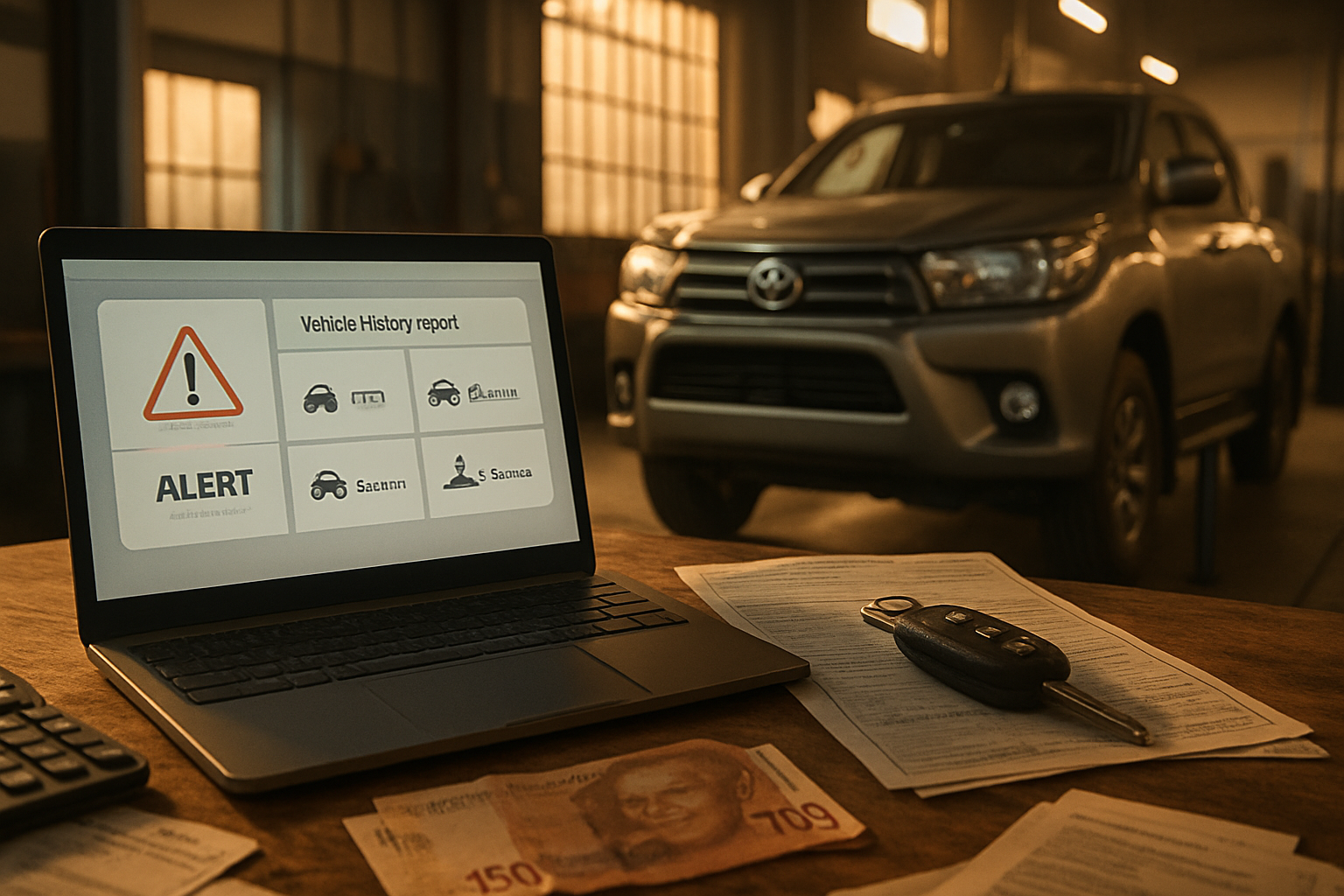
You found a 2018 Toyota HiLux on AutoTrader ZA for R385,000 in Sandton. Photos look right. The seller has had it 4 years. You are heading over Saturday with a bank-guaranteed cheque.
Spend R150 first. A NaTIS-linked vehicle history check before buying any used car in South Africa is the single highest-return move in the entire process. Clean check = peace of mind. Dodgy check = the R30,000 disaster you swerved.
Here is what each line on a typical SA vehicle history report actually means — and how to react.
What NaTIS Actually Is
The National Traffic Information System (eNaTIS) is the South African government's vehicle and driver licence database, run by the Road Traffic Management Corporation (RTMC). It records:
- Every registered vehicle in SA — VIN (chassis number), engine number, registration history
- Every change of ownership
- Mileage records taken at each roadworthy inspection and ownership transfer
- Vehicle status: registered, deregistered, scrapped, stolen, write-off categories
- Outstanding licence fee status
- Driver's licence records
You cannot search NaTIS directly as a private buyer. Commercial credit bureaus (TransUnion Auto, Compuscan, Experian) pull NaTIS data into vehicle history reports they sell. Banks and dealers also have NaTIS access for valuations.
The Reports You Should Run Before Buying
For about R150-R250, you can pull a comprehensive SA vehicle history report from one of these providers:
- TransUnion Auto Information Solutions (TransUnion Vehicle Report) — the most widely used, often pre-purchased by dealers
- WeSpec — popular for private buyers
- VinDecode SA
- The major banks (Standard Bank, Absa, FNB, Nedbank) often offer free history reports for their customers
A typical SA vehicle history report covers:
- NaTIS registration details (current owner, previous owners, change-of-ownership history)
- Theft and stolen-vehicle status (cross-checked with SAPS)
- Insurance write-off status (Code 1, 2, 3, 4 — see below)
- Outstanding finance / lien
- Mileage history and discrepancy detection (recorded at each NaTIS event)
- Open recall information from manufacturers
- Cross-border import status (vehicles imported from outside SA)
The 5 Findings That Should Make You Walk Away
1. Outstanding Finance
The single most common nasty surprise in SA private used-car sales. The seller still owes the bank or finance house. In South Africa, the finance house has a security interest registered over the vehicle. If you buy and the seller defaults, the finance house can repossess the car from you — even though you bought it in good faith.
If finance shows on the report:
- Get written confirmation from the finance house that the loan will be settled at point of sale
- Pay the finance house directly for the settlement amount, with the balance going to the seller
- OR walk away
Real cost of ignoring: the entire purchase price. R385,000 ute can become a R385,000 lesson.
2. Stolen Marker
If the vehicle is recorded as stolen on SAPS records, you cannot legally own it. Police will seize it the moment they cross-reference the VIN at any roadblock, registration transfer, or insurance claim. You lose the car and the money.
Real cost: 100% loss. SAPS recovery rates on stolen vehicles in SA are increasing but the original buyer rarely recovers anything.
3. Code 3 or Code 4 Write-Off
South African insurance write-off categories:
- Code 1 — Used (any normal used vehicle)
- Code 2 — Permanent demolish (cannot be re-registered, must be scrapped)
- Code 3 — Built-up (was a write-off, has been rebuilt and re-registered. Can be on the road but must be disclosed.)
- Code 4 — Permanently unfit / scrap only
Code 2 or Code 4 = the car cannot legally be driven. Anyone selling it as drivable is committing fraud.
Code 3 = legal but value is 30-50% below clean equivalent. Insurance is harder and more expensive. Buy only with: (a) detailed repair invoices showing structural work was professionally done, (b) independent pre-purchase inspection by a qualified panel beater or mechanic, (c) a price that reflects the Code 3 status.
4. Mileage Discrepancy
The report compares the seller's claimed mileage against the records taken at every NaTIS event (roadworthy inspection, change of ownership, finance application). If the 2022 NaTIS record shows 95,000 km and the car is now being advertised at 78,000 km, the odometer has been wound back.
Odometer fraud is a criminal offence in South Africa. The car is also worth a fraction of asking price (and may have hidden mechanical wear consistent with the higher real mileage).
5. Cross-Border Import Without Proper Papers
Many cars enter SA from other Southern African countries (Namibia, Botswana, Mozambique, Zambia). Some are legitimately imported with proper SARS clearance, customs duty paid, and SABS roadworthy certification. Others are smuggled — stolen in another country, brought across porous borders, sold cheap.
If the report shows "import" status without corresponding clearance documentation, treat it as suspect. Demand to see import permits, SARS receipts, and SABS roadworthy. Walk if missing.
Findings That Need a Conversation, Not Walking
- Multiple owners in short succession — could be a problem vehicle being passed on, or could be company fleet pool. Ask why each transfer.
- Recent licence not paid — common, often just an oversight, but some sellers let it lapse intentionally. Confirm settlement at sale.
- Open manufacturer recall — common, often free to fix at the dealer. Ask seller to complete before pickup, or budget time yourself.
- Mileage gap between two NaTIS readings — could be car standing unused for a year, could be reading error. Ask for explanation.
What History Reports DO NOT Tell You
- Mechanical condition (you need a physical inspection)
- Service history quality (logbook stamps tell that story)
- Cash repairs done outside insurance (no record exists)
- Hijacking incidents that did not result in write-off (often unrecorded)
- Whether the car was ever a fleet vehicle, taxi, or ride-share
This is why vehicle history is one piece of the puzzle, alongside: physical inspection (or paid pre-purchase inspection), test drive, gut feel about the seller, and your own mechanical sanity check.
The 5-Minute Pre-Purchase Process
- Get the VIN (chassis number) AND registration number from the seller before you visit
- Run a paid SA vehicle history report (R150-R250)
- If everything checks out, drive over and inspect the car physically
- If you are seriously interested, pay for an independent pre-purchase inspection (R600-R1,500) — the Automobile Association of South Africa, Dekra, and many independent panel beaters offer this service
- Verify the seller's ID matches the registered owner on NaTIS
Total cost: R150-R1,750. Saved cost when something is wrong: R30,000-R150,000.
If You Discover a Problem AFTER Buying
- Stop driving the car immediately
- Contact your provincial consumer protection office
- If you bought from a registered dealer, the Consumer Protection Act 2008 gives you specific rights — see article 4 in this series for details
- If finance is outstanding, contact the finance house directly — they will tell you the settlement figure and your options
- For stolen vehicles: contact SAPS immediately and your insurance company
- Report any fraud to the Hawks (Directorate for Priority Crime Investigation) or the National Consumer Commission
Sources & Further Reading
- Road Traffic Management Corporation (RTMC) — operates eNaTIS, official vehicle and driver records
- South African Government services — vehicle registration and licensing
- AARTO — Administrative Adjudication of Road Traffic Offences (related demerit and roadworthy data)
- Department of Transport — federal transport policy and vehicle regulations
- South African Police Service (SAPS) — stolen vehicle reporting
- SARS — South African Revenue Service — vehicle import customs and duties
- Information Regulator (POPIA) — data privacy of vehicle records
- TransUnion Auto Information Solutions — primary commercial vehicle history report — transunion.co.za
- AutoTrader ZA — listings and price benchmarks — autotrader.co.za
- Cars.co.za — used car listings and dealer reviews — cars.co.za
Why We Care
My Mekavo is free for South African car owners. Once you buy a car that passed history check cleanly, log every service, every receipt, every kilometre — so when you sell, the next buyer can run their own NaTIS check AND see your transparent ownership record. Trust both ways.
Note on scenarios: The shops, names, addresses, and case reference numbers in this article are fictional and used solely to illustrate how the cited statutes operate in practice. Any resemblance to actual shops, owners, or events is coincidental. The statutes, regulations, and agency procedures cited are real and current as of publication.