English
 Español
 Deutsch
 FI
FI
 PT
PT
 BR
BR
 FR
FR
 AR
AR
 ZH
ZH
 UR
UR
 TL
TL
 TH
TH
 TR
TR
 PL
PL
 RO
RO
 BG
BG
 ID
ID
 MS
MS
 LT
LT
 IT
IT
 NL
NL
 CS
CS
 SK
SK
 SL
SL
 ET
ET
 SV
SV
 NB
NB

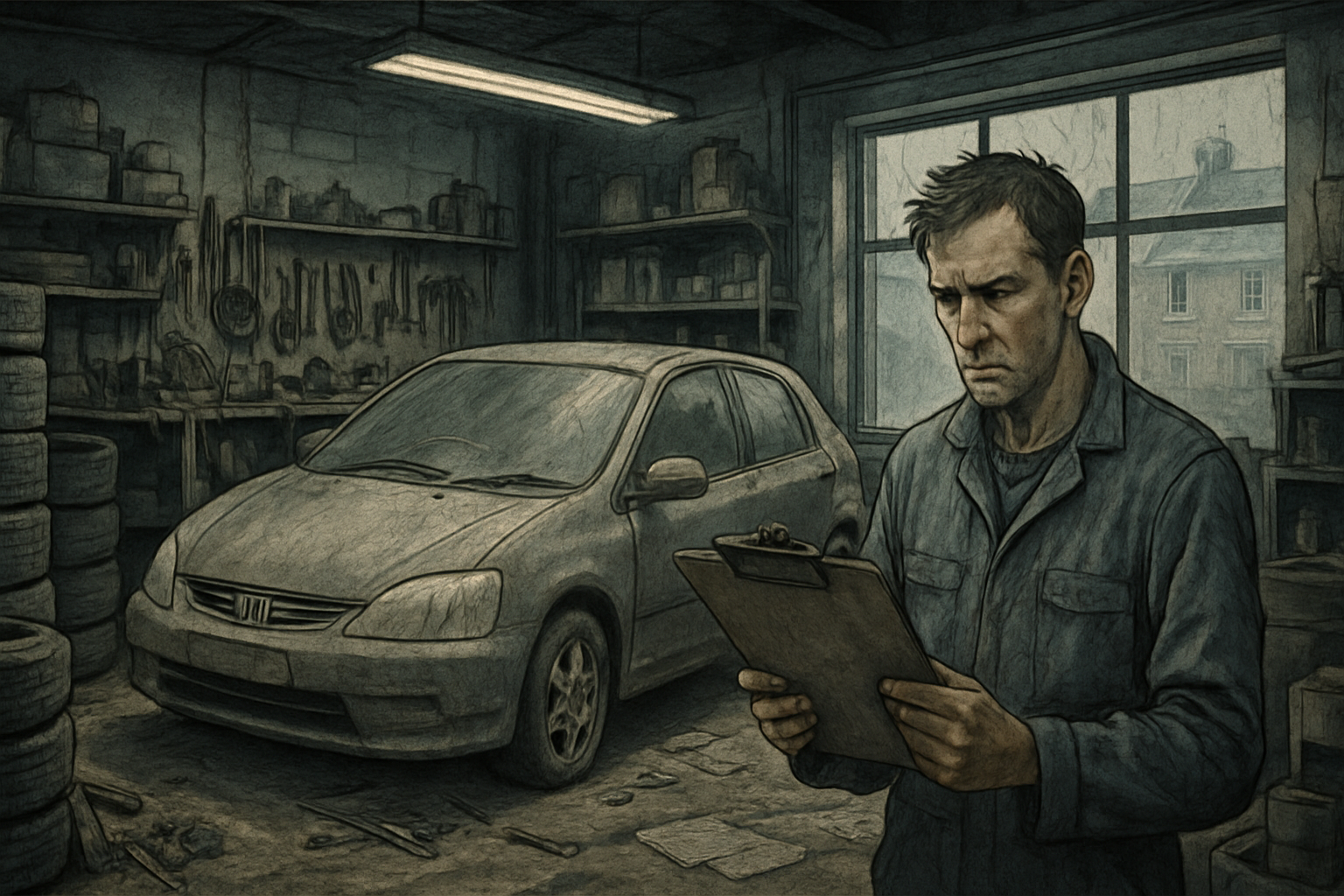
Dave runs a one-man garage in Manchester. Sixteen years on the tools, good name locally, 4.8 on Google. Three months ago he replaced a timing belt on a 2016 Ford Focus. Job went fine. The customer paid cash, drove off happy.
On Monday morning Dave opened his post. Between the junk mail and a parts invoice, a stamped envelope from Stockport County Court. Inside: a Form N1 Claim Form. The customer was suing him for £1,200. The belt had failed at 8,400 miles, the car had been recovered, the customer had paid a main dealer for a new belt and was now claiming the full cost back under the Consumer Rights Act 2015.
Dave had 14 days to respond.
He read the claim. Then he opened his filing cabinet looking for his copy of the original invoice. The invoice had the job description, the parts, the labour hours, the total, the VAT number, and his mobile number. It did not have:
- A written quote the customer had agreed to before work started
- A stated labour warranty period
- Any reference to parts warranty or manufacturer terms
- A record of who supplied the timing belt (customer or garage)
- A line pointing the customer to Trading Standards or the Motor Ombudsman for disputes
Dave rang his accountant. The accountant said: "You need a solicitor, not me." He rang a solicitor he knew from the pub. The solicitor read the claim, read the invoice, and said: "Dave, your invoice is the problem. You did the job right. But the piece of paper you gave her doesn't prove anything the judge needs to see. You can win this, but it's going to cost you a day in court and probably £400 in solicitor time. And if you lose, you get a CCJ on your credit file for six years."
What follows is the five things Dave's invoice should have carried. They aren't optional extras. They're what the law assumes is on every service invoice in the UK — and what most small garages miss.
The law, not folklore
British mechanics love to say "three months warranty, that's the law." It isn't. The UK has no equivalent of Spain's RD 1457/1986 that mandates a specific warranty period for workshop services. What it has is the Consumer Rights Act 2015 — and that's arguably worse for a sloppy garage, because the Act is written from the customer's point of view, and everything falls into her lap unless the garage can evidence otherwise.
The four sections that matter for a repair job:
- Section 49 — "Service to be performed with reasonable care and skill." This is the core obligation. The customer doesn't need to prove negligence. She needs to show the service wasn't performed with reasonable care and skill. The burden of rebuttal is on you.
- Section 51 — "Reasonable price to be paid for a service." If the price wasn't agreed in writing before work, a reasonable price is charged. "Reasonable" means what the court thinks is reasonable. Without a written quote, you're arguing from behind.
- Section 52 — "Service to be performed within a reasonable time." Same principle. Without a written timeline, the court decides what reasonable looks like.
- Section 55 — "Right to repeat performance." If the service breached s.49, the customer can demand the work be done again at your cost. If that's not possible (car's at the main dealer now, engine's been rebuilt), she moves to Section 56 — price reduction. Up to and including a full refund.
This is the framework Dave's customer was using. She wasn't claiming Dave was incompetent. She was claiming that a belt failing at 8,400 miles was prima facie evidence the service wasn't performed with reasonable care and skill, and she wanted her money back plus her main-dealer bill. Legally coherent. Dave was on the defensive from the opening line.
What the court process actually looks like
For a claim under £10,000, it goes on the small claims track. Fee schedule, direct from the HMCTS table:
- Up to £300 → £35
- £300.01–£500 → £50
- £500.01–£1,000 → £70
- £1,000.01–£1,500 → £80
- £1,500.01–£3,000 → £115
- £3,000.01–£5,000 → £205
- £5,000.01–£10,000 → £455
For £70 your customer can have the court demand that you justify your work. If you don't respond within 14 days, default judgment — the court rules in her favour without a hearing. She gets her claim plus interest (8% per annum on unpaid judgments under the Judgments Act 1838) plus a County Court Judgment (CCJ) entered against you.
A CCJ is the one that bites. It sits on your credit register for six years unless you pay in full within 30 days. During those six years:
- Your business bank account can be restructured or closed
- Equipment finance gets harder (Snap-on, Vehicle Lifts)
- Your commercial lease renewal gets flagged
- If you need a second garage unit or a van loan — answer is often "computer says no"
All for a £1,200 claim you could have won on the evidence. Most small UK garages who lose these cases lose because of missing paperwork, not bad workmanship.
Five things your invoice should already carry
1. A written quote, agreed before work starts
This is the s.51 shield. If the customer agreed £420 for the belt job in writing before you started, she can't credibly argue you charged unreasonably. If she didn't — you're arguing what "reasonable" looks like with no anchor.
A written quote doesn't have to be on paper. A WhatsApp message with the itemised price counts. A quote sent through software that she accepts by clicking a link counts. What doesn't count: "we talked about it on the phone" or "I told her roughly what it would cost when she dropped the car off."
The Motor Ombudsman's code of practice — voluntary but used as a benchmark by small claims judges — explicitly requires written quotes for any job over £75. That's not a legal requirement, but a judge will lean on it.
2. Labour warranty period, in writing, on the invoice
Most UK garages offer "3 months or 3,000 miles" informally. The courts treat anything written on the invoice as binding. The problem is when nothing is written: the customer argues for "reasonable" warranty under s.55, and in 2026 a reasonable workshop warranty for a labour-intensive job like a timing belt is increasingly being argued at 6 months in small claims.
If your invoice says "Our labour and workmanship is warranted for 3 months or 3,000 miles, whichever comes first" — that's what the judge reads. If it says nothing, the judge decides.
3. Parts warranty pointer
New parts fitted carry the manufacturer's warranty, not yours. A Dayco timing belt is warranted by Dayco for 2 years. A Bosch alternator is warranted by Bosch. Your invoice should state this explicitly, so when a part fails the customer knows to claim through the manufacturer, not demand a full refund from you.
Sample language: "New parts fitted carry the manufacturer's standard warranty, typically 12 months. Defective parts will be replaced under warranty subject to the manufacturer's terms. No labour charges will be passed on for warranty claims within the first 3 months."
4. Customer-supplied parts disclaimer
This is the biggest leak for every UK garage we've spoken to. Customer brings their own pads from eBay, mechanic fits them, pads squeal at 500 miles. Customer claims the fit was poor. Without an explicit disclaimer, you're defending the fit and the part.
The Consumer Rights Act doesn't force the issue, but standard practice borrowed from the Motor Ombudsman code is: the invoice should mark customer-supplied parts distinctly and carry a disclaimer like "Customer-supplied parts are excluded from our warranty. Our labour warranty still applies." When you have that on paper, a small claims judge treats your labour and the part as two separate questions.
5. Dispute authority pointer at the footer
One line at the bottom of every invoice: "Disputes: Trading Standards (gov.uk/find-local-trading-standards) or The Motor Ombudsman (themotorombudsman.org)."
It sounds like a formality. It isn't. It does two things. One, it signals to the customer that you know about consumer rights and don't treat complaints as nuisance — which reduces the probability of escalation to a court claim. Two, if the customer does escalate to small claims, it shows the judge that your business pointed her at the legitimate dispute channels. Judges notice.
Trading Standards — the other route that matters
Small claims court is the customer's tool. Trading Standards is the state's. Under Schedule 5 of the Consumer Rights Act 2015, Trading Standards officers have full investigatory powers: entry to your premises, inspection of invoices and records, ability to seize documentation, ability to issue enforcement orders.
They don't walk into every garage. They respond to patterns of complaints. Three customer complaints about the same garage in 12 months is usually the trigger. If your invoices are clean and you respond professionally to the first complaint, the pattern doesn't form. If your invoices are sparse and you stonewall the first complaint, by the third you're on a Trading Standards database.
From there the path runs:
- Notice of investigation (30-day response window)
- Voluntary compliance request
- If refused: prosecution under the Consumer Protection from Unfair Trading Regulations 2008 — unlimited fine on conviction, criminal record
- Parallel civil enforcement by the Competition and Markets Authority if the Trading Standards investigation reveals systemic breaches
Nothing about this applies to one-man garages running honestly. But "running honestly" includes having invoices that document what you did and what the customer agreed to. The honest mechanic with bad paperwork is the one who ends up on a database.
Why Mekavo exists
Mekavo is workshop management software built for independent UK garages. We built the five shields above into the invoice template, not as add-ons — because no small garage should lose a small claims case for want of a sentence.
Every Mekavo invoice carries automatically:
- The labour warranty clause, exact wording that holds up in court
- The parts warranty pointer (manufacturer-owned)
- A customer-supplied parts disclaimer when you tick a box on any line
- A Trading Standards / Motor Ombudsman footer in the correct format
- A linked public quote URL so the customer's acceptance is timestamped before work starts
The reception document — with customer signature — records the scope of work and the quote the customer accepted. That's the piece of paper Dave didn't have. It's the piece of paper that ends small claims cases in 20 minutes at the directions hearing.
If you run a garage in the UK, try Mekavo free. No card. No import required. You'll have invoices that survive a court claim before your next job pulls onto the ramp. It's worth far more than a day you spend in Stockport County Court learning this the hard way.
Frequently asked
I've been trading 20 years and never had a court claim. Is this over the top?
Probably not in your case. But the UK small claims system handles around 1.8 million money claims a year. A lot of them are auto-generated by debt-collection agencies, but service-dispute claims against trades have been climbing steadily since 2019. The fee is low, money claim online takes 15 minutes, and the customer doesn't need a solicitor. More customers are using it.
I do quick jobs — oil changes, bulb changes — surely I don't need a quote for those?
For low-value work, an itemised invoice with the price agreed in person is fine, provided the price is on the paperwork the customer leaves with. What doesn't work is a blank ticket with "service" written on it and a total. That's the format that loses claims.
The customer refused to sign a reception document. What do I do?
Document the refusal. Mekavo's reception flow lets you mark "customer declined to sign" with a timestamp. A judge will treat that as evidence you offered — the equivalent under s.50 of providing binding information about the service. It protects you more than an unsigned document lying around.
Are Motor Ombudsman members required to follow all this?
Motor Ombudsman membership is voluntary but the code is enforceable on members. Non-members aren't bound by the code, but small claims judges use it as a benchmark for "industry standard" reasonableness under s.49. Practically: it's the floor whether you've signed up or not.
If I get served, can I just pay and move on?
You can. Pay within 30 days of judgment and the CCJ is removed from your credit register. After 30 days it stays for six years. The six-year mark is why responding properly within the 14-day window matters — even if you're going to lose, you want to negotiate down or pay promptly, not let it become a default judgment you didn't respond to.
Sources and references
- UK Legislation — Consumer Rights Act 2015 (full text)
- CRA 2015 — Part 1 Chapter 4 (Services)
- The Consumer Protection from Unfair Trading Regulations 2008
- HMCTS — civil court fee schedule (money claims)
- gov.uk — County Court Judgments (CCJ) impact
- gov.uk — find your local Trading Standards office
- The Motor Ombudsman — code of practice for motor trade
- Citizens Advice — small claims court guide
- Competition and Markets Authority (CMA) — consumer enforcement
Published April 2026. Consumer Rights Act 2015 and HMCTS fee table current at date of publication. If you have been served with a claim form, get professional legal advice before responding — the window is 14 days and clock starts on the date of service, not the date you opened the letter.
Note on scenarios: The shops, names, addresses, and case reference numbers in this article are fictional and used solely to illustrate how the cited statutes operate in practice. Any resemblance to actual shops, owners, or events is coincidental. The statutes, regulations, and agency procedures cited are real and current as of publication.