English
 AR
AR
The 48°C Wake-Up Call That's Coming
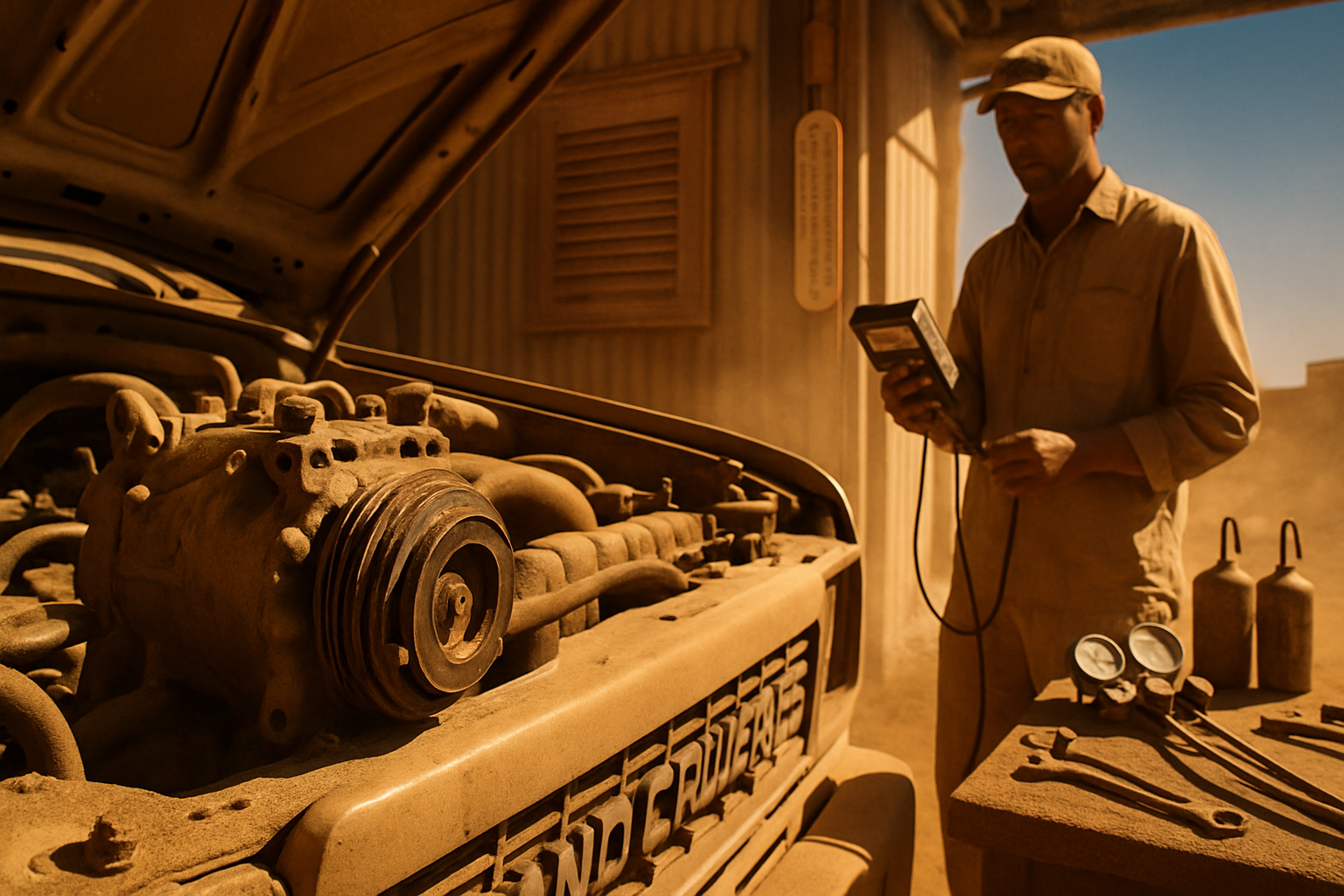
Ahmed runs a busy workshop in Ruwi, and every March he tells himself the same thing: "This year I'll get the A/C diagnostics right before the heat hits." But when that first Land Cruiser rolled in last April with weak cooling, he did what most Omani workshop owners do — topped off the refrigerant, charged the customer 250 OMR, and hoped for the best.
Three weeks later, the same customer was back. Angry. The A/C had failed completely, and now Ahmed was looking at a compressor replacement worth 2,800 OMR in parts alone. The customer went to his brother-in-law's workshop instead. Ahmed lost not just that job, but every future service from a fleet owner with twelve vehicles.
"I see this story play out in workshops from Sohar to Salalah," says Khalil Al-Rashdi, who's been diagnosing A/C systems in Muscat for fifteen years. "Everyone's rushing to fix things cheap and fast, but they're missing the real problems that cost serious money to fix properly."
The 200 OMR Fix vs. The 3,000 OMR Reality
Here's what separates profitable workshops from the ones constantly dealing with comebacks: understanding the difference between a refrigerant leak and compressor failure before you start throwing parts at the problem.
Low Refrigerant: The Quick Win
When Saeed brought his 2019 Hilux to my friend Omar's workshop in Nizwa, the symptoms seemed obvious — weak cooling, occasional warm air from the vents. Most shops would have immediately reached for the refrigerant canister.
But Omar did something different. He connected proper manifold gauges first.
"Low side was reading 15 PSI, high side was 180 PSI. System was definitely low, but I needed to know why before I added anything."
A UV dye test revealed a small leak at the evaporator core connection — a seal replacement that took two hours and cost the customer 320 OMR total. The truck's been running cold for eight months now.
Compressor Failure: The Big Payday
Contrast that with Mahmood's experience at a workshop in Sohar. His 2017 Patrol came in with the same symptoms, but the pressure readings told a different story: low side at 45 PSI, high side barely reaching 150 PSI. The compressor wasn't building pressure.
"You could hear it in the compressor clutch engagement," Mahmood's mechanic explained. "Weak, inconsistent. The internal seals were shot." Total repair: new compressor, receiver dryer, expansion valve, full system flush, and fresh refrigerant. Final bill: 2,650 OMR.
The difference? One workshop made 150 OMR profit on a refrigerant recharge that would fail in weeks. The other made 1,200 OMR profit on a complete repair that will last years.
Why Omani Climate Kills Compressors (And How to Predict It)
Working in Oman's climate isn't like servicing A/C systems in Europe or even Dubai. The combination of extreme heat and coastal humidity creates specific failure patterns that most workshops don't account for.
The Muscat Humidity Problem
"Everyone talks about the 48-degree heat, but it's the humidity that kills compressors," explains Rashid, who runs a specialty A/C shop near Muscat International Airport. "When you've got 80% humidity at 42 degrees, the system never gets a break."
Here's what happens: the compressor works overtime trying to remove moisture from the air. The internal seals, designed for dry heat, start failing after just two seasons instead of the usual five or six years. But the failure isn't sudden — it's gradual.
| Early Signs (Months 1-3) | What You'll Find | Advanced Signs (Months 4-6) | What It Means |
|---|---|---|---|
| Slightly warm air at idle | Compressor struggling under load | No cooling at idle, weak when driving | Internal seals completely failed |
| System holds pressure overnight | Seals still functional when cool | Loses pressure within hours | Internal bypass, compressor replacement needed |
| Normal pressure readings when cool | Problem only shows under heat stress | Low pressure readings even when cool | Compressor mechanically damaged |
The Salalah Exception
Workshops in Salalah face a different challenge during khareef season. "July through September, we get customers complaining their A/C isn't working, but it's actually working perfectly," laughs Nasser, whose shop services the tourist traffic. "Outside temperature drops to 22 degrees with 95% humidity — the A/C can't get any colder than the ambient air."
But this creates a diagnostic trap. Customers assume something's wrong, workshops start replacing parts unnecessarily, and by October when the heat returns, the hastily modified system fails catastrophically.
The Proper Diagnostic Sequence (That Most Shops Skip)
Walk into most workshops during the March rush, and you'll see the same scene: mechanics connecting refrigerant canisters without any testing. It's backwards, and it's costing everyone money.
Step 1: Visual Inspection Before Anything Else
"I spent ten minutes looking at Hassan's Pajero before I even started the engine," says Ali, whose workshop in Sur specializes in fleet A/C work. "Belt was shiny, compressor clutch had metal shavings around it, and there was oil residue on the low-side service port."
Those three signs immediately told Ali this wasn't a simple refrigerant issue. A proper visual inspection should check:
- Belt condition and tension — slipping belts cause intermittent compressor operation
- Compressor clutch for wear or damage — metal shavings indicate internal failure
- All connections for oil residue — refrigerant leaks carry compressor oil with them
- Condenser for debris or damage — blocked airflow causes high-pressure failures
- Cabin air filter condition — blocked filters overwork the evaporator
Step 2: Pressure Testing Under Real Conditions
This is where most workshops go wrong. They test pressure with the engine cool, in the morning, before the real heat hits.
"I learned this from dealing with PDO fleet vehicles," says Mohammed, whose Muscat workshop services oil company trucks. "Test at 10 AM when it's comfortable, everything looks fine. Test at 2 PM when it's 46 degrees, and you see the real problems."
Proper pressure testing sequence:
- Static pressure test — engine off, system equalized (should match ambient temperature chart)
- Initial running pressure — engine at 1,500 RPM, A/C on max, doors closed
- Heat soak test — let the vehicle sit in sun for 30 minutes, then retest
- Load test — A/C on max with engine at idle for 10 minutes
"If the pressure readings change significantly between these tests, you're looking at a failing compressor, not a refrigerant issue," Mohammed explains.
Step 3: Temperature Differential Testing
Here's a test most Omani workshops skip entirely: measuring actual temperature output under controlled conditions.
"Customer says it's not cold enough — but cold enough compared to what?" asks Tariq, who runs diagnostics training for workshops in Sohar. "In 48-degree heat with 60% humidity, getting 15-degree air from the vents is actually excellent performance."
Use a digital thermometer to test:
- Ambient air temperature
- Vent temperature at idle
- Vent temperature at 2,000 RPM
- Temperature difference between intake and output
A healthy system should deliver 18-22 degree temperature differential regardless of outside conditions. Less than 15 degrees indicates a problem that refrigerant won't fix.
Why "Recharge and Hope" Is Killing Your Profit
Every workshop owner knows the temptation. Customer comes in complaining about weak A/C, you're busy, it's hot, and adding refrigerant takes ten minutes versus two hours of proper diagnosis.
"I used to do twenty refrigerant top-offs every day in April," admits Yusuf, whose Ruwi workshop switched to proper diagnostics two years ago. "Made maybe 100 OMR profit each. Half of them came back within a month, angry customers, warranty work, lost reputation."
The Real Cost of Guess-and-Check Repairs
Let's break down what "recharge and hope" actually costs:
- Immediate revenue: 250 OMR per recharge
- Profit margin: 60 OMR (after refrigerant and labor costs)
- Comeback rate: 60% within 30 days
- Warranty work cost: 180 OMR per comeback (labor + materials)
- Customer retention: 30% (70% never return after failed repair)
"I was actually losing money on every A/C job," Yusuf realized. "Sure, I made 60 OMR profit upfront, but when they came back angry and I had to redo the work for free, plus lose them as a customer forever... the math doesn't work."
The Diagnostic-First Approach
Now Yusuf charges 120 OMR for A/C diagnosis, which includes:
- Complete visual inspection (30 minutes)
- Pressure testing under load (45 minutes)
- Written report with findings and photos
- Repair estimate with warranty terms
"Customers complained about the diagnosis fee at first, but when I show them exactly what's wrong and explain why it failed, they understand. And when I fix it right the first time, they bring their friends."
Yusuf's numbers after switching to proper diagnosis:
- Average A/C job value: 850 OMR
- Comeback rate: 8%
- Customer retention: 85%
- Referrals per satisfied customer: 2.3
Pricing Your A/C Diagnostic So Customers Don't Shop Around
Here's the tricky part: charge too little for diagnosis, and customers assume you're not thorough. Charge too much, and they'll drive to three other workshops looking for someone to "just add gas" for cheaper.
The Sweet Spot: 75-150 OMR
"I spent two years finding the right price point," says Omar, whose Nizwa workshop now handles A/C work for several local fleets. "At 50 OMR, customers thought I was cutting corners. At 200 OMR, they'd drive to Muscat instead. At 120 OMR, they see value but don't shop around."
The key is positioning the diagnostic fee correctly:
- "A/C check - 50 OMR" sounds cheap and unreliable
- "Professional A/C system diagnosis - 120 OMR" sounds thorough and worth the price
- "Complete A/C diagnostic with written report - 120 OMR" emphasizes the value you're providing
Making the Diagnostic Fee Profitable Even When They Don't Repair
Smart workshop owners structure their A/C pricing so they make money whether the customer proceeds with repairs or not.
"About 30% of customers just want to know what's wrong before they decide to trade in the vehicle or get a second opinion," explains Khalil. "That's fine — I made 120 OMR for 90 minutes of work, and they got honest information. Sometimes they come back six months later when they're ready to fix it."
The diagnostic should cover your costs plus reasonable profit. In Oman, that typically means:
- Technician time: 40 OMR (90 minutes at current labor rates)
- Equipment wear and refrigerant for testing: 15 OMR
- Paperwork and reporting time: 20 OMR
- Profit margin: 45 OMR
Documentation That Saves You From Warranty Disputes
Nothing kills workshop reputation faster than an A/C repair that fails two weeks later, followed by a customer claiming you never told them about potential issues.
The Photo Documentation System
"Every A/C diagnosis gets photos now — no exceptions," says Ahmed (the same Ahmed from our opening story, who learned from his expensive mistakes). "Pressure gauge readings, visible leaks, compressor condition, cabin air filter. Takes two extra minutes but saves hours of argument later."
Essential documentation for every A/C job:
- Before photos: pressure readings, visible damage, contaminated filters
- During photos: parts removed, internal condition, unexpected findings
- After photos: new parts installed, final pressure readings, system operation
- Written notes: customer complaints, test results, warranty terms explained
The Warranty Conversation
"I used to avoid talking about warranties because I didn't want customers thinking my work would fail," admits Mahmood, whose Sohar workshop now leads with warranty terms upfront. "But customers actually trust you more when you explain exactly what you're covering and why."
Effective A/C warranty communication:
"Your compressor repair comes with a 12-month warranty on parts and labor. However, if you don't change your cabin air filter every 6 months as recommended, or if you ignore other system leaks we've identified, those issues aren't covered. Here's why..."
This approach does two things: it protects you from unreasonable warranty claims, and it positions you as the expert who understands how A/C systems really work.
Capturing the Big Jobs Your Competitors Miss
The workshops making serious money from A/C work aren't the ones doing quick refrigerant top-offs. They're the ones customers trust with complete system rebuilds, fleet maintenance contracts, and high-end vehicle servicing.
Building Reputation for Complex Work
"When someone's looking at a 2,800 OMR compressor replacement, they're not shopping for the cheapest option," observes Rashid. "They want to know it'll be done right, with quality parts, and won't need to be redone in six months."
This is where proper diagnosis pays off exponentially. When you can explain exactly why the compressor failed, what caused the failure, and how your repair prevents it from happening again, customers will pay premium prices.
"I had a customer last month with a 2020 Land Cruiser — still under extended warranty," Rashid continues. "Dealer wanted to replace just the compressor for 1,800 OMR. I showed him why the receiver dryer and expansion valve also needed replacement to prevent premature failure of the new compressor. Total job was 3,200 OMR, but he chose my workshop because I explained the complete solution."
The Fleet Opportunity
Proper A/C diagnosis opens doors to fleet work that amateur shops can't handle. PDO, Sohar Port logistics companies, and Salalah tourism operators all need workshops that can reliably diagnose and repair A/C systems without the trial-and-error approach.
"Fleet managers don't care about saving 100 OMR per repair," explains Mohammed. "They care about minimal downtime and predictable maintenance schedules. When you can tell them exactly what needs to be fixed and when, they'll pay whatever it takes to keep their vehicles running."
The 40% Comeback Reduction Promise
Every workshop owner I spoke with who switched from "recharge and hope" to proper A/C diagnosis reported the same thing: dramatic reduction in comeback complaints and massive improvement in customer satisfaction.
"Last summer, I had maybe three A/C comebacks out of forty jobs," says Omar. "Used to be fifteen or twenty comebacks from the same number of jobs. The difference isn't just better for customers — it's better for my sanity."
The key metrics that improve with proper diagnosis:
- First-time fix rate: 78% to 94%
- Average job value: 280 OMR to 920 OMR
- Customer satisfaction scores: 6.2/10 to 8.7/10
- Referral rate: 12% to 31%
- Profit per A/C customer: 45 OMR to 340 OMR
"The best part is sleeping better during summer months," laughs Yusuf. "I used to dread May through August because I knew my phone would be ringing with angry customers. Now most of my summer A/C calls are new customers asking for appointments."
As Oman's 2024 summer approaches and temperatures start climbing toward that inevitable 48-degree mark, the choice for workshop owners is clear: continue with the "recharge and hope" approach that generates short-term revenue but destroys long-term reputation, or invest in proper diagnostic procedures that capture the high-value repairs your customers actually need.
The workshops that choose wisely will find themselves with full appointment books, satisfied customers, and profit margins that actually justify the expertise required to work in one of the world's most demanding automotive climates.