English
 Español
 Deutsch
 FI
FI
 PT
PT
 BR
BR
 FR
FR
 AR
AR
 ZH
ZH
 UR
UR
 TL
TL
 TH
TH
 TR
TR
 PL
PL
 RO
RO
 BG
BG
 ID
ID
 MS
MS
 LT
LT
 IT
IT
 NL
NL
 CS
CS
 SK
SK
 SL
SL
 ET
ET
 SV
SV
 NB
NB
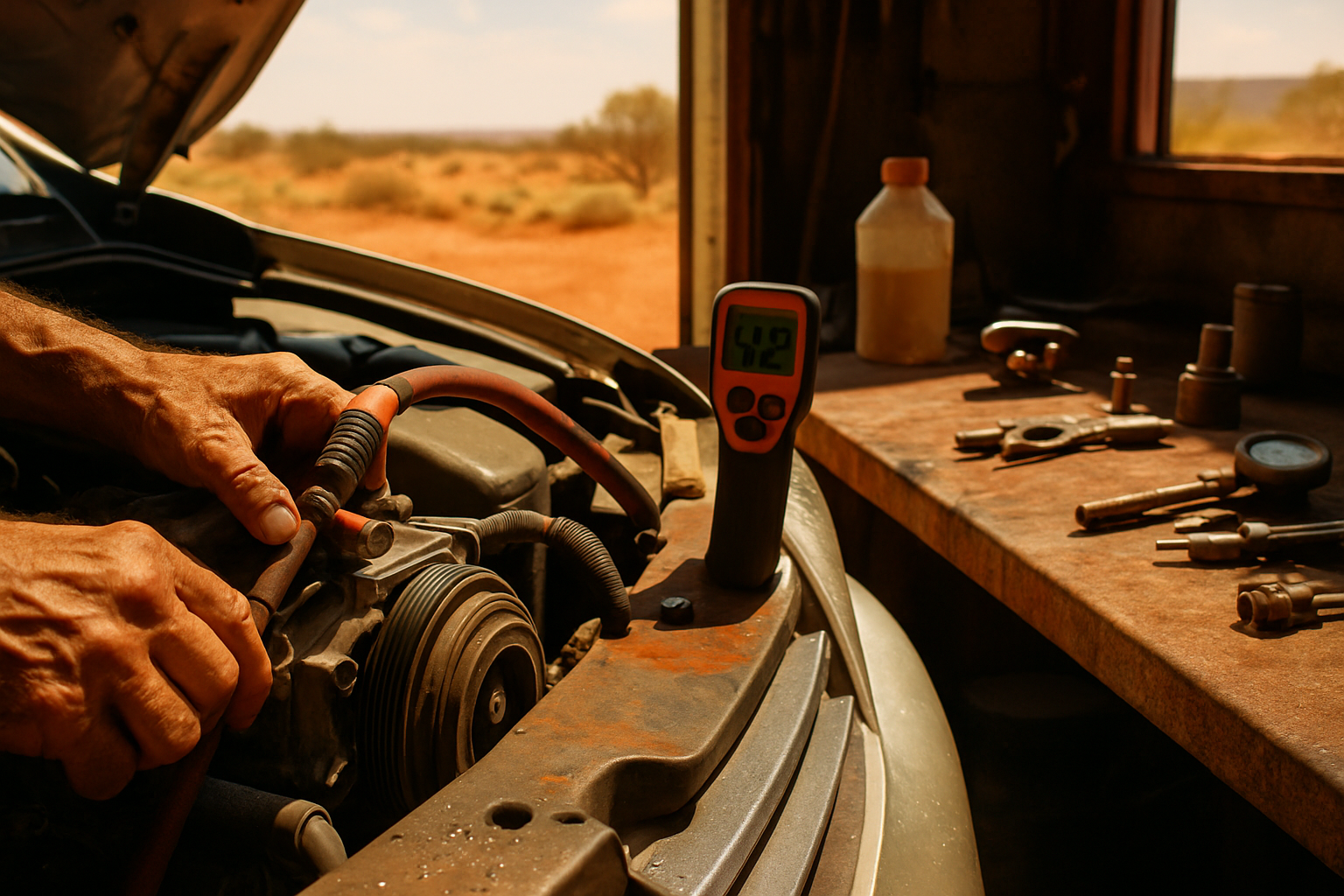
Australian summer is not the same as summer in most of the world. 45°C in Marble Bar, 50°C+ recorded in parts of the Pilbara, sustained 40°C across western NSW and northern Victoria. Cars built for global markets get tested at their thermal limits here. Things fail.
The good news: most summer failures are predictable. AC compressors, radiators, batteries (especially in the heat — yes, batteries die more in heat than cold), tyre pressures, coolant. They fail in the same ways every January and February.
Spend an hour and a few hundred dollars in October-November and you drive through the heatwave without incident. Skip it, and you join the 3:00 PM roadside-assistance queue with a steaming radiator on the Hume Highway.
1. Air Conditioning Service and Recharge
The single most-used system in an Aussie summer. Cars built since 2017 use R1234yf refrigerant (more environmentally friendly, more expensive). Older cars use R134a. Both deplete over time — typically 10-15% per year through normal seal permeation.
- Symptoms of weak AC: blows cool but not cold; takes too long to cool the cabin; warmer on highway than at city speeds
- Cost of recharge: $90-$160 R134a; $200-$400 R1234yf (newer cars)
- If recharging is needed every year: there is a leak. UV dye test ($60-$120) finds it. Common leak points: condenser (front of car, takes stone hits), compressor seal, evaporator (in dash, expensive to access).
- The "blower works but no cold" scenario: usually a failed compressor clutch ($600-$1,400) or failed compressor itself ($1,200-$2,500 fitted). Catch it early — running an AC system that is low on refrigerant kills the compressor.
2. Cooling System — Coolant, Radiator, Hoses
Engine cooling failures are catastrophic in Aussie heat. A coolant leak that develops slowly in winter becomes an engine-killing event in February.
- Coolant level: check between MIN and MAX cold. If it has dropped between checks, there is a leak — usually visible as crusty white or coloured deposits on engine, hoses, or under the car.
- Coolant condition: should be clear pink, green, blue, or orange depending on the type your car uses. Brown, rusty, or jelly-like = degraded; flush and replace.
- Coolant freeze/boil rating: most modern coolants are rated to boil at 130°C+ under cap pressure. If the coolant is old, the rating drops — meaning your engine boils sooner.
- Replacement schedule: typically every 4-5 years or per manufacturer schedule, whichever comes first. Your owner's manual specifies the exact type — using the wrong coolant causes corrosion and seal damage.
- Radiator inspection: any visible bent fins from stone strikes, sediment buildup, or external corrosion = reduced cooling capacity. A radiator flush and inspection ($120-$200) is cheap insurance.
- Hose condition: squeeze each rubber hose with the engine cold. Should feel firm but pliable. Rock-hard or balloon-soft = ready to fail. Burst hose at 38°C = engine-block-cracking territory.
3. Battery — Killed by Heat, Not Cold
Counter-intuitive but true: heat kills car batteries faster than cold does. Cold reduces cranking power but rarely kills outright; sustained 40°C+ ambient temperatures evaporate electrolyte, accelerate corrosion, and shorten battery life from a typical 4-5 years to often just 3 in northern Australia.
- Battery age: stamped on the case, usually as a date code. Anything 4+ years old in Brisbane / Darwin / Perth deserves a load test.
- Free load test: most major auto parts retailers (Supercheap Auto, Repco, BCF) will load-test your battery free. Drive in, 5-minute test, get the printout.
- Replacement: $180-$350 for a quality battery installed. Better than $200+ for emergency callout PLUS $300+ for emergency replacement at premium prices.
- Terminals: clean any white/green corrosion off the terminals (use baking soda and water, then grease them lightly with petroleum jelly). Corroded terminals cause hard starts.
4. Tyres — Pressure, Tread, Age
Tyre failures spike in Aussie summer. Hot tarmac + underinflated tyres + sustained highway speeds = blowout. Western Sydney, the Hume, the Pacific Highway, the Princes — every year, tyre debris all over the road from summer blowouts.
- Pressure: check at LEAST monthly during summer, more often before long trips. Pressure rises with heat — the cold-pressure recommendation on the door sticker accounts for this. Do not lower pressure because it has risen during driving — that is normal.
- Underinflation is the killer: a tyre 20% under-pressure runs much hotter, flexes more, and can blow out at sustained 100+ km/h on hot tarmac.
- Tread depth: legal minimum 1.5mm. For summer driving, aim for 4mm+ on all four. Wet weather grip drops dramatically as tread depth drops — and Aussie summer storms produce sudden heavy rain on hot dry roads (the worst combination for hydroplaning).
- Tyre age: DOT date code on sidewall (e.g. "2622" = 26th week of 2022). Tyres over 6 years old harden and become unsafe even with tread remaining. Spare wheels often suffer this — they sit unused, age out, then fail when you most need them.
- Sidewall inspection: walk around each tyre. Cracks, bulges, deep scuffs from kerb strikes = potential failure. A sidewall bulge fails roadworthy inspection and is a blowout waiting to happen.
5. Wipers, Washer Fluid, Sun Damage
- Wipers: summer UV destroys rubber faster than winter use. Wipers that worked fine in July may streak and tear by November. Replace if they show any cracking, splitting, or audible juddering. $25-$45 a pair, 5 minutes to fit.
- Washer fluid: bug splatter season. Use a summer-grade fluid with bug-cutting additives. Top up monthly.
- Headlight oxidation: Aussie sun yellows headlight covers, cutting light output 30-50%. A $20 restoration kit + 30 minutes restores them. Worth doing annually in northern Australia.
- Interior sun damage: sunshade in the windscreen when parked. UV cracks dashboards, fades upholstery, kills electronics. A $20 sunshade adds years to the cabin's life.
6. Oil — Heat-Stable Viscosity
- Use the right oil for hot climates: many manufacturers specify a slightly heavier viscosity for sustained high-temperature operation (5W-30 instead of 0W-20 in some cases). Check your owner's manual for the hot-climate or "sustained high temperature" specification.
- Synthetic oil: outperforms conventional in heat. Maintains viscosity at 100°C+ engine-bay temperatures where conventional oil thins out.
- Time it before peak summer: a fresh oil change in October-November means you go through the hottest months on clean lubricant.
7. Outback / Long-Distance Summer Driving Kit
If you drive any significant distance from major cities in summer (the Big Lap, the Stuart Highway, anywhere west of the Great Dividing Range in the heat), an emergency kit is mandatory, not optional:
- Plenty of drinking water (5L per person minimum, more in remote areas)
- Sun protection (hat, sunscreen, long sleeves)
- Spare engine coolant (a litre will do for a slow leak limp-home)
- Spare engine oil (1L)
- Tyre repair kit and 12V air compressor (roadside punctures common)
- Fully charged jump-start pack OR booster cables
- Sat phone or PLB (Personal Locator Beacon) for true outback driving — mobile coverage drops fast outside major roads
- Map and offline directions (Google Maps fails when there is no signal)
- Basic first aid kit
- UHF radio (standard truck/4WD comms in remote areas)
The Honest Cost
Done at home with basic tools: $200-$300 for the consumables (oil change, AC recharge if mild, washer fluid, wiper blades, coolant top-up).
Done at a garage with a "summer service": $350-$600 depending on shop and what is included.
The cost of NOT doing it: easily $500-$3,000 in a single summer breakdown — engine damage from boilover, dead AC compressor in 40°C, blowout from underinflated old tyres, dead battery on the Nullarbor.
Sources & Further Reading
- Bureau of Meteorology — Australian seasonal forecasts and extreme heat warnings
- National Heavy Vehicle Regulator — heavy vehicle summer compliance and fatigue rules
- ANCAP — vehicle safety standards and stability ratings
- ACCC — vehicle recalls including summer-relevant safety items
- Product Safety Australia — Recall Search (free, by VIN)
- Your vehicle owner's manual — definitive source for hot-climate oil viscosity, AC refrigerant type, coolant specification
- Supercheap Auto / Repco / BCF — battery testing service (free in-store)
- Bureau of Meteorology — heat outlook for trip planning across Aussie summer
Related Mekavo articles: Real annual cost of running a car in Australia — where summer prep fits in the bigger ownership budget.
Why We Care
My Mekavo is free for Australian car owners. Log when you did each summer prep item — battery test, AC recharge, coolant flush, oil change. Mekavo reminds you next October before the heat hits. No more "did I check the battery this year?" guesswork. The data your car has been trying to tell you, in one place.
Note on scenarios: The shops, names, addresses, and case reference numbers in this article are fictional and used solely to illustrate how the cited statutes operate in practice. Any resemblance to actual shops, owners, or events is coincidental. The statutes, regulations, and agency procedures cited are real and current as of publication.