English
 Español
 Deutsch
 FI
FI
 PT
PT
 BR
BR
 FR
FR
 AR
AR
 ZH
ZH
 UR
UR
 TL
TL
 TH
TH
 TR
TR
 PL
PL
 RO
RO
 BG
BG
 ID
ID
 MS
MS
 LT
LT
 IT
IT
 NL
NL
 CS
CS
 SK
SK
 SL
SL
 ET
ET
 SV
SV
 NB
NB
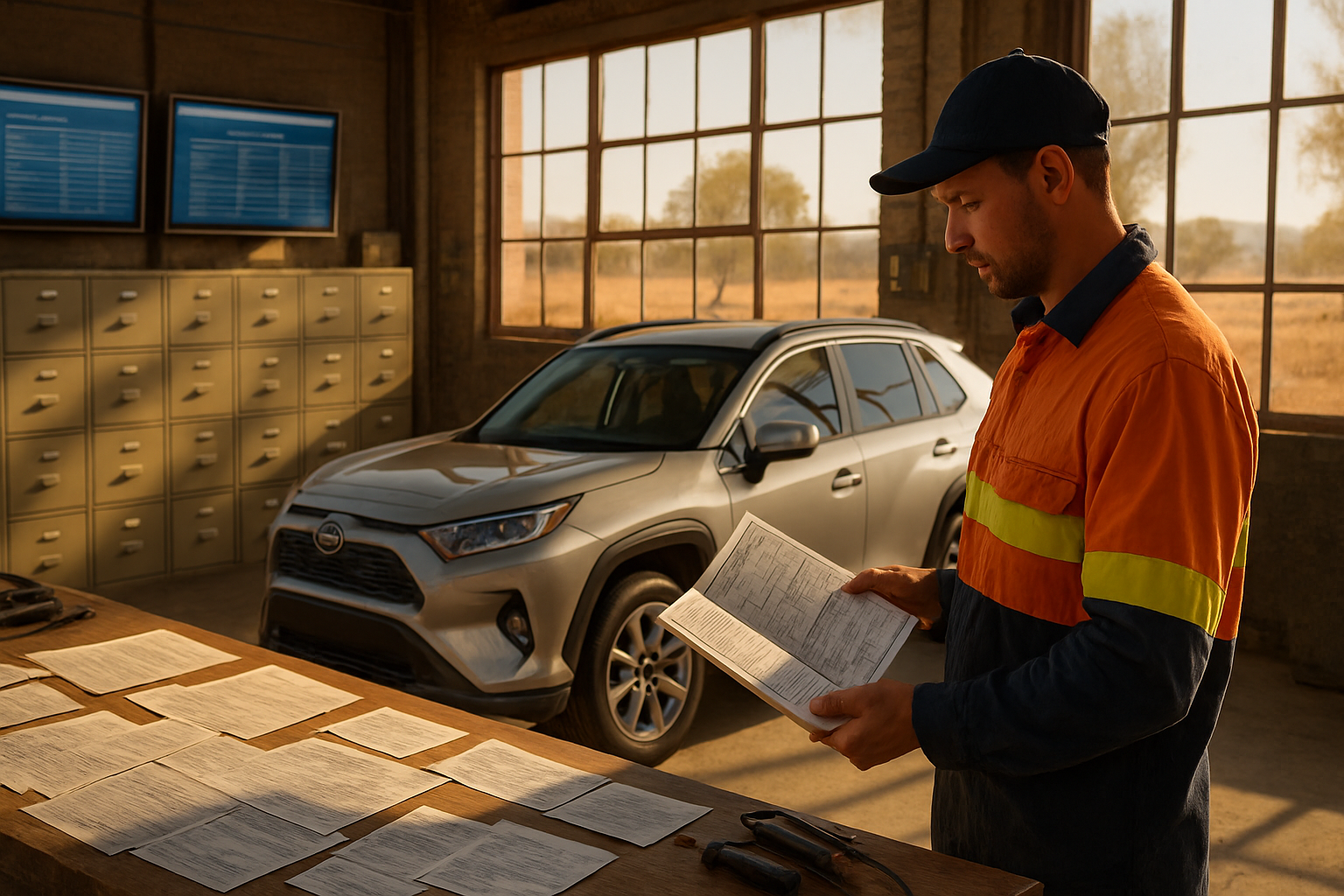
Walk through any Carsales listing or the lot at any Aussie used-car dealer. You will see hundreds of mainstream cars — RAV4, CX-5, CR-V, X-Trail, HiLux, Ranger, Camry, Corolla — at almost identical kilometres and similar trim, advertised at prices that vary by $2,000 to $6,000.
The difference is rarely the colour or the badges. It is almost always the same thing: proof of how the car has been looked after.
Australian buyers, dealers and the algorithms used by Carsales, Drive and the auction houses all weight service history heavily in valuation. Here is the honest picture of what that proof is worth, what counts as proof, and how to build it from today even if you have nothing.
The Aussie Service History Hierarchy
Used-car listings in Australia commonly use these terms:
- FSH — Full Service History. Every service stamp in the logbook, every receipt, no missed intervals. Strong premium at sale.
- FDSH — Full Dealer Service History. Every service done at a franchised brand dealer (Toyota dealer for Toyota, Ford for Ford, etc.). Highest premium.
- PSH — Partial Service History. Some services documented, others missing. Buyers expect a discount.
- NSH — No Service History. No book, no receipts. Significant discount, often $1,500-$5,000 below FSH equivalent.
The premium for FSH over NSH on a typical Aussie family car (5-8 years old, 80,000-130,000 km) is consistently $1,500-$4,000. On premium vehicles (BMW, Audi, Mercedes, Land Rover, Range Rover) the gap can reach $5,000-$10,000 — buyers in this segment fear unknown maintenance because parts and labour are eye-wateringly expensive if neglected.
Why Aussie Buyers Pay More for Documented Cars
Three reasons, every time:
- Risk reduction. A used car is a gamble. Every service receipt is evidence the previous owner cared enough to spend money keeping it right. Buyers will pay a premium to reduce the gamble — even if the car drives identically.
- Manufacturer warranty implications. Cars under 5 years often have remaining capped-price service warranty or extended warranty. These usually require continuous service history evidence to honour future claims. NSH cars are excluded from warranty transfers.
- Trade-in vs private gap closes. A dealer offering trade-in for an FSH car will pay close to RedBook trade value. For NSH, expect 15-30% below trade. Private buyers will pay more than dealers — but only if they trust the history.
FDSH vs FSH — Is the Brand-Dealer Premium Real in Australia?
Yes — for some categories. No — for others.
Where FDSH adds significant value:
- European prestige (BMW, Mercedes, Audi, Volvo) — buyers in this segment specifically look for main-dealer history
- Land Rover, Range Rover, Jaguar — known for expensive failures if neglected; FDSH is buyer reassurance
- Cars under 5 years old where remaining manufacturer warranty / capped-price servicing is a feature
- Performance variants (M Sport, AMG, S-Line, GTI) — buyers willing to pay for thorough records
Where FDSH adds little or nothing:
- Older Toyota, Mazda, Hyundai, Kia at high mileage — buyers accept independent garages
- Cars over 8-10 years where main dealer servicing would cost half what the car is worth annually
- Vehicles where the owner can show a coherent independent history (same garage for years, detailed receipts)
If you have a 2020 BMW 320i with full BMW dealer stamps, that materially helps at sale. If you have a 2014 Toyota Corolla serviced at a local garage with proper receipts, that is just as good as FDSH for your buyer pool.
What Counts as "Strong" Service History (Beyond Stamps)
A logbook full of dealer stamps is good. Better is:
- Date and kilometre reading at every service
- The garage's name, address, ABN on each invoice
- Itemised work — oil grade, filter brand, fluids changed, tyre pressures noted
- Major service intervals attended (timing belt or chain inspection at the manufacturer's recommended kilometres — typically 100,000-150,000 km)
- Brake, clutch (if manual), tyre and battery replacement receipts
- Roadworthy / pink slip / safety certificate history (state-dependent)
- PPSR clear (no outstanding finance, written-off, or stolen flags)
- Inspection certificates from each state your car has been registered in
A buyer reading that pack thinks "this person actually looked after the car". A buyer reading a logbook with one stamp and a missing 60,000 km service thinks "what else has been skipped".
The Carsales / Drive / Pickles Reality
List your car on Carsales without service history mentioned and the asking-price suggestion is lower than identical FSH listings. Drive's and Carsales's pricing tools explicitly ask whether service history is full, partial or none — and the offered price reflects it.
The dealer auction houses (Pickles, Manheim, Lloyd's) explicitly notate service history status on lot descriptions. Cars at auction with full log books sell at higher hammer prices than NSH equivalents in same condition.
This is not marketing trickery. The algorithms and the dealers are reflecting what private buyers actually pay. Documented cars sell faster (less time on Carsales = less listing fee, less hassle) and at higher prices.
If You Have No Records — How to Build Them Now
Even if your car is 8 years old and you have nothing, it is not too late. Start tonight:
- Photograph the odometer today — your starting baseline
- Phone the garage(s) you have used — they often retain records and will email or print your full service history with them, free
- Phone the dealership where you bought the car (if applicable) — same, their service department records
- Look up your state vehicle history (each state offers some level of free or low-cost online check)
- Going forward, photograph every receipt the moment you walk out of the garage — invoice, parts receipt, pink slip / RWC, courtesy car return form
- Save them in a system you trust to not lose them (cloud, local backup, both)
In 18-24 months, you have a documented service history that adds $2,000-$4,000 to your sale price.
State-Specific Inspection Records
The pink slip / blue slip / RWC / safety certificate history matters as part of overall service documentation. Each one is a third-party verification that the car was safe at that point. Strong proof.
- NSW — pink slip records held by Authorised Inspection Stations, plus annual rego renewal
- VIC — RWC issued at sale, held by issuing tester
- QLD — safety certificate at sale
- NT — annual roadworthy
Keep copies of every certificate. They are part of your complete history.
Sources & Further Reading
- ACCC — used vehicle consumer rights, dealer disclosure obligations
- PPSR — vehicle finance and security check (part of the trust pack)
- Product Safety Australia — open recall search by VIN
- ANCAP — independent crash safety ratings (relevant context for buyers)
- Service NSW — vehicle history checks (NSW)
- VicRoads — Victorian vehicle history
- TMR Queensland — Queensland vehicle history
- Carsales — listings and pricing benchmarks reflecting service history premium — carsales.com.au
- Drive — used-car listings with service-history filtering — drive.com.au
- RedBook — wholesale and trade pricing benchmarks — redbook.com.au
- Pickles — auction sales (often where ex-fleet and ex-lease cars are dispersed; service history affects hammer price) — pickles.com.au
Related Mekavo articles: Real annual cost of running a car in Australia — service costs across vehicle categories.
Why We Care
My Mekavo is free for Australian car owners. Photograph every service, every pink slip / RWC / safety certificate, every receipt — your car's full story in one place, ready to hand to the next buyer when you sell. The folder that proves you cared and adds $2,000-$4,000 to the asking price.
Note on scenarios: The shops, names, addresses, and case reference numbers in this article are fictional and used solely to illustrate how the cited statutes operate in practice. Any resemblance to actual shops, owners, or events is coincidental. The statutes, regulations, and agency procedures cited are real and current as of publication.