English
 Español
 Deutsch
 FI
FI
 PT
PT
 BR
BR
 FR
FR
 AR
AR
 ZH
ZH
 UR
UR
 TL
TL
 TH
TH
 TR
TR
 PL
PL
 RO
RO
 BG
BG
 ID
ID
 MS
MS
 LT
LT
 IT
IT
 NL
NL
 CS
CS
 SK
SK
 SL
SL
 ET
ET
 SV
SV
 NB
NB
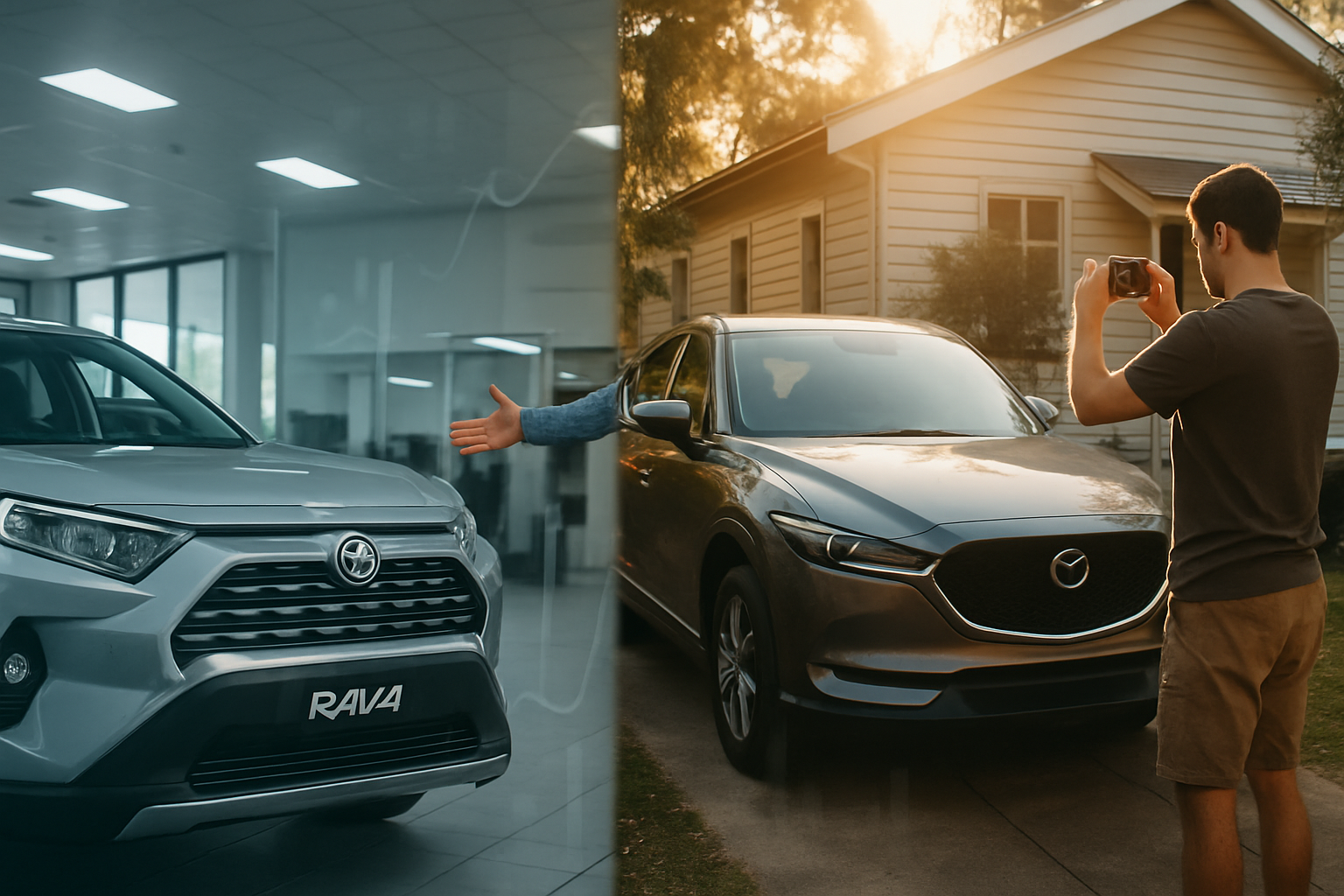
You walk into the Toyota dealer to look at a new RAV4. Sales rep asks: "Are you trading something in?" You mention your 2018 CX-5. They quote you $19,500 trade-in. The same CX-5 is selling on Carsales for $25,000 to $27,000.
The dealer wants $5,500 of margin out of you. The question is whether $5,500 of your time, hassle, and risk is worth it to manage the private sale yourself.
This is the most-debated decision in Aussie car ownership. Here is the honest math.
The Real Numbers Across Common Vehicle Categories
Indicative gap between dealer trade-in price and likely private-sale price for a 5-year-old vehicle in average condition:
| Vehicle category | Trade-in | Private sale | Gap |
|---|---|---|---|
| Small hatch (Yaris, Mazda 2) | $11,500 | $14,000 | $2,500 |
| Mid-size sedan (Camry, Mazda 6) | $18,500 | $23,000 | $4,500 |
| Mid-size SUV (CX-5, RAV4) | $22,000 | $26,500 | $4,500 |
| Mainstream ute (HiLux, Ranger) | $32,000 | $38,500 | $6,500 |
| Large SUV (LandCruiser, Patrol) | $58,000 | $68,000 | $10,000 |
| European premium (BMW 3, Audi A4) | $24,000 | $31,000 | $7,000 |
The pattern: the gap is wider for higher-value vehicles, where dealer margins are larger and private buyers are more willing to pay near asking.
The Stamp Duty Offset Aussie Owners Often Forget
This is where trade-in actually claws back some of the gap. In most Australian states, when you trade in a car against a new purchase, stamp duty on the new car is calculated on the price after deducting the trade-in value. NOT on the full purchase price.
State-by-state stamp duty rates (light passenger vehicles, indicative — check current rates):
- NSW: ~3% on purchase price (with brackets)
- VIC: ~4-5% (more for luxury cars over $80,000)
- QLD: ~3-4% (concessions for hybrids)
- WA: ~3-4% (sliding scale)
- SA: ~4%
- TAS: ~3-4%
- ACT: ~3% with green-vehicle concessions
- NT: ~3%
Worked example: NSW buyer purchasing a $50,000 new car, trading in their CX-5 valued $19,500 by the dealer.
- Without trade-in: stamp duty on $50,000 = ~$1,830
- With trade-in: stamp duty on ($50,000 − $19,500) = $30,500 = ~$915
- Stamp duty saving: ~$915
So the effective gap closes: dealer gave you $5,500 less than private, but you save $915 in stamp duty = real cost of dealer trade is $4,585.
If you sold privately for $25,000, you would have $5,500 more cash — but pay the full $1,830 stamp duty on the new car. Real benefit of private sale: $5,500 − ($1,830 − $915) = $4,585.
Different car, different math. Always run the actual numbers before deciding. Higher-value cars + states with higher stamp duty tilt toward trade-in. Lower stamp duty + higher gap tilt toward private.
The Hidden Costs of Private Sale
The "you make $5,500 more" private-sale headline ignores real costs:
- Listing fees: $35-$120 Carsales + Drive cross-list
- Pre-sale inspection / detailing: $200-$500 to make the car presentable
- Roadworthy / safety certificate / pink slip (state-dependent): $50-$170
- Time: 5-25 hours of phone calls, test drive coordination, paperwork. At your hourly rate, that is real money.
- Risk: bounced cheques (rare with bank transfers), buyer disputes after sale, unhappy buyer chasing you later
- Holding costs: while waiting for sale, you still pay rego, CTP, insurance, depreciation. 6-week sale at typical running cost = $400-$700.
Realistic total real cost of private sale: $700-$1,500 + your time.
So the gap of $4,585 net (after stamp duty) becomes more like $3,000-$3,800 real benefit. Still worth it for most sellers, but the gap is smaller than headline.
The Hidden Costs of Trade-In
- You may accept a lower trade-in price than offered elsewhere: some dealers offer high trade-in but only when buying their car at full retail. Cross-shop several dealers to find the best trade-in price independently of any new-car deal.
- Lock-in pressure: dealers may use the trade-in offer as leverage to close the new-car sale at retail. You think you got a great trade; you actually paid retail when you could have negotiated 5-8% off.
- Trade-in is only valuable if you are buying immediately. If your timeframe is "next 3-6 months", trade-in has no value to you.
The Decision Framework
Choose Trade-In If:
- You are buying a new car right now (within 30 days)
- The car is 8+ years old and would sell for under $10,000 privately (gap shrinks at the bottom)
- The car has known issues you do not want to disclose to private buyers (engine warning lights, recent accident, mechanical concerns)
- You genuinely value 30 minutes of paperwork over 8-30 hours of private sale management
- You live in a state with high stamp duty (VIC, NSW, WA) and are buying a high-priced new car (the offset is meaningful)
- You are time-poor and the $3,000-$5,000 difference is not life-changing for you
Choose Private Sale If:
- You are not in a hurry to buy a new car
- The car is in good condition, has full service history, and would photograph well
- The car is in a high-demand category (HiLux, Ranger, RAV4, popular SUVs)
- You have time to manage 4-8 weeks of inquiries and test drives
- The gap is $5,000+ — the math nearly always favours private at that scale
Consider an Instant-Buy Service If:
- You need to sell in 7 days, not 6 weeks
- The trade-in offer would be even lower than the instant-buy offer (run both)
- The vehicle is not your daily driver and is costing you holding fees
The Pre-Sale Move That Pays Best
Whatever path you choose, get TWO independent valuations before deciding:
- RedBook online: free, gives you trade and private benchmarks
- Carsales valuation tool: free, shows current market
- Two independent dealer trade quotes (call dealers of your make AND a different make — the different-make dealer has no upsell agenda)
- One Instant Offer quote (Carsales Instant Offer, sellanycar.com)
You now have 4-5 data points. The truth is usually within $1,500 of the median.
The Negotiation Tactic Most Aussie Sellers Miss
If you are doing a trade-in plus new car purchase, negotiate them SEPARATELY. Get the trade-in price first. Lock it in. THEN negotiate the new car price as if you were a cash buyer. Dealers prefer to bundle the negotiation because it lets them obscure where the margin is. Separate negotiations cost them visibility and benefit you.
Tell the dealer: "I want your best trade-in price as a number. Then separately, I want your best price on the new car ignoring the trade." If they refuse, walk to a different dealer.
Sources & Further Reading
- ACCC — used vehicle consumer rights and dealer obligations
- Australian Taxation Office — luxury car tax thresholds (relevant for cars over $80,000)
- Service NSW — stamp duty calculation NSW
- VicRoads — stamp duty Victoria
- TMR Queensland — stamp duty QLD
- Scamwatch (ACCC) — private-sale scam patterns
- Carsales — listing and valuation — carsales.com.au
- RedBook — trade vs private benchmarks — redbook.com.au
- Drive — secondary listing platform — drive.com.au
- Pickles, Manheim — auction consignment alternatives — pickles.com.au, manheim.com.au
Related Mekavo articles: Service history value at sale and Carsales vs Drive vs Gumtree vs Facebook Marketplace — all three together cover the full Aussie selling decision.
Why We Care
My Mekavo is free for Australian car owners. Track every running cost, every service receipt, every kilometre — across the whole life of the car. When you decide whether to trade in, sell privately, or use Instant Offer, you have the actual data to compare offers properly. The folder of evidence that pushes private buyers to your asking price.
Note on scenarios: The shops, names, addresses, and case reference numbers in this article are fictional and used solely to illustrate how the cited statutes operate in practice. Any resemblance to actual shops, owners, or events is coincidental. The statutes, regulations, and agency procedures cited are real and current as of publication.