English
 Español
 Deutsch
 FI
FI
 PT
PT
 BR
BR
 FR
FR
 AR
AR
 ZH
ZH
 UR
UR
 TL
TL
 TH
TH
 TR
TR
 PL
PL
 RO
RO
 BG
BG
 ID
ID
 MS
MS
 LT
LT
 IT
IT
 NL
NL
 CS
CS
 SK
SK
 SL
SL
 ET
ET
 SV
SV
 NB
NB
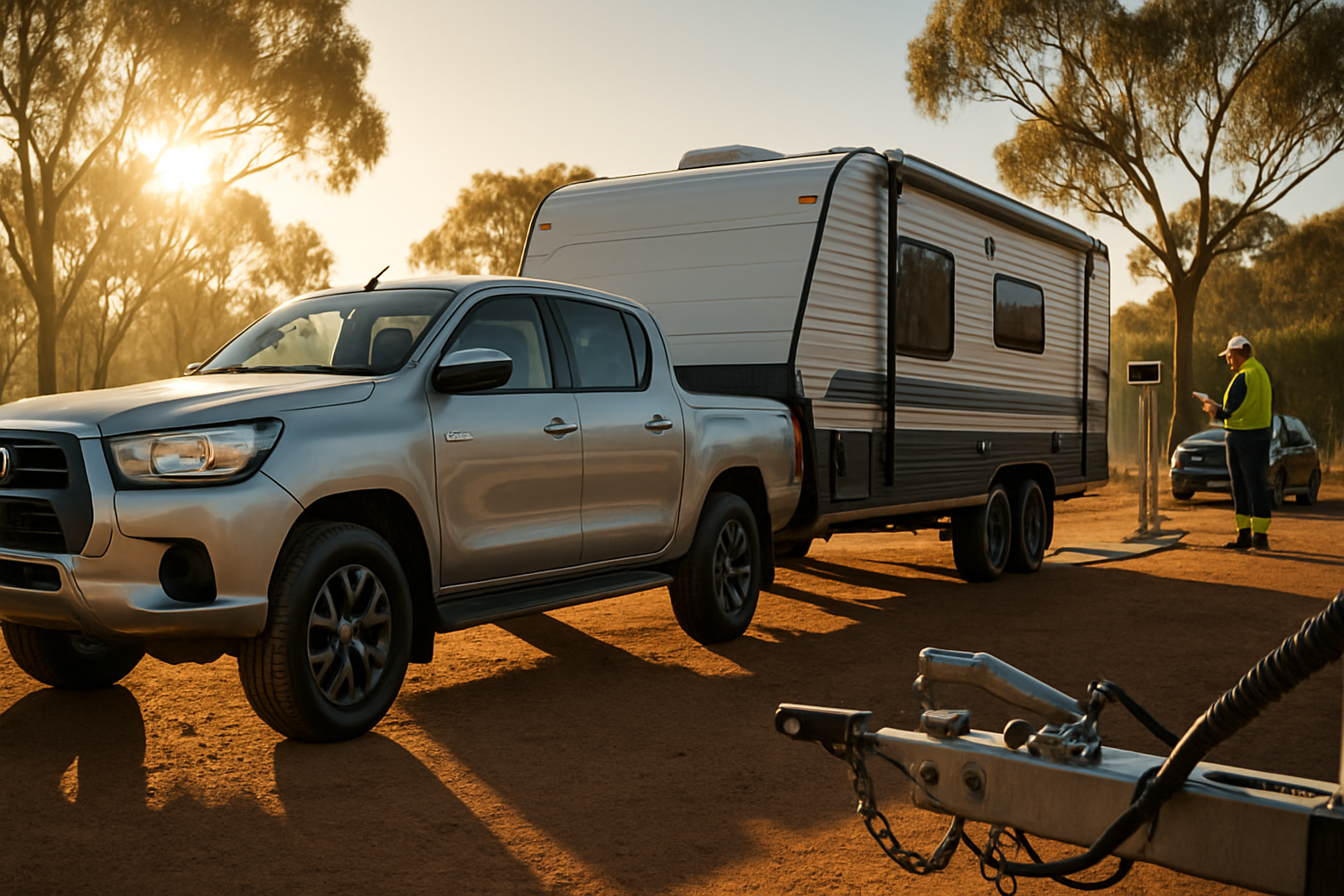
Walk into any caravan park in Australia and ask owners about their tow setup. Most will quote their ute's "3,500 kg towing capacity" with confidence. Most are unknowingly driving illegally — overloaded vans, exceeded GCM, undeclared payloads. Police roadside weigh stations catch them constantly. Insurance companies use weight as the first reason to deny claims after caravan rollovers.
The brochure number is a marketing best-case under specific conditions. Real Aussie towing has three weight limits to respect, and they almost never line up with the headline figure. Here is the honest breakdown.
The Three Numbers Every Tow-er Must Know
1. Maximum Towing Capacity
The number on the brochure. The maximum weight the manufacturer says the vehicle can tow under controlled conditions, with specific tow ball, transmission setup, and weight distribution.
Common values for Aussie utes:
- HiLux 4WD diesel: 3,500 kg braked
- Ranger 4WD diesel: 3,500 kg braked
- Triton: 3,500 kg braked
- LandCruiser 300 Series: 3,500 kg braked
- Patrol Y62: 3,500 kg braked
- D-Max: 3,500 kg braked
Almost every modern Aussie ute and large 4WD claims 3,500 kg. The number is real — but only achievable under conditions you almost certainly do not meet.
2. Maximum Payload
The maximum extra weight you can put IN the vehicle: passengers, cargo in the cab, accessories, anything in the tray.
Calculation: GVM (Gross Vehicle Mass) − Tare Mass = payload.
- HiLux SR5: GVM 3,000 kg − Tare 2,150 kg = 850 kg payload
- Ranger Wildtrak: GVM 3,200 kg − Tare 2,300 kg = 900 kg payload
- Triton GLS: GVM 2,900 kg − Tare 2,000 kg = 900 kg payload
Now subtract: 4 adults (320 kg), full fuel (60 kg), kids' bags (50 kg), tools (40 kg), aftermarket accessories — bull bar (40 kg), tow bar (30 kg), winch (50 kg), drawer system (60 kg), roof rack (15 kg), spare wheel (35 kg). Suddenly you have 50 kg left of payload, before you put anything else in the tray.
3. Gross Combined Mass (GCM) — The One Most Owners Have Never Heard Of
The maximum total weight of the vehicle PLUS the trailer it is towing. This is where most caravan rigs are illegal and most owners do not know.
- HiLux: GCM ~5,850 kg
- Ranger: GCM ~6,000 kg
- Triton: GCM ~5,885 kg
- LandCruiser 300: GCM ~6,750 kg
The math: a HiLux at full GVM (3,000 kg) towing 3,500 kg = 6,500 kg combined. That exceeds the GCM of 5,850 kg by 650 kg. Illegal. Insurance void.
To legally tow 3,500 kg behind a HiLux, the ute itself can weigh no more than 5,850 − 3,500 = 2,350 kg. Tare weight is already 2,150 kg. That leaves 200 kg of payload — driver, passenger, fuel, anything else in the cabin or tray. Almost impossible in real-world towing.
The Maximum Tow Ball Mass — Limit #4 Almost Nobody Knows
Caravans transfer some of their weight onto the tow vehicle through the coupling. That weight pressing down on the tow ball is "tow ball mass" or "tow ball download". It is part of the ute's payload (it sits on the tow hitch which is fixed to the chassis).
- Most caravan tow ball mass: 200-350 kg (industry standard ~10% of trailer weight)
- HiLux maximum tow ball mass: 350 kg
- Ranger maximum tow ball mass: 350 kg
This 200-350 kg comes OFF your available payload. So a HiLux towing a typical 3-tonne caravan with 250 kg ball mass loses 250 kg of cabin/tray payload before anything else loads.
Real-World Worked Example
Sydney family: HiLux SR5 4WD diesel, towing a 3,000 kg twin-axle van for the Big Lap.
| Item | Weight (kg) |
|---|---|
| HiLux tare | 2,150 |
| Driver + 1 passenger + 2 kids | 270 |
| Full fuel tank (80L diesel) | 67 |
| Bull bar + winch + driving lights | 110 |
| Tow bar (heavy duty) + electric brake controller | 40 |
| Cabin gear (clothes, food, tools, fridge in cabin) | 100 |
| Tray gear (camping kit, recovery gear, chainsaw) | 250 |
| Caravan tow ball mass (10% of 3,000 kg) | 300 |
| HiLux loaded weight | 3,287 kg |
| HiLux GVM limit | 3,000 kg |
| OVER GVM by | 287 kg |
Add the 3,000 kg caravan: combined weight = 6,287 kg. HiLux GCM limit is 5,850 kg. Over GCM by 437 kg.
This rig is illegally overweight in two ways before it leaves the driveway. Police weigh, insurance is void, brake performance compromised, suspension overworked.
What Aussie Owners Should Actually Do
Step 1: Weigh the rig
Public weighbridges exist across Australia (search "public weighbridge near me" — most rural and outer-suburb tip stations have them, $20-$50 per weigh). Weigh the loaded ute (no van), then weigh ute + van, then weigh just the van. You now know:
- Loaded ute mass — check against GVM
- Combined mass — check against GCM
- Caravan ATM (Aggregate Trailer Mass) — check against caravan's rating
- Tow ball mass = (Loaded ute) − (ute alone with same load minus tow ball)
Step 2: Check upgrades and modifications
Many Aussie tow vehicles have GVM upgrade kits (legal aftermarket suspension upgrades that increase the registered GVM). Common providers: ARB, Ironman 4x4, Lovells. These can increase your legal GVM by 200-500 kg, but require state-by-state engineer certification (in some states an engineer's plate is mandatory; in others, a manufacturer's SSM/VSCV is sufficient).
Note: GVM upgrade does NOT automatically increase GCM. Many owners think upgrading GVM solves their towing weight problem — it does not, in many cases the GCM stays the same.
Step 3: Match the tow vehicle to the actual van
If you bought a 3-tonne van for your HiLux thinking 3,500 kg towing capacity covers you, you may need:
- A LandCruiser 300 (GCM 6,750 kg) instead of HiLux (5,850 kg)
- OR a smaller van (typically below 2,500 kg ATM for HiLux to remain legal at typical loads)
- OR a single-vehicle alternative (motorhome instead of ute + van)
The Insurance Reality
If you have a serious accident while towing over GVM or GCM, your insurer will almost certainly find out — police will request weighing as part of the investigation, weighbridge records may exist. An overweight finding can void your comprehensive cover entirely. You bear all costs of the accident, plus liability for any third-party damage.
This is not theoretical. Caravan rollover claims are denied regularly on weight grounds. Multiple high-profile cases each year. Treat the weights as legal limits, not aspirations.
Brakes, Tyres, Suspension Specific to Towing
- Trailer brake controller: legally required in Australia for trailers with ATM > 2,000 kg if the trailer has electric brakes. Most modern utes are pre-wired for one — fitting cost ~$300-$600. Tekonsha Prodigy is the industry standard.
- Tyres: load rating must accommodate the GVM. The standard tyres on most utes are rated for unloaded use; under full GVM + ball mass, some standard fitments are at or near load limit. Look for Light Truck (LT) construction tyres for heavy towing duty.
- Suspension: standard ute coil/leaf springs sag when fully loaded. GVM upgrade kits address this with stiffer springs and uprated shocks. Towing without an upgrade on a fully-loaded vehicle = poor handling, premature suspension wear.
The Honest Decision Tree
If you are buying a tow setup or evaluating an existing one:
- Weigh first, debate second. No conversation about tow capacity matters until the actual rig is on a weighbridge.
- If overweight, options are: lighter van, heavier tow vehicle, GVM upgrade (limited help), accept reduced cargo. Pick one before the next trip.
- Plan for full water tanks and full gas bottles in the van — these significantly increase ATM. Many vans empty are within tow rating; full of water and gas they are not.
- Document everything: weighbridge tickets, GVM upgrade certificates, brake controller install receipt. If you ever need to defend yourself to insurance or police, the documentation is what saves you.
Sources & Further Reading
- National Heavy Vehicle Regulator (NHVR) — heavy combination rules, mass limits, Chain of Responsibility (some applies to recreational towing)
- ANCAP — vehicle safety ratings (towing affects rollover risk)
- ACCC — caravan and trailer consumer rights, mandatory disclosures
- Bureau of Infrastructure and Transport Research Economics — heavy vehicle accident data
- Transport for NSW — towing rules and weight limits in NSW
- VicRoads — towing rules in Victoria
- TMR Queensland — Queensland towing and trailer regulations
- Your vehicle owner's manual — definitive source for YOUR exact GVM, GCM, tow ball mass, and tow capacity by build configuration
- Caravan manufacturer plate (compliance plate) — shows tare, ATM, GTM
- Public weighbridges — search Australia's major rural weigh stations or your state transport department
Related Mekavo articles: Buying a used HiLux, Ranger or Triton — 12-point pre-purchase check, especially relevant if buying a tow vehicle.
Why We Care
My Mekavo is free for Australian car owners. Log your weighbridge results, GVM upgrade certificates, brake controller install records — all in one place. When insurance investigators or the next buyer ask "is this rig legal?", you have the documentation. Good for safety, good for resale, good for sleep.
Note on scenarios: The shops, names, addresses, and case reference numbers in this article are fictional and used solely to illustrate how the cited statutes operate in practice. Any resemblance to actual shops, owners, or events is coincidental. The statutes, regulations, and agency procedures cited are real and current as of publication.