 English
 Español
 Deutsch
 FI
FI
 PT
PT
 BR
BR
 FR
FR
 AR
AR
 ZH
ZH
 UR
UR
 TL
TL
 TH
TH
 TR
TR
 PL
PL
 RO
RO
 BG
BG
 ID
ID
 MS
MS
 LT
LT
 IT
IT
 NL
NL
 CS
CS
 SK
SK
 SL
SL
 ET
ET
 SV
SV
 NB
NB
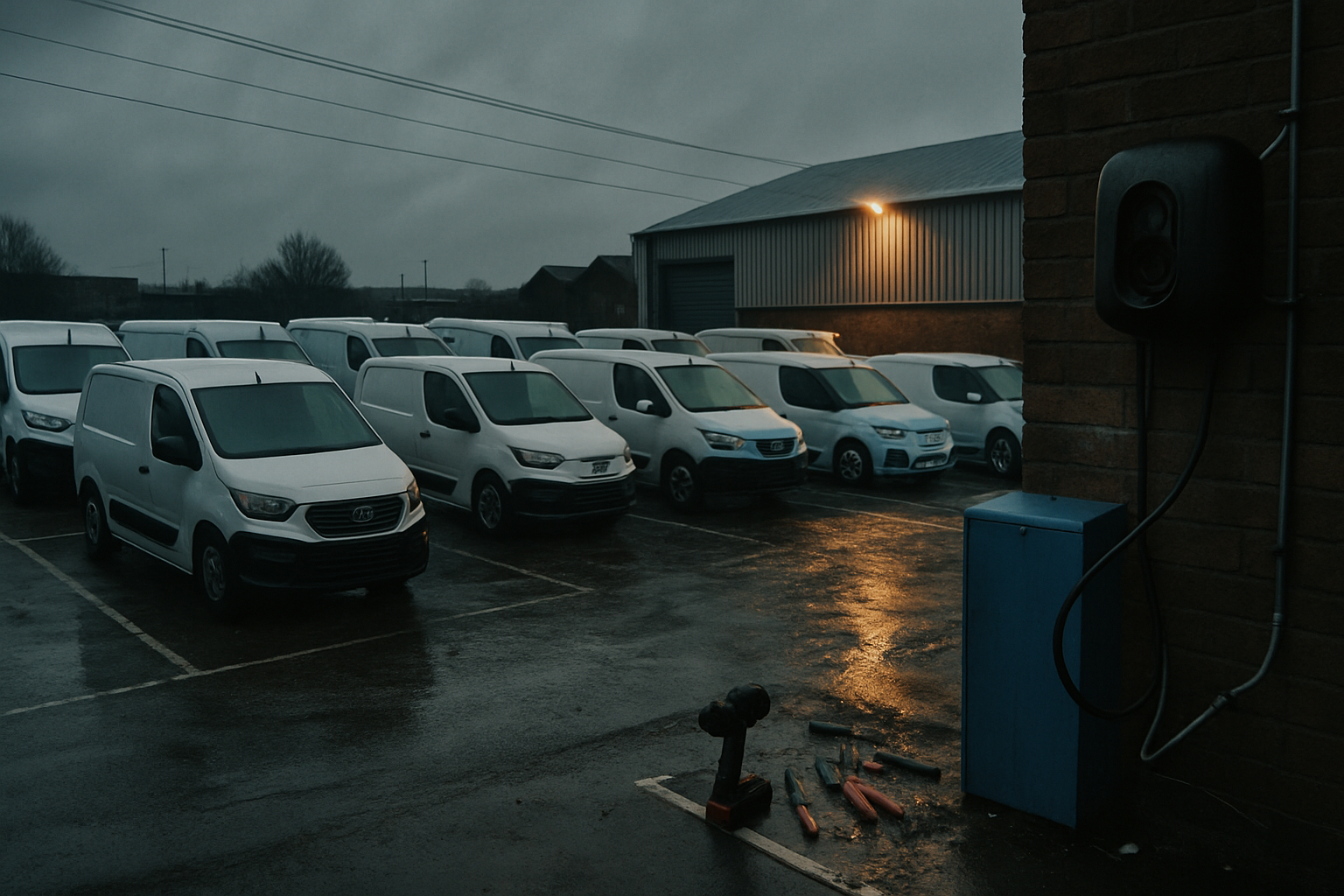
You run 20 vans from a yard off the A64 in Leeds. A third are diesel Transit Customs, a third are Combo vans, a third are Vivaros. Your accountant keeps mentioning the 2030 deadline for new ICE van sales. Your insurance broker just slid you a leaflet on EV fleet transition. A sales rep from a van leasing company is quoting E-Transits at what looks like a decent monthly figure. Your drivers are unanimously sceptical.
Here is the honest 2026 total cost of ownership for going electric on a 20-van SMB fleet in the UK. No manufacturer-brochure figures, no optimistic "average" driver cycles. Real depot capex, real used-van curves, real winter range on a plumber covering 150 miles a day.
The capex nobody budgets for — depot charging
The van is half the story. The charger install is the other half, and most fleet managers discover it late.
For a 20-van fleet returning to a single depot overnight, the realistic setup is 10-12 x 22kW AC charge points (two vans share a charger on alternating overnight cycles, or you run full 22kW per van for fastest cycles). That requires somewhere between 240kW and 440kW of installed electrical capacity on the site.
Almost no small commercial premises in the UK have that spare capacity on the existing connection. You will need a DNO upgrade — from your regional Distribution Network Operator. For Leeds that is Northern Powergrid. For the South East, UK Power Networks (UKPN). For Scotland, SSEN. For most of the Midlands, National Grid Electricity Distribution.
Connection quotes in 2026 for an 11kW-plus LV upgrade on an industrial unit typically land at:
- £5,000-£15,000 if existing capacity allows an uprate without substation work
- £20,000-£60,000 if a substation upgrade or new feeder is needed
- £80,000-£200,000+ if the network upgrade is constrained by the local grid
You only know which bucket you are in by requesting a formal connection quote. That is free but takes 6-12 weeks. Do this before you order a single van. On top of the connection cost:
- 10-12 AC chargers (Zappi, Wallbox, Rolec Commercial or similar) fully installed: £1,800-£3,500 per charge point = £18,000-£42,000.
- Load management / backplane for staggered charging: £3,000-£8,000.
- Metering, mode-3 cabling, site civils: £5,000-£20,000 depending on yard layout.
Realistic total depot capex for a 20-van SMB: £40,000 to £120,000, spread wildly by site and grid. Over 7 years that is £5,700-£17,000/year in fleet charging capex amortisation alone.
Official framework for connections and responsibilities: Ofgem regulates the DNOs. Network upgrade rules are on the National Grid ED, UKPN, Northern Powergrid and SSEN websites.
Used electric van resale — the 40% problem
The brutal number nobody in the electric-van industry wants to discuss openly. Three-year-old electric light commercials have depreciated 40-55% from new in most 2024-2026 auction data.
Examples from the UK used van market in early 2026:
- Vauxhall Combo-e — new 2022 at roughly £32,000, used 2022 at £16,000-£19,000. ~45% drop in 4 years.
- Ford E-Transit 2022 350L3H2 — new at roughly £56,000, used 2022 at £28,000-£34,000. ~40-50% drop.
- Mercedes eVito 2021/22 — new at roughly £52,000, used 2021 at £20,000-£25,000. ~55% drop.
- Peugeot e-Expert / Citroën e-Dispatch / Vauxhall Vivaro-e (all the Stellantis triplets) — similar 40-50% curve.
Compare to diesel: a 2022 diesel Transit Custom at 45,000 miles typically holds 55-65% of new price in 2026. That is a 10-20 percentage point TCO disadvantage for electric on resale alone.
Why? Battery anxiety from second-hand buyers, range degradation unknowns, fast-charging habits of the previous owner, and the new-van price of electric falling as 2023-2026 models arrived. Also: small fleets prefer diesel, so the used EV van market has fewer buyers than the equivalent diesel market.
The upside: buying USED electric at those prices is now genuinely interesting if you have depot charging. A £19,000 used Combo-e vs a £17,000 used diesel Combo is close enough on price that the fuel savings bridge the gap quickly.
Range reality — UK winter, 150 miles a day, plumber edition
Manufacturer range claims are on the WLTP cycle at 20-23°C. UK winter reality for a fully-laden van in real use:
- Combo-e / Vivaro-e / e-Expert — WLTP ~175 miles. Winter fully-loaded real range: 110-135 miles. Highway heavy: 95-115 miles.
- E-Transit (68kWh standard) — WLTP ~196 miles. Winter fully-loaded real range: 120-150 miles. Highway heavy: 100-125 miles.
- eVito (60kWh) — WLTP ~162 miles. Winter fully-loaded real range: 95-120 miles.
A plumber covering 150 miles in an outer-city day, mostly urban with a few dual carriageway runs, is inside realistic range on any of the above in summer, and borderline on a small-battery variant in winter. A long-range E-Transit (89kWh) is comfortable but costs £8-12k more.
Practical consequence: your highest-mileage drivers (field engineers, couriers, site staff running 180+ miles a day) cannot yet go electric reliably in winter without mid-shift charging or a bigger battery. Your urban drivers (mobile servicing in one city, deliveries, local installs) almost certainly can.
The honest transition profile for a 20-van SMB fleet in 2026: 60-70% of routes can go electric now. 30-40% cannot. Transition the routes that fit, keep diesel on the routes that do not. Do not electrify everything on day one.
OZEV Plug-in Van Grant — what it actually pays in 2026
As of early 2026, the Plug-in Van Grant from the Office for Zero Emission Vehicles (ozev.uk via the main gov.uk plug-in grants page) has seen multiple rounds of reduction since its peak. Check the live page before buying — the terms are still periodically revised.
At the time of writing the latest OZEV van grant communications have been scaling down. Assume £2,500-£5,000 per small van and nothing for large if the scheme still exists at all by your order date. Do not build a TCO case on a grant that may disappear. Build it on the unsubsidised numbers and treat any grant as a bonus.
The Workplace Charging Scheme is still a useful lever — up to £350 per socket, max 40 sockets per site. For a 10-charger depot that is £3,500 off your capex. Worth the paperwork.
BiK tax — the genuine win in 2026
Benefit-in-Kind tax for company-provided vehicles is where electric genuinely wins. BiK on an electric van for private use remains at 0-3% of the list price depending on the tax year (always check the gov.uk company van BiK page for current rates). Diesel vans are taxed at a flat rate that in 2026 sits in the several-hundreds of pounds-per-year range per driver.
For 20 drivers getting private use, a few thousand pounds of employee tax per year is legitimately saved by going electric. That is real money — in the driver's pocket, but it is also a recruitment and retention argument. An electric van with full private use is worth about £500-£1,000/year in take-home pay compared to a diesel.
Rates change. HMRC publishes the current figures. A finance lead who is not checking these annually is the weakest link in your transition case.
The honest 7-year TCO for a 20-van fleet — diesel vs mixed
Rough maths, 2026 UK, realistic:
- All-diesel 20 vans, £22,000 purchase × 20 = £440,000 capex. Fuel at £0.18/mile × 20,000 miles × 20 vans × 7 years = £504,000. Residual at year 7 roughly 20% = -£88,000 recovered. Net: £856,000 over 7 years.
- Mixed 14 electric + 6 diesel, electric at £28,000 new × 14 = £392,000 + diesel £22,000 × 6 = £132,000. Depot capex £80,000 (mid estimate). Electricity at £0.06/mile × 20,000 × 14 × 7 = £117,600. Diesel fuel at £0.18 × 20,000 × 6 × 7 = £151,200. Residuals, assume brutal electric depreciation to 25% and diesel to 20% at year 7 = -£98,000 + -£26,400 recovered. Net: £748,400 over 7 years.
Roughly £107,000 better over 7 years for the mixed fleet — about £765/van/year advantage. That is meaningful but it is not revolutionary, and it depends entirely on:
- Your DNO connection quote landing at £80,000 or less. If it is £200,000, the advantage evaporates.
- Electric residuals not collapsing further. They may.
- Electricity price staying around £0.18-£0.28/kWh depot. It may rise.
- Diesel staying above £1.50/litre pump. It almost certainly will.
The checklist before you order a single electric van
- Pull 3 months of actual route data. How many vans do under 120 miles/day every day?
- Get a formal DNO connection quote for your depot. No commitment required.
- Get 3 used-van quotes — new electric, nearly-new used electric, and diesel equivalents.
- Get a real energy-cost quote for your depot. Half-hourly commercial rates, not residential.
- Read the current OZEV Plug-in Van Grant and Workplace Charging Scheme T&Cs on the day you order.
- Check current BiK rates on gov.uk. Plug them into driver packages.
- Start with 3-5 electric vans on the routes that fit. Keep diesel on the routes that do not.
- Review every 18 months. Grant changes, residual curves, and your own data will shift the answer.
When electric is not right in 2026
Be honest. Electric is not right if:
- Your routes regularly exceed 150 miles in winter on small-battery vans.
- Your depot DNO quote exceeds £150,000 and you cannot recover it in 5 years.
- Your drivers regularly park at customer sites for multi-day jobs with no charging.
- You are 2-3 years from selling the business and the residual risk sits with you, not the buyer.
There is no badge-of-honour for being all-electric by 2027 if the maths does not work. The 2030 new-ICE-sale deadline does not force you to scrap anything — existing diesel vans remain legal to run for their life. The genuine transition pressure is the 2035+ used-van market, where diesel residuals may fall faster than expected.
Sources & further reading
- gov.uk — Plug-in vehicle grants — current OZEV grant rates
- OZEV — Office for Zero Emission Vehicles
- gov.uk — Workplace Charging Scheme — up to £350/socket
- gov.uk — Company van Benefit-in-Kind — current BiK rates
- HMRC — HM Revenue & Customs — tax rules
- Ofgem — electric vehicles and the energy network
- National Grid Electricity Distribution — DNO for the Midlands
- UK Power Networks — DNO for London and the South East
- Northern Powergrid — DNO for Yorkshire and the North East
- SSEN — Scottish and Southern Electricity Networks
- DfT — transitioning to zero-emission cars and vans delivery plan
Related Mekavo articles: ULEZ and CAZ compliance for small fleets, Fleet MOT scheduling for SMB operators, Driver licence checking with DVLA, Spotting fuel card fraud in your data.
Why we care
Mekavo Fleet tracks diesel and electric vans side by side — per-vehicle pence-per-mile, real-world range data from driver-logged routes, charging receipts attached to the vehicle. When you are part-way through a mixed-fleet transition, that is the view you need. The lightweight fleet manager for 10-50 vehicle SMB operators, without the enterprise pricing of Webfleet or Samsara.
Note on scenarios: The shops, names, addresses, and case reference numbers in this article are fictional and used solely to illustrate how the cited statutes operate in practice. Any resemblance to actual shops, owners, or events is coincidental. The statutes, regulations, and agency procedures cited are real and current as of publication.