 English
 Español
 Deutsch
 FI
FI
 PT
PT
 BR
BR
 FR
FR
 AR
AR
 ZH
ZH
 UR
UR
 TL
TL
 TH
TH
 TR
TR
 PL
PL
 RO
RO
 BG
BG
 ID
ID
 MS
MS
 LT
LT
 IT
IT
 NL
NL
 CS
CS
 SK
SK
 SL
SL
 ET
ET
 SV
SV
 NB
NB
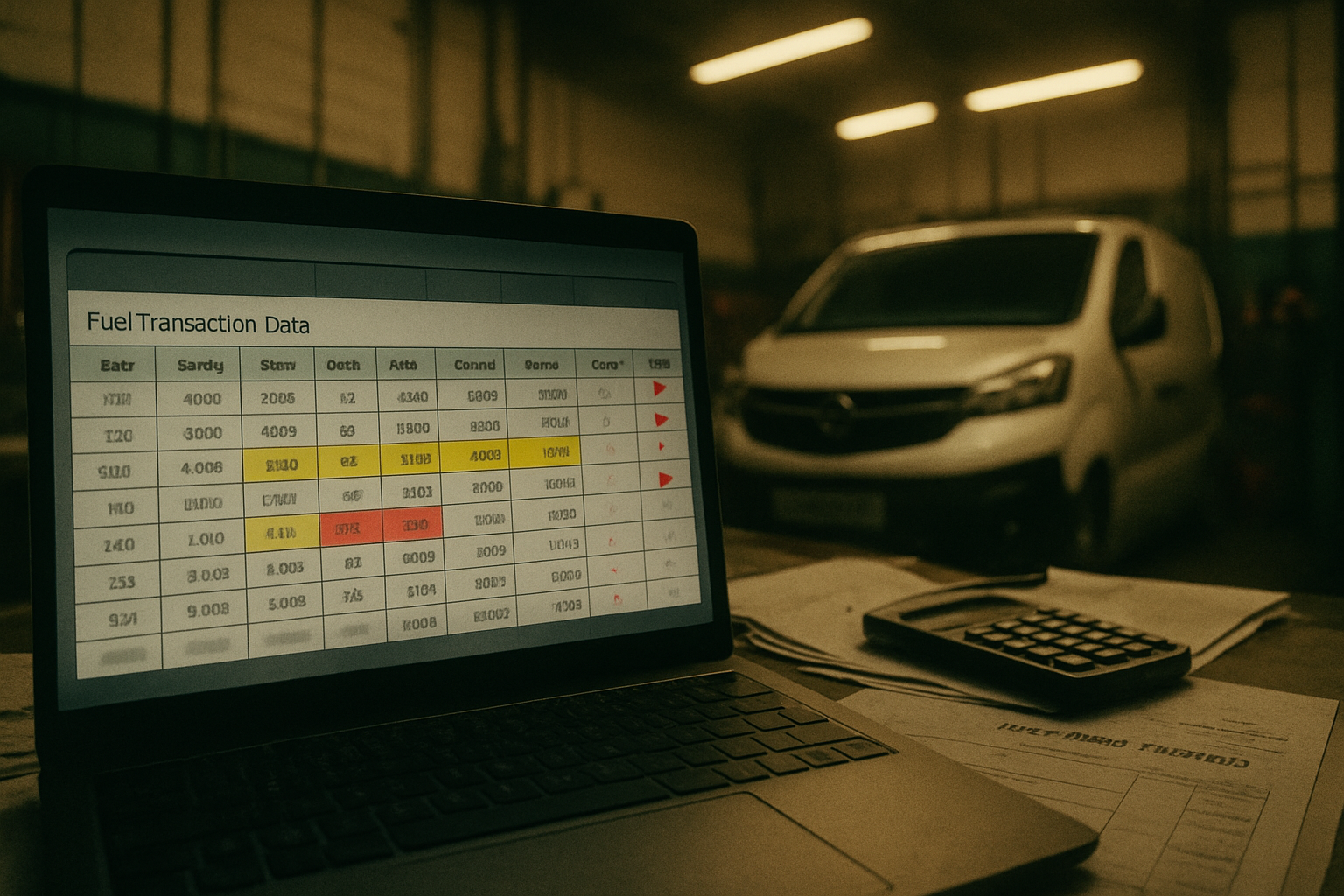
A 20-van plumbing firm in Birmingham. Fuel budget £6,000 a month, managed on Allstar cards. Every month the invoice is a bit higher than the MD expects, but nobody has time to analyse 300+ transaction lines. After 11 months the bookkeeper notices a driver's card is filling at 74 litres on a Vauxhall Vivaro whose tank is 66 litres. One investigation later: that driver has been filling his personal car at the same forecourt on a swap arrangement with the attendant, £600-£900 a month for a year. Total loss: roughly £9,500. Plus the other driver he recruited a few months in.
Fuel card fraud is not rare in SMB fleets. It is quietly common, and mostly preventable. You do not need fleet telematics. You need 20 minutes a month and the ability to read a CSV.
The four patterns that 90% of SMB fuel fraud falls into
1. Off-vehicle fills — diesel into a non-diesel tank
The driver fills his personal petrol car on the company diesel card. The giveaway: the volume and the fuel grade. If your fleet is all diesel and a transaction shows unleaded petrol or super-unleaded, that is either an admin error or a fraud. If your card is restricted to diesel-only (all major providers offer this — turn it on), this becomes a declined transaction and the attempt is visible.
Even on a diesel-only card, watch the litres. A Ford Transit Custom has a 70-litre tank. A Vauxhall Vivaro is 66 litres. A Mercedes Sprinter 3.5t is typically 71-92 litres depending on trim. A fill over 10% above tank capacity is suspicious — somebody ran the pump through two vehicles.
2. Phantom mileage — fuel volume vs recorded miles
Every month, per van, compare total fuel bought (litres) against odometer change (miles). Convert to MPG.
- Modern Euro 6 diesel van, mixed use: 28-38 MPG is realistic.
- Under 22 MPG for a standard van = either heavy urban stop-start work (plausible), mechanical fault, or fuel going somewhere else.
- Over 55 MPG = odometer fraud, someone is under-reporting miles (often to avoid lease excess-mileage charges).
This check catches 70% of SMB fuel fraud on its own. Nobody does it because it requires someone to read the odometer every month. A weekly driver-reported odo plus a fuel volume summary solves it. Phone-photo the dashboard odometer, attach to the fuel receipt, done.
3. Card-swap — driver A's card, driver B's van
Drivers share a depot, one driver's card gets left in the wrong van. This is usually accidental. But if it happens with the same two drivers repeatedly, and the fills are at unusual times, one of those drivers is using the other's card to avoid a per-card spend limit or a geographic restriction.
Check: every transaction has a timestamp and a location. If driver A's card is being used at a forecourt 40 miles from any job driver A worked that day, there is a problem.
Most providers (Allstar, Shell Fleet Solutions, BP Plus, Texaco Fastfuel, Esso) let you set geofences or day/time restrictions per card. Use them. A van card that fills at 2am on Sunday in a city 80 miles away should not be possible.
4. Forecourt complicity — attendant-assisted theft
The hardest to detect. The driver buys £30 of diesel for the van and £30 of snacks, cigarettes and a personal petrol fill on the same receipt, all put through as "fuel" on the card. Or the attendant slides an extra transaction onto the card after the driver has left.
The patterns:
- Same forecourt, fills always end in round numbers (£50.00, £40.00) — suspiciously convenient.
- A transaction at 17:45 and another at 17:47 on the same card — the attendant ran a second fill on the idle card.
- A "fuel" line of £55 at a forecourt where the van's tank at that mileage should only take £40 of diesel.
The fix: restrict cards to fuel-only (no forecourt convenience). All major providers support this. It kills snacks-and-cigs fraud overnight. Also: rotate the regular forecourt. A driver who always fills at the same Esso near his house and never anywhere else has a relationship with that forecourt. That relationship is sometimes innocent. Often not.
How to actually spot this in your Allstar, Shell, BP or Texaco export
All the major UK fleet fuel card providers — Allstar, Shell Fleet Solutions, BP Plus, Texaco Fastfuel, Esso, UK Fuels — export a monthly CSV or XLS with every transaction. Fields typically include: card number, driver name, vehicle reg, date/time, forecourt location, litres, grade, price, total.
The 20-minute monthly check:
- Pivot by vehicle reg. Total litres per van for the month.
- Pull odo readings from the job sheets or driver-submitted photos. Miles driven per van.
- Calculate MPG per van. Flag anything outside 22-50 MPG.
- Pivot by driver. Total spend per driver. Flag anyone 20%+ above the fleet average when normalised for miles.
- Sort all transactions by litres. The top 10 — do they exceed the tank capacity of the vehicle on the transaction? Flag.
- Sort by timestamp. Any two transactions on the same card within 3 minutes? Flag.
- Plot forecourt locations against the day's job sheet. Fills 20+ miles from the day's nearest job are a red flag.
The first time you do this takes an hour. From month 2 onwards it is 20 minutes. It finds 90% of fraud within 3 months of starting.
What Mekavo tracking does differently
Fuel-card providers give you the transaction. They do not give you the photo of the receipt, the photo of the pump reading, or a tie between that fill and a specific job on a specific day. When a driver disputes a flagged transaction you have their word against the forecourt's.
The step up: every fuel fill gets photographed — receipt plus pump reading plus dashboard odometer — and attached to the vehicle record. It is 10 seconds of driver effort per fill. Over a month you have a photographic audit trail no forecourt attendant will try to fiddle because they can see the driver photographing. Fraud opportunities collapse at the source.
This is not telematics. It is phone-camera-and-discipline. A 20-van SMB does not need £40/van/month telematics to solve most fuel-card fraud. It needs a policy, a receipt photo rule, and the 20-minute monthly CSV review.
When to involve the police, and when to just terminate
Fraud under £2,000 and a single driver: document, confront, terminate. Most SMB operators do not prosecute under that threshold because the recovery is usually worse than the legal cost.
Fraud over £2,000, forecourt collusion, or a pattern across multiple drivers: report to Action Fraud (the UK's national fraud reporting service) and consider civil recovery. If the forecourt is implicated, the provider's own fraud team — Allstar, Shell, BP all have them — will often investigate and pursue the forecourt for you.
Always check your cover: most commercial motor and business liability policies exclude employee dishonesty, but a fidelity guarantee or employee theft policy bolt-on covers it. Under £500/year for a small fleet. Often worth it.
The prevention checklist
- Every card set to fuel-only (no convenience purchases).
- Every card restricted to the correct fuel grade (diesel-only for diesel fleets).
- Geographic restrictions where possible — your operating area plus a reasonable buffer.
- Time restrictions — no fills 11pm-5am unless you run a night fleet.
- Every driver gets one card. One card per van is an alternative but is weaker on accountability.
- Driver photographs receipt + pump reading + dashboard odometer on every fill.
- Monthly 20-minute CSV review by someone who does not drive the vans.
- MPG calculated per van per month. Outliers investigated.
- Policy signed at recruitment stating fuel fraud is gross misconduct and will be prosecuted at the employer's discretion.
Sources & further reading
- Action Fraud — UK national fraud reporting service
- Serious Fraud Office — for larger-scale fraud investigations
- Fraud Act 2006 — the statute under which employee fuel fraud is prosecuted
- HMRC EIM30100 — fuel provided for company vehicles — tax treatment
- HMRC — advisory fuel rates used for reimbursement benchmarking
Related Mekavo articles: ULEZ and CAZ compliance for small fleets, Fleet MOT scheduling for SMB operators, Driver licence checking with DVLA, Electric fleet TCO for a 20-van SMB in 2026.
Why we care
Mekavo Fleet lets your drivers photograph every fuel receipt and pump reading from the phone in 10 seconds, attached to the vehicle and the job. The MPG review you used to do manually runs automatically. No telematics box, no £40 a month per van, no three-year contract. Just the visibility that stops the £9,500 surprise on the end-of-year accounts.
Note on scenarios: The shops, names, addresses, and case reference numbers in this article are fictional and used solely to illustrate how the cited statutes operate in practice. Any resemblance to actual shops, owners, or events is coincidental. The statutes, regulations, and agency procedures cited are real and current as of publication.