 English
 Español
 Deutsch
 FI
FI
 PT
PT
 BR
BR
 FR
FR
 AR
AR
 ZH
ZH
 UR
UR
 TL
TL
 TH
TH
 TR
TR
 PL
PL
 RO
RO
 BG
BG
 ID
ID
 MS
MS
 LT
LT
 IT
IT
 NL
NL
 CS
CS
 SK
SK
 SL
SL
 ET
ET
 SV
SV
 NB
NB
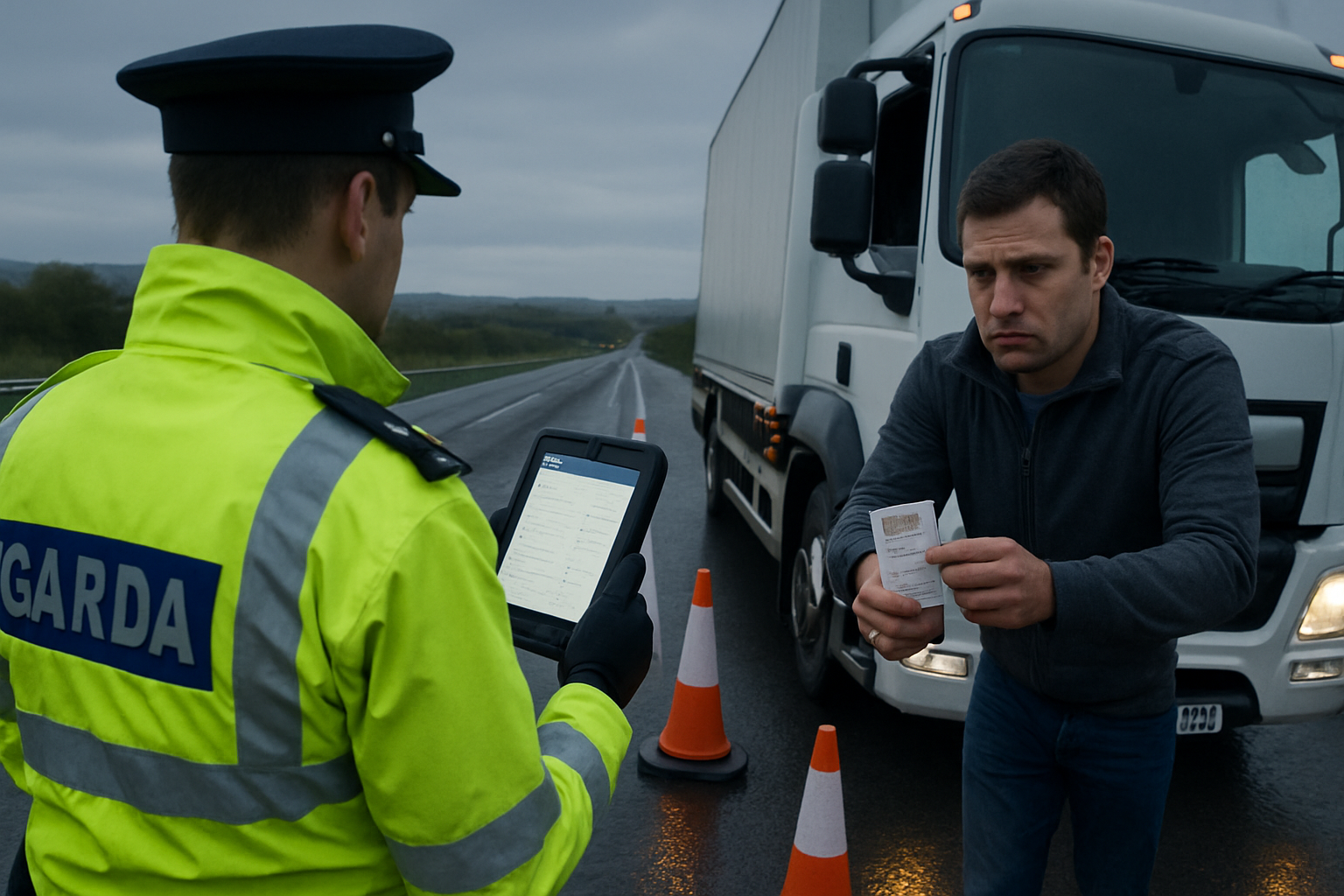
It is a Tuesday morning on the M7 near Kildare. You run a 7-truck regional haulier out of Limerick. One of your drivers has left Limerick at 04:40 with a 26-tonne curtainsider loaded for Dublin Port. He has been running Holyhead-to-Dublin ferry rotations for three weeks. The tachograph download is two weeks overdue because the office administrator has been out sick. His Driver CPC expired in January. It is now April.
A Garda checkpoint stops the truck for a routine commercial-vehicle inspection. The officer asks for the Driver Qualification Card. Expired. The tachograph card is inserted. A download shows three consecutive weeks of daily driving exceeded (10+ hours instead of the 9-hour limit, with one 11-hour extension taken twice in the same week — only two 10-hour extensions per week are allowed, 11 hours is never allowed). The inspection escalates. The truck is impounded pending a fresh driver. The driver is down a week of income. You are down €4,500 in lost revenue, €2,400 in subcontract recovery, €500 in fixed-charge offences on CPC, and a fine stack on driver-hours breaches that your transport lawyer will negotiate to somewhere between €2,000 and €6,000.
The compliance stack Irish SMB hauliers actually need is not complicated. It is five things, done on a calendar, not in a panic. Here they are.
The five compliance lines every Irish haulier runs on
- Driver CPC — every professional truck driver (Category C/CE) must hold a current Driver Qualification Card, renewed every 5 years via 35 hours of periodic training, 7 hours at a time.
- Digital tachograph cards and downloads — every driver carries a personal digital tachograph card, renewed every 5 years from RSA driver card services. Downloads are required every 28 days (driver card) and every 90 days (vehicle unit).
- EU drivers' hours rules — max 9 hours daily driving (extendable to 10 hours twice a week), max 56 hours in a week, max 90 hours in any two consecutive weeks, 45 minutes break after 4.5 hours.
- Road Freight Carrier's Licence — the operator licence for hire-and-reward haulage with vehicles over 3.5 tonnes. Renewed every 5 years. Check your licence status and renewal cycle on Gov.ie road transport operator licensing.
- Working Time Directive compliance — separate from drivers' hours. Max 48 hours/week average over 17-week reference period, 6 hours max before a break, night work rules.
Miss any of these and a Garda roadside stop or an RSA enforcement visit to the operating centre turns into a fine stack. The shipper conversation that follows is usually worse than the fine.
Driver CPC — the simple rotation that saves €500 fines
Driver CPC training is delivered by RSA-approved training organisations at roughly €70-€120 per 7-hour module. Total cost per driver over 5 years: €350-€600. It is not expensive. It is operationally inconvenient because each driver needs a full day off driving for each module.
The SMB rotation that works:
- Spread all 35 hours across the 5-year cycle — 7 hours per year, not 35 hours in month 59.
- Book training blocks in quiet weeks — typically second week of January, first week of August, and the week between Christmas and New Year if your load book is light.
- Rotate modules: first-aid-focused one year, drivers' hours refresher another, load-securing another, ECO-driving another, customer service another. Drivers should not do the same module 5 times.
- Keep a single tracker with every driver's DQC expiry date and their 5-year rotation plan. An expired DQC is the single most common roadside offence for Irish hauliers.
When a driver reaches the 35-hour total within the 5-year window, RSA issues a new DQC. The driver keeps the card in the cab alongside the tachograph card. Lose the card, expire the card, wrong name on the card — all the same fine. Fixed-charge penalty for driving professionally without a current CPC is in the €1,000-€2,000 band depending on how the prosecution proceeds.
Tachograph — the 28-day and 90-day rule most SMBs miss
Every digital tachograph records driver activity on both the driver's personal card and the vehicle unit's internal memory. Both must be downloaded on schedule or the data is overwritten:
- Driver cards — download every 28 days. The card holds roughly 28 days of detailed activity. Miss the window by 3 days and the oldest 3 days rotate out of the card. If an RSA inspector asks for the missing day, you cannot produce it.
- Vehicle units — download every 90 days. Memory holds roughly 12 months, but the legal requirement is 90 days.
- Retention — all data must be retained for at least 12 months and presented on request.
The download hardware is a small handheld unit (Optac, Tachomaster, Digifobpro and similar products on the Irish market) or increasingly a laptop-and-cable setup. Cost: €400-€900 for the unit, plus a software subscription at €20-€50/month per operator. Analysis software flags infringements automatically — daily rest too short, weekly rest missed, 4.5-hour break not taken, speed over 90 km/h on a 3.5t+ vehicle.
The honest SMB reality: most 5-15 truck hauliers let downloads slip when an administrator is off, then panic-download three months at once. The analysis flags 40 infringements, most minor, a handful serious. The administrator assumes the company "has a tachograph problem" and stops running reports. The data is downloaded but the infringements are never addressed. The next roadside stop is the next time anyone looks at the data.
The fix is a recurring task, owned by one person, with a named backup:
- Last Friday of every month: every driver inserts their card into the office reader before leaving for the weekend. 5-minute download per card.
- First Monday of every quarter: every vehicle unit downloaded. 10 minutes per truck.
- Wednesday of the week after download: transport manager reviews the infringement report and has a 10-minute coffee with any driver flagged more than once. This is the single most effective compliance habit a haulier can build.
EU drivers' hours — the numbers every driver and every planner must know
The rules are EU-wide (Regulation 561/2006) and enforced identically in Ireland:
- Daily driving — 9 hours, extendable to 10 hours on any two days per week.
- Weekly driving — 56 hours maximum.
- Fortnightly driving — 90 hours across any two consecutive weeks.
- Break — 45 minutes after 4.5 hours of driving. Can be split as 15 + 30 (in that order).
- Daily rest — 11 hours, reducible to 9 hours three times a week.
- Weekly rest — 45 hours regular, reducible to 24 hours on one week out of two (compensation required).
The source-of-truth summary is on RSA drivers' hours and rules. Post a laminated A4 with these numbers in every cab. Drivers who know the rules self-police.
The Road Freight Carrier's Licence — and what happens when you miss the renewal
Every operator running 3.5t+ vehicles for hire-and-reward needs a Road Freight Carrier's Licence (and for international work, a Community Licence). The licence is granted by the Department of Transport road transport operator licensing unit and renewed every 5 years.
Requirements:
- Good repute — no serious criminal or transport-offence history for directors and the transport manager.
- Financial standing — roughly €9,000 in reserves for the first vehicle and €5,000 for each subsequent vehicle. Evidenced by audited accounts or a bank letter.
- Professional competence — the nominated transport manager holds a CPC in Road Transport (Goods) qualification. This is a separate qualification from Driver CPC.
- Stable operating centre — a declared yard with parking space for the fleet, documented.
Miss the renewal and the licence lapses. Operating without a current licence carries fines into the €10,000+ range and personal director liability. Renew at least 3 months before expiry — the application takes time to process.
The compliance folder every Irish SMB haulier should keep
On a server, in a shared cloud drive, or in a paper ring binder — pick one, but one of them:
- Per driver — copy of licence, DQC, digital tacho card, medical report, training records (Driver CPC module certificates), contract of employment with working-time acknowledgement signed.
- Per vehicle — V5 equivalent registration, current CRW, current motor tax screenshot, insurance schedule, annual tachograph calibration certificate (legally required every 2 years via an approved calibration centre).
- Operator-wide — Road Freight Carrier's Licence, Community Licence (if international), operating centre proof, financial standing evidence, Transport Manager CPC certificate.
- Rolling records — tachograph downloads and analysis reports (retained 12 months minimum), working-time records (retained 24 months), driver disciplinary records related to hours or compliance.
An RSA transport officer arriving unannounced at the operating centre expects to see this folder. If the transport manager can produce everything inside 30 minutes, the visit is usually a procedural tick. If the folder is half-empty, the visit becomes an investigation.
What enterprise fleet software does — and why it is usually overkill at 7 trucks
Platforms like Fleetmatics, Webfleet, Transpoco and Samsara offer integrated tacho download, infringement flagging, vehicle tracking and CPC date tracking in one dashboard. Pricing sits around €25-€45 per vehicle per month for compliance-only packages, more for full telematics. For a 50-truck operation they earn their place. For a 5-7 truck SMB the economics are marginal — €2,100-€3,800 per year for compliance alone, on top of the tachograph analysis software you already need.
The honest SMB stack is: tachograph analysis subscription (€300-€600/year), a simple shared spreadsheet or light fleet app for CPC/CRW/motor-tax date tracking, a disciplined monthly download routine, and an engaged transport manager. The fines the stack prevents are far larger than the stack costs.
Sources & further reading
- Road Safety Authority — regulator, Driver CPC, tachograph cards, enforcement
- RSA — drivers' hours and rules — EU Regulation 561/2006 summary
- RSA — driver card application — digital tachograph card process
- RSA — Driver CPC — 35-hour requirement, DQC, training providers
- gov.ie — road transport operator licensing — Road Freight Carrier's Licence rules
- Citizens Information — driver licensing — plain-language summaries
Related Mekavo articles: CVRT scheduling for Irish SMB fleets, Irish motor tax and BIK for fleet buyers.
Why we care
Mekavo Fleet tracks every driver's CPC expiry, tachograph card expiry, licence expiry and medical expiry in one place, with automated reminders at 90, 60 and 30 days out. We do not replace your tachograph analysis software — that is a specialist tool. We stop the small calendar misses that turn into €8,000 checkpoint fines.
Note on scenarios: The shops, names, addresses, and case reference numbers in this article are fictional and used solely to illustrate how the cited statutes operate in practice. Any resemblance to actual shops, owners, or events is coincidental. The statutes, regulations, and agency procedures cited are real and current as of publication.