 English
 Español
 Deutsch
 FI
FI
 PT
PT
 BR
BR
 FR
FR
 AR
AR
 ZH
ZH
 UR
UR
 TL
TL
 TH
TH
 TR
TR
 PL
PL
 RO
RO
 BG
BG
 ID
ID
 MS
MS
 LT
LT
 IT
IT
 NL
NL
 CS
CS
 SK
SK
 SL
SL
 ET
ET
 SV
SV
 NB
NB
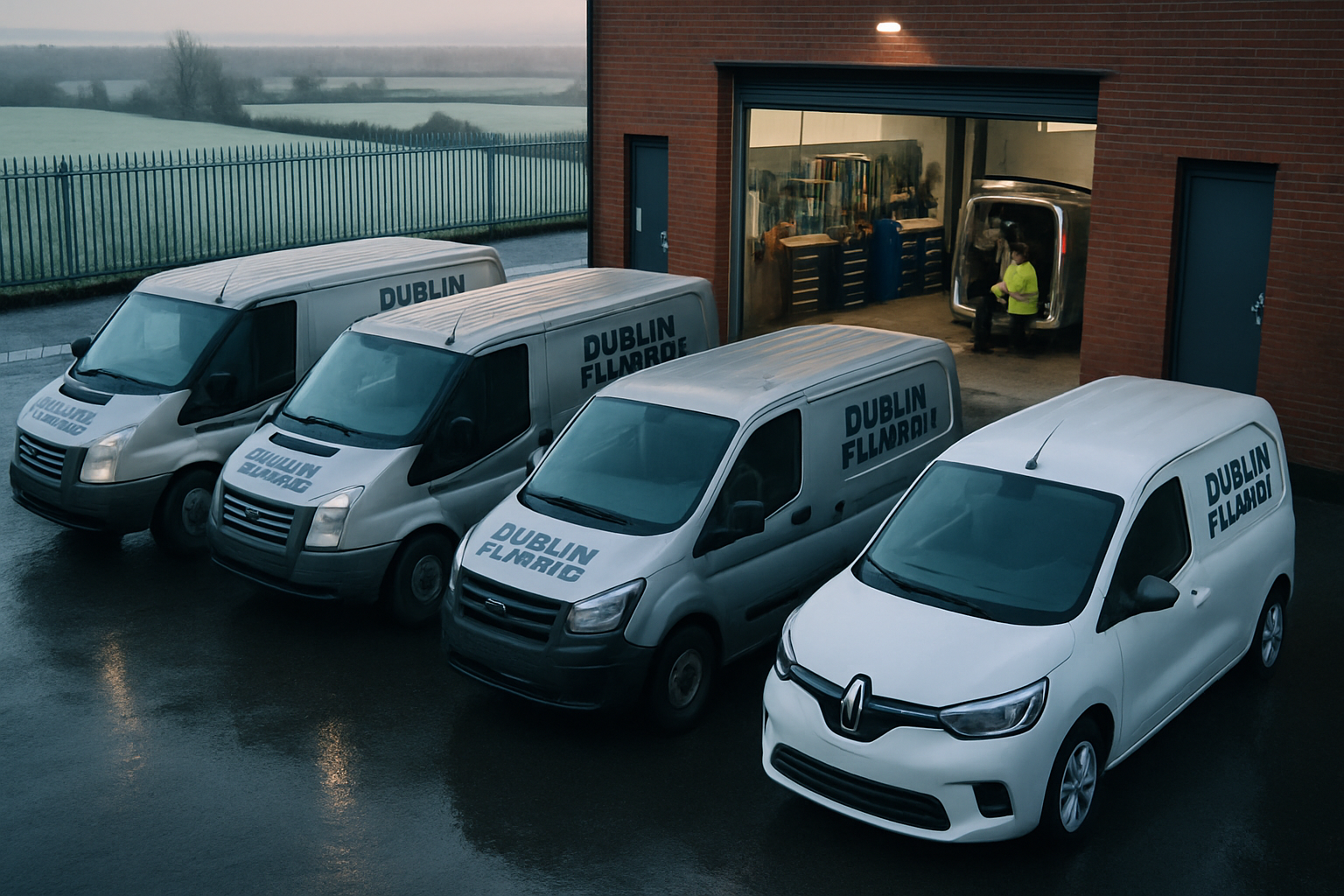
It is a Wednesday in January in Dublin. You run a 15-van plumbing and heating installation business covering Dublin, Meath, Kildare and Wicklow. Four of your oldest diesels — 2017 and 2018 Transits — are due replacement this year. Your accountant has sent a note on capital allowances. A supplier sends a pitch deck on electric vans. Your bookkeeper asks whether you have started costing the switch.
You should. The 2026 Irish tax-and-grant stack has tilted the four-year TCO on urban fleet vans firmly toward electric for the right route profile. It is also genuinely hostile to EVs for the wrong route profile. The question is which half of your fleet sits in each camp. Here is the honest maths.
The 2026 Irish incentive stack — what is actually on offer
Four separate schemes stack on top of each other. Miss any one and the TCO breaks.
1. SEAI EV grant for light commercial vehicles
The SEAI electric van grant pays up to €3,800 toward the purchase of a new N1 category electric van, subject to a list price cap (around €60,000 ex-VAT at 2026 rates — check SEAI for the current figure). Dealer applies the grant at point of sale so the invoice shows it as a discount. Eligible models include Renault Kangoo E-Tech, Ford E-Transit Custom, Peugeot e-Partner, Vauxhall/Opel Combo-e Cargo, Citroën e-Berlingo, Maxus eDeliver 3, Volkswagen ID. Buzz Cargo and others. Check the SEAI EV grants page for the current eligible-models list before you order.
2. VRT relief on electric vehicles
Revenue offers VRT relief on battery-electric vehicles up to a maximum of €5,000 (for cars). For commercial vans the base VRT is already low (13.3% of OMSP for N1 category), so the practical effect is that most electric light commercials register with negligible VRT. Check the Revenue VRT rates page for 2026 specifics — the EV reliefs are reviewed each Budget and generally taper.
3. Accelerated Capital Allowance (ACA)
For corporation-tax-paying businesses, the Accelerated Capital Allowance for energy-efficient equipment lets you write off 100% of the cost of a qualifying EV in year 1, instead of the standard 12.5% per year over 8 years. For a €36,000 Kangoo E-Tech, that is an immediate €36,000 deduction against profit, worth roughly €4,500 in corporation tax (at 12.5%) in year 1 versus €4,500 spread over 8 years. Cash-flow-positive.
4. Workplace Charging Scheme
The SEAI workplace charging grant pays up to €5,000 per installed commercial charge point (for a 22 kW AC unit; DC fast-charge grants are structured differently). A 15-van fleet likely installs 4-8 depot chargers to support overnight charging on the four replacement vans initially, scaling as more diesels rotate out. That is potentially €20,000-€40,000 in grants just for the depot infrastructure. Details on the SEAI workplace charging grant page.
The four-year TCO for the Dublin plumbing fleet
Four replacement vans. Two options:
Option A — diesel Ford Transit Custom LWB 2.0 TDCi 150 (status quo)
- List price ex-VAT: €30,500
- Less fleet discount: €28,000 delivered
- 4-year fuel: 35,000 km/year × 4 × 9 L/100km × €1.75/L = €22,050
- 4-year motor tax: €333 × 4 = €1,332
- 4-year servicing + tyres + consumables: €6,400
- 4-year total per van: €57,782
- Resale at year 4 (55% residual): -€15,400
- Net TCO per van: €42,382
Option B — electric Renault Kangoo E-Tech L2 L2H1 (comparable cargo space)
- List price ex-VAT: €37,000
- Less SEAI grant: -€3,800
- Less fleet discount: €32,000 delivered
- ACA first-year tax saving (12.5% × €32,000): -€4,000 (cash value)
- 4-year electricity: 35,000 km/year × 4 × 22 kWh/100km × €0.22 avg (depot night rate + ESB fast): €6,776
- 4-year motor tax: €120 × 4 = €480
- 4-year servicing + tyres + consumables: €3,200 (no oil, no timing belt, regen extends brake life)
- 4-year total per van: €38,456
- Resale at year 4 (45% residual — EV resale uncertain): -€14,400
- Net TCO per van: €24,056
Gap per van over 4 years: €18,326 cheaper on EV. Across 4 replacement vans: €73,300. Add the workplace charging grant worth roughly €15,000-€20,000 on the depot side and the economic case is lopsided.
But only if the route profile works — and here is where fleets get burnt
The WLTP range on a Renault Kangoo E-Tech is 230 km. The Irish winter range on a Dublin plumber's Kangoo, loaded with 200 kg of tools, a ladder on the roof rack, heater on full, running short stop-start urban routes in 4°C January weather is 120-150 km.
If your fleet covers 30-80 km per day within 50 km of the depot, that is fine. The van returns at 17:00 with 40% state of charge, plugs in, sits at 100% at 06:00. Zero public charging. Zero range anxiety. This is the majority of urban installer and maintenance routes.
If your fleet covers 180-250 km a day across a regional territory — Dublin-Wexford-Dublin, or Cork-Limerick-Galway-Cork — the Kangoo will not complete the day without a public fast charge mid-shift. That means 30 minutes on an ESB HPC hub, which is €0.65-€0.75 per kWh (not your €0.15 night depot rate), and it means your installer is paid to drink coffee while the van charges. The TCO advantage narrows and the operational hassle grows.
The honest rule for Irish SMB fleets in 2026:
- Urban routes, under 120 km daily, return-to-base every night — switch now. The numbers are overwhelmingly on EV.
- Suburban routes, 120-180 km daily, mostly return-to-base — a larger-battery van (Ford E-Transit Custom with 64 kWh usable, Maxus eDeliver 9 with 72 kWh, Volkswagen ID. Buzz Cargo with 77 kWh) handles this. Budget an extra €5,000-€8,000 per van and run the TCO again.
- Regional routes, 180 km+ daily with unpredictable stop patterns — keep diesel for now. Revisit in 2027-2028 when 400+ km real-world electric vans land at sub-€40,000 fleet price.
The ESB charging network — what actually exists and where the gaps are
The ESB eCars public charging network covers roughly 1,600 charge points nationwide as of early 2026, including High-Power Charging hubs on the main motorway corridors (M1, M4, M6, M7, M8, M9, M11) and standard AC and DC points in towns. The SEAI EV charging overview is the best gov-side summary; route planning for drivers is better done through the operator's own app.
The real gaps in 2026:
- Rural Ireland off the motorway network — West Mayo, North Donegal, Beara Peninsula, parts of Wicklow mountains. Charge points are sparse and often single-unit. One out-of-service charger ruins a van's route.
- Peak-time HPC queueing — Friday evening on M1 northbound near Dundalk, Sunday evening on M7 near Portlaoise. A "30-minute fast charge" can turn into a 60-minute wait behind holiday traffic.
- Depot charging in older industrial estates — not the charge point itself but the grid upgrade. Installing 8 × 22 kW AC chargers may require a new ESB Networks connection at the yard. Get an ESB Networks quote before you assume the grant covers everything.
The honest operational rules for fleet drivers
Once the vans are on the road, the driver habits that make or break the TCO:
- Plug in every night, every van, every time. 18:00 depot routine. No exceptions. A van at 20% SOC in the morning ruins the route.
- Charge on night-rate electricity at depot. Commercial night tariff in Ireland runs €0.12-€0.18/kWh. Day rate is €0.28-€0.42/kWh. The TCO maths assumes night charging. Day charging kills the fuel saving.
- Public HPC is for emergencies, not planned range extension. If you are planning mid-shift fast charges every day, you bought the wrong van.
- Preheat from mains while plugged in. Heating a cold cabin from mains saves roughly 10-15% of range in January. Every modern fleet EV has app-based preheat scheduling.
- One designated driver per van where possible. Range confidence builds with familiarity. Shared vans get treated more conservatively (more range buffer, more public charging, more range anxiety).
The 2026 transition checklist for an Irish SMB fleet owner
- Pull 12 months of mileage data per van. Plot daily km. Identify vans consistently under 120 km/day.
- Pick the 3-5 vans with the flattest, lowest-km profiles for the first wave. Not the oldest diesels — the best EV candidates.
- Get an ESB Networks quote for depot charging upgrade. This is sometimes the bottleneck, not the van purchase.
- Apply for SEAI workplace charging grant before buying chargers.
- Order EV vans with the SEAI grant applied at dealer level. Confirm ACA eligibility with your accountant.
- Run a 90-day pilot on 2-3 vans before replacing the rest. Measure: actual winter range loaded, actual depot charging cost, actual total cost vs the diesels.
- Revisit the diesel vans in year 2 with 12 months of real pilot data. Scale what works. Keep diesel on the regional routes that do not.
Sources & further reading
- SEAI — electric vehicle grants — current grant schedule, eligibility, list prices
- SEAI — electric van grant — N1 category van-specific rules
- SEAI — workplace charging grant — business depot charging support
- Revenue — Accelerated Capital Allowance — 100% first-year write-down for EVs
- Revenue — VRT rates — current EV relief schedule
- SEAI — EV charging overview — public charging network summary
- Citizens Information — electric vehicles — plain-language grant and tax summary
Related Mekavo articles: Irish motor tax and BIK for fleet buyers, CVRT scheduling for Irish SMB fleets, Importing a UK van to Ireland after Brexit.
Why we care
Mekavo Fleet tracks vehicle cost, consumption, service records and running costs for both diesel and electric vans in the same fleet view — so the TCO comparison in year 2 is based on your actual numbers, not a supplier spreadsheet. If you run a mixed-powertrain fleet (which most Irish SMBs will for the next 3-5 years), that reality needs to live somewhere central. That is the gap we fill.
Note on scenarios: The shops, names, addresses, and case reference numbers in this article are fictional and used solely to illustrate how the cited statutes operate in practice. Any resemblance to actual shops, owners, or events is coincidental. The statutes, regulations, and agency procedures cited are real and current as of publication.