English
 AR
AR
The April Exodus: When Kuwait's Best Mechanics Start Looking
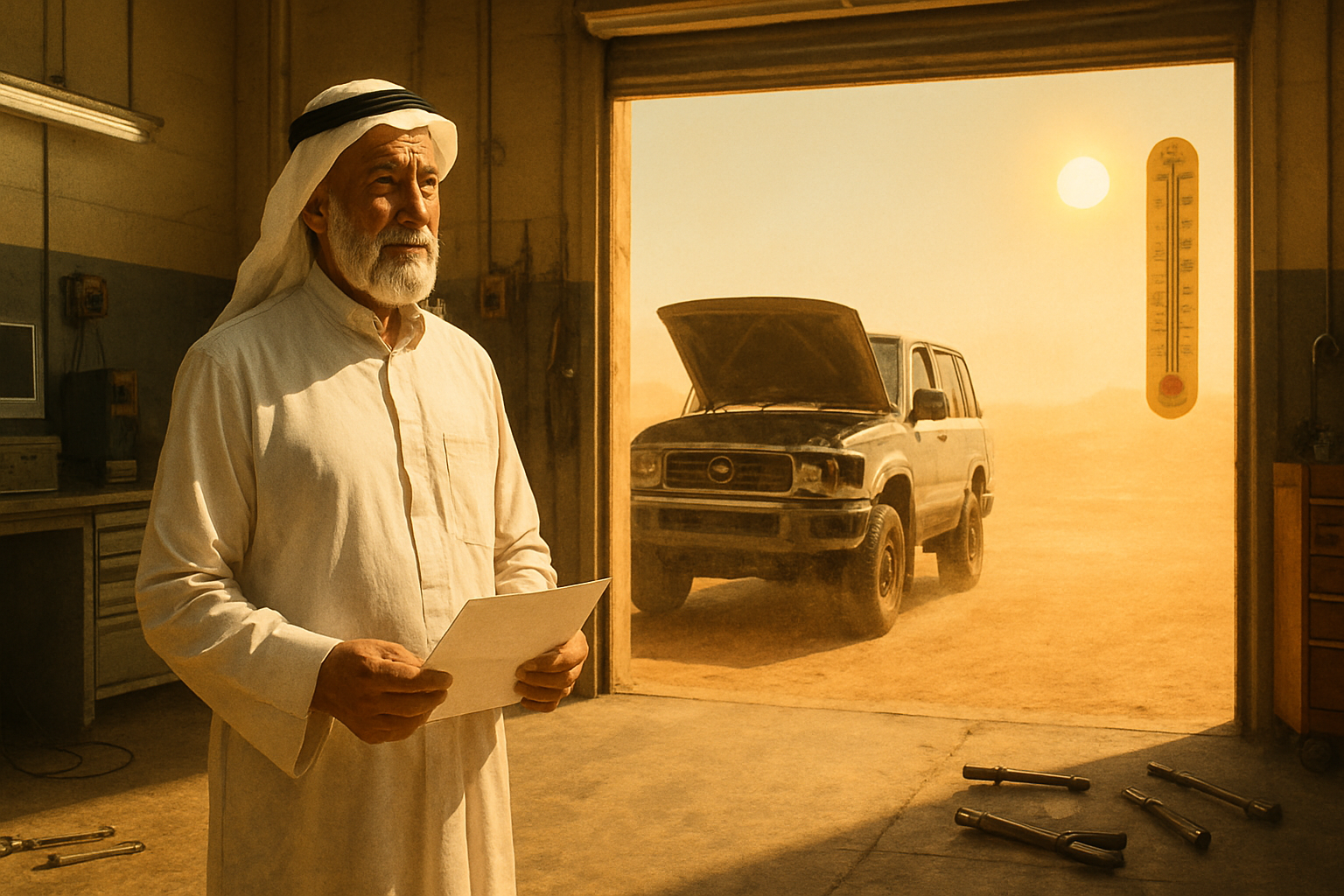
Ahmed walked into my friend's workshop in Shuwaikh last week with his resignation letter. Three years of reliable work on Land Cruisers and Patrols, and he was heading to a Toyota dealership. The timing? Classic April departure.
"Every spring, I lose my best people," says Khalid, who runs a 12-bay operation near the industrial area. "April hits, the heat starts climbing, and suddenly my senior technicians are getting calls from dealerships, Saudi shops, even UAE positions with visa sponsorship."
This isn't coincidence. April in Kuwait triggers a perfect storm: temperatures jumping toward 40°C, dealerships ramping up seasonal hiring, and mechanics realizing they'll be working in furnace conditions for the next six months. The good ones start calculating whether the grass is greener elsewhere.
But here's what surprised me after talking to dozens of mechanics across Kuwait City and Ahmadi: it's not primarily about money. Sure, salary matters, but the mechanics leaving aren't just chasing higher paychecks. They're escaping situations where they feel stuck, unrecognized, and treated like replaceable parts rather than skilled professionals.
The workshops keeping their best people? They've figured out three specific systems that create loyalty without matching dealership salaries. Let me show you what actually works.
The Salary Myth: What Kuwait Dealerships Really Pay
Before we dive into solutions, let's kill the myth that dealerships always pay dramatically more. I spent a month researching actual salaries across Kuwait's automotive sector, and the numbers might surprise you.
A senior technician at Toyota Kuwait earns 400-550 KWD monthly, plus benefits. That same skill level at a good independent shop? 350-450 KWD. We're talking about a 50-100 KWD difference, not the massive gap most shop owners assume.
"I actually took a pay cut when I went to the dealership," admits Omar, who left an independent shop in Hawally last year. "But I got tired of being treated like I was disposable. At the dealership, there's structure. I know where I stand, what I need to do to advance."
This is the real issue. Mechanics aren't just selling their time—they're investing their careers. When a shop offers no clear progression path, no recognition system, and no professional development, even competitive pay feels like a dead end.
Consider Fahad, a transmission specialist in Jahra. He stayed with his independent shop for five years at 380 KWD monthly when dealerships offered 420 KWD. Why? "My boss invested in training me on new CVT systems. He sends me to courses, gives me a tool budget, treats me like a partner in the business. The dealership guys? They're just numbers."
The Hidden Dealership Costs
Dealerships also come with downsides that smart independent shops can exploit:
- Rigid schedules: No flexibility for family emergencies or personal needs
- Corporate bureaucracy: Every decision needs approval from three managers
- Limited customer interaction: Mechanics become faceless parts of a machine
- Standardized processes: Less room for creative problem-solving
The opportunity for independent shops isn't matching dealership compensation—it's providing what dealerships can't: personal recognition, flexible progression, and a sense of ownership in the business.
System #1: Recognition and Progression That Actually Means Something
Most Kuwait workshops have two job titles: "mechanic" and "head mechanic." That's it. A talented 22-year-old starts as a mechanic, and if he's lucky, becomes head mechanic when the current guy retires or leaves. No wonder people feel trapped.
Successful shops create real progression paths with specific milestones and rewards.
The Four-Tier Structure That Works
Apprentice Technician (0-18 months): 180-220 KWD monthly, focused on basic maintenance and learning
General Technician (18 months-4 years): 250-320 KWD monthly, handling routine repairs and diagnostics
Senior Technician (4+ years): 350-450 KWD monthly, complex repairs and mentoring newer staff
Lead Technician/Workshop Supervisor (6+ years): 500-650 KWD monthly, managing workflow and training programs
But titles alone don't create retention. The progression needs teeth—formal reviews every six months where advancement depends on documented skill development, not just time served.
"I know exactly what I need to learn to get promoted," says Hassan, who works at a progressive shop in Salmiya. "My manager sits down with me every six months, shows me my skill checklist, and we plan my next training. I'm not just waiting for someone to notice me."
This shop uses a simple skills matrix: basic maintenance, engine diagnostics, electrical systems, A/C repair, transmission work, and customer relations. Each category has beginner, intermediate, and advanced levels. Technicians advance by demonstrating competency, not by waiting for openings.
Making Recognition Visible
Recognition can't happen in private. The best workshops I visited had visible systems:
- Technician of the Month: Based on customer satisfaction scores, not just volume
- Skill Badges: Physical displays showing each technician's specializations
- Project Ownership: Senior techs get their names on complex jobs they complete
- Training Certificates: Displayed prominently, showing ongoing education
These cost almost nothing but create powerful psychological ownership. When customers see "Hassan - Transmission Specialist, Certified 2024," it builds respect for both the technician and the shop.
System #2: Dignified Working Conditions That Show Respect
Walk into most Kuwait workshops in July, and it's an endurance test. Temperatures hitting 50°C outside, and inside the bays it's barely better. Quality mechanics aren't just looking for work—they're looking for places that respect their physical well-being and professional dignity.
The shops keeping their best people have made strategic investments in working conditions that signal respect, not just comfort.
Climate Control as Competitive Advantage
"I spent 45,000 KWD on climate control for my bays," says Mohammed, whose Ahmadi workshop has zero turnover in the past two years. "Everyone said I was crazy. But when it's 48°C outside and my guys are working in 28°C, they're not looking at job ads on 4Sale."
The math works. Climate-controlled bays cost 3,000-5,000 KWD per bay to install, plus 200-300 KWD monthly in electricity. Compare that to losing experienced technicians who cost 15,000-25,000 KWD each to replace.
But air conditioning is just the beginning. Real dignity comes from proper tooling and clear role definitions.
Tool Budgets That Build Ownership
Most workshops expect mechanics to provide their own tools, then complain when jobs take too long because someone's working with a worn-out wrench set. Progressive shops flip this dynamic.
Successful operations provide:
- Annual tool budgets: 200-500 KWD per technician, controlled by the mechanic
- Specialty tool sharing: Expensive diagnostic equipment owned by the shop
- Upgrade programs: Performance bonuses can be taken as tool credits
- Maintenance responsibilities: Mechanics maintain shop tools but aren't responsible for replacement due to normal wear
"When my boss gave me 400 KWD and said 'buy whatever tools you need,' I knew he trusted me," explains Saeed, a senior tech in Kuwait City. "I'm not fighting with old equipment anymore. I can do my job properly."
Role Clarity: Mechanics Fix Cars, Period
Nothing kills morale faster than asking skilled technicians to sweep floors, answer phones, or handle paperwork. The best workshops have clear divisions:
Mechanics focus on: Diagnosis, repair, quality control, and mentoring newer staff
Service advisors handle: Customer communication, scheduling, and paperwork
Apprentices handle: Cleanup, parts organization, and basic maintenance under supervision
When a 450 KWD-per-month technician spends time doing 150 KWD-per-month work, everyone loses. The mechanic feels undervalued, efficiency drops, and customers wait longer for repairs.
System #3: Fair Piece-Rate Structure That Builds Partnership
The traditional Kuwait workshop model is simple: owner sets prices, mechanics get fixed salaries, profits belong to the owner. This creates an adversarial relationship where mechanics have no incentive to work efficiently or satisfy customers beyond avoiding complaints.
The shops with the highest retention have moved to transparent piece-rate systems that make mechanics feel like business partners, not employees.
The 30-40% Formula That Works
Here's how progressive shops structure compensation:
- Base salary: 60-70% of total compensation, paid monthly for security
- Piece rate: 30-40% of labor revenue on jobs they complete
- Quality bonus: Additional percentage based on customer satisfaction scores
- Efficiency bonus: Extra payment for completing jobs faster than book time without quality issues
For example: A brake job bills at 45 KWD labor. The technician might earn a base 15 KWD (33%) plus bonuses for efficiency and customer satisfaction. This aligns interests—mechanics want to work efficiently and satisfy customers because it directly impacts their earnings.
Transparency Builds Trust
The key is showing mechanics exactly how the math works. Yassin runs a 8-bay shop in Shuwaikh and posts labor rates publicly where all technicians can see them.
"My guys know that brake pads bill at 25 KWD labor, transmission service at 35 KWD, A/C diagnosis at 40 KWD," he explains. "They understand that when they complete a 100 KWD labor day, they earn 35 KWD in piece-rate pay. No secrets, no wondering if they're being cheated."
| Job Type | Labor Rate (KWD) | Technician Piece Rate (35%) | Quality Bonus Available |
|---|---|---|---|
| Oil Change | 8 | 2.8 | 0.5 |
| Brake Pads | 25 | 8.75 | 1.5 |
| A/C Diagnosis | 40 | 14 | 3 |
| Engine Diagnosis | 60 | 21 | 5 |
| Transmission Service | 35 | 12.25 | 2 |
Customer Satisfaction Integration
Volume-based bonuses create perverse incentives—rush jobs, cut corners, maximize throughput at the expense of quality. Customer satisfaction bonuses align everyone's interests.
Quarterly reviews track:
- First-time fix rate: Jobs that don't come back within 30 days
- Customer feedback scores: WhatsApp surveys or Google reviews mentioning specific technicians
- Warranty claims: Comebacks due to workmanship issues
- Upsell acceptance: When technicians identify additional needed work, do customers accept recommendations?
Top performers earn an additional 10-15% on their piece-rate earnings. This creates a culture where quality and customer relations matter as much as speed.
The Dealership Comparison: Why Independent Shops Actually Have Advantages
When mechanics consider dealership jobs, they're usually attracted by perceived stability and structure. But dealerships have significant downsides that smart independent shops can exploit.
What Dealerships Really Offer
Advantages: Brand training, structured advancement, steady work flow, benefits packages
Hidden disadvantages: Rigid procedures, limited customer interaction, corporate bureaucracy, less variety in work
"At the dealership, I saw the same problems every day," says Ali, who returned to independent work after 18 months at a major Kuwait City dealership. "Oil changes, recalls, warranty work. I never learned anything new. Here, every day is different—Land Cruiser transmissions, Patrol electrical issues, modified Silverados. I'm actually growing as a mechanic."
Playing to Independent Shop Strengths
Independent shops can offer what dealerships can't:
- Variety: Work on different brands, custom modifications, unique problems
- Customer relationships: Repeat customers who request specific technicians
- Flexibility: Accommodating family needs, religious obligations, personal schedules
- Learning opportunities: Exposure to different systems and technologies
- Entrepreneurial growth: Path to shop ownership or partnership
"My best customers ask for me by name," explains Nasser, who chose to stay independent despite dealership offers. "Mrs. Fatima brings her Camry only to me. Mr. Abdullah trusts me with his modified Patrol. At a dealership, I'd just be employee number 47."
Positioning Your Shop Culture
The key is articulating these advantages to current and prospective mechanics. Don't compete on dealership terms—create your own value proposition:
"We're not a dealership. We're better."
- More variety in work keeps skills sharp
- Direct customer relationships build reputation
- Flexible environment respects personal needs
- Clear advancement based on merit, not corporate politics
- Partnership opportunities for top performers
The Real Cost of Turnover: Why Investment in Retention Pays
Most Kuwait workshop owners underestimate the true cost of losing experienced technicians. They see the obvious replacement costs—recruitment, training, lost productivity during the learning curve—but miss the hidden expenses that can devastate profitability.
The 25,000 KWD Reality
When Ahmed left that Shuwaikh workshop, here's what it really cost the owner:
Direct costs:
- Recruitment: 1,500 KWD (job posting, screening, interviewing)
- Training: 3,000 KWD (8 weeks of reduced productivity while new hire learns systems)
- Documentation: 500 KWD (updating procedures, customer handovers)
Hidden costs:
- Lost productivity: 8,000 KWD (jobs that take longer with inexperienced replacement)
- Quality issues: 4,000 KWD (comebacks and warranty work from new hire's mistakes)
- Customer attrition: 8,000 KWD (customers who follow the technician or lose confidence in the shop)
Total cost: 25,000 KWD per experienced technician lost
Now compare this to retention system costs:
- Improved working conditions: 3,000 KWD per bay (one-time)
- Recognition systems: 500 KWD annually per technician
- Tool budgets: 400 KWD annually per technician
- Piece-rate bonuses: 1,200-2,400 KWD annually per technician
Total retention investment: 2,000-3,000 KWD annually per technician
The Break-Even Math
If retention systems prevent just one experienced technician from leaving every 8-10 years, they pay for themselves. Most shops implementing these systems see much faster returns—reduced turnover within 6-12 months.
"I invested 35,000 KWD in climate control and retention systems two years ago," calculates Khalid. "I haven't lost a senior technician since. My old turnover rate cost me 75,000 KWD annually in replacement costs. Best investment I ever made."
The Compound Benefits
Stable, experienced teams create exponential value:
- Faster diagnosis: Experienced mechanics identify problems quickly
- Higher first-time fix rates: Fewer comebacks and warranty claims
- Better customer relationships: Repeat customers request specific technicians
- Improved efficiency: Smooth workflows between experienced team members
- Training capability: Senior staff can develop new hires effectively
This creates a virtuous cycle: better service leads to higher prices and more customers, which funds further investments in retention systems.
Making the Change: Implementation Reality
Reading about retention systems and implementing them are different challenges. Based on conversations with shop owners who've successfully made these transitions, here's the realistic timeline and obstacles to expect.
Start Small, Think Systems
Don't try to implement everything simultaneously. Successful shops typically follow this sequence:
Month 1-2: Implement recognition systems and career progression discussions
Month 3-4: Introduce tool budgets and role clarity
Month 5-6: Begin piece-rate compensation trials
Month 7-12: Make facility improvements based on feedback
"I made the mistake of trying to change everything at once," admits Faisal, who runs a successful operation in Hawally. "My mechanics thought it was a trick or that I was in financial trouble. Gradual changes let them see the sincerity and adjust to new expectations."
The Resistance You'll Face
Both owners and mechanics resist change, even positive change. Common objections:
From mechanics: "What's the catch?" "This won't last." "More responsibility means more pressure."
From owners: "These guys should be grateful for steady work." "Investment is too high." "What if they leave anyway?"
The key is starting with small, visible changes that build trust over time.
Cultural Adaptation
Kuwait's workshop culture emphasizes hierarchy and traditional owner-employee relationships. These retention systems work within that context, not against it:
- Respect traditional hierarchy: Senior technicians mentor junior staff
- Maintain owner authority: Final decisions remain with ownership
- Honor cultural values: Flexible scheduling for religious obligations and family responsibilities
- Build on existing relationships: Use personal connections and trust that already exist
The most successful implementations feel like natural evolution of good management practices, not revolutionary changes imported from other cultures.
April will come again next year. When it does, will your best mechanics be planning their exit, or will they be too invested in their careers at your shop to consider leaving?
The choice—and the systems—are up to you.