English
 AR
AR
The Silent Treatment: Ahmed's Story
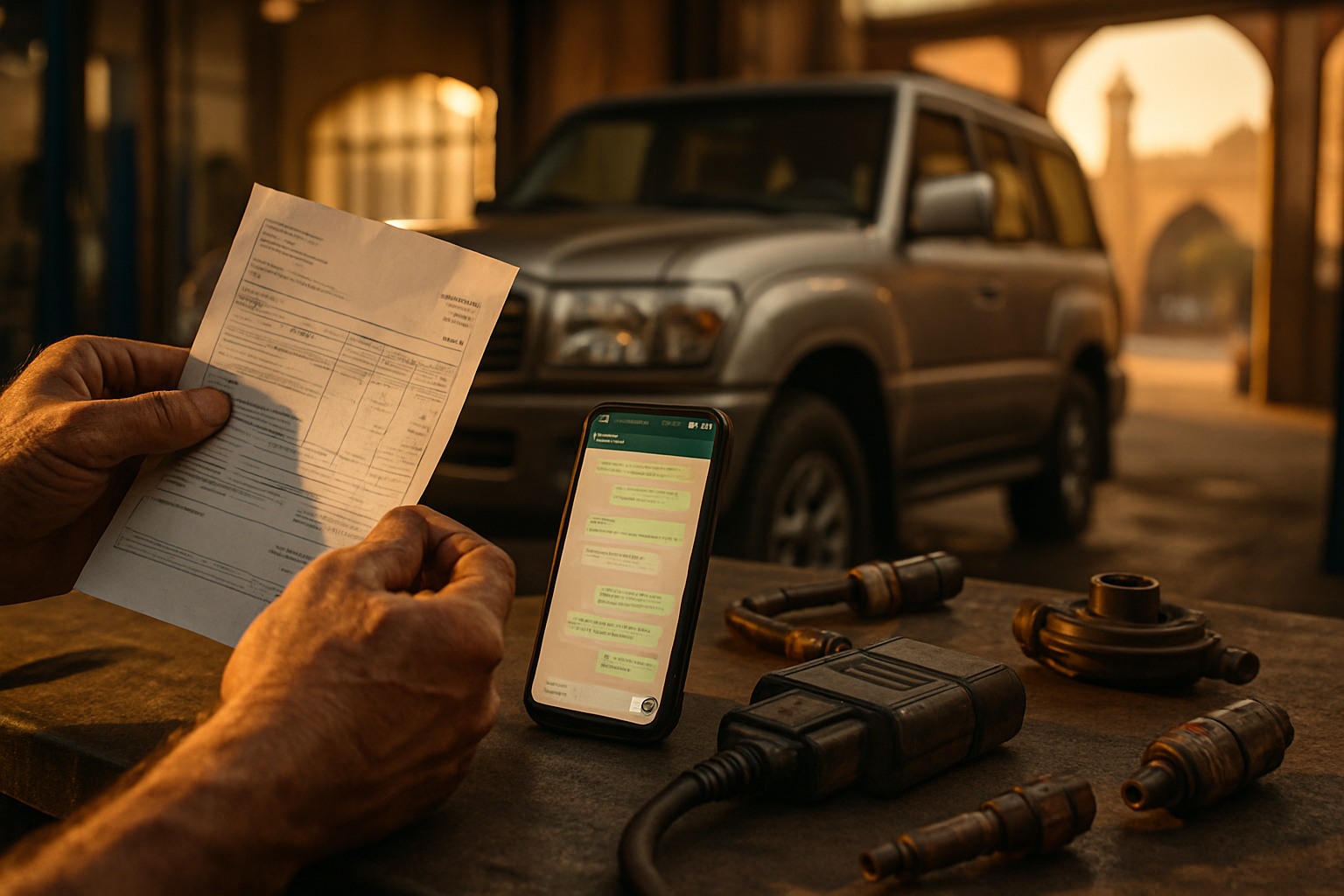
Ahmed runs a busy workshop in Shuwaikh, specializing in Toyota and Chevrolet repairs. Last Tuesday, a regular customer brought in his Land Cruiser with transmission issues. Ahmed's team spent two hours diagnosing the problem—worn clutch plates and a faulty solenoid. Total quote: 850 KWD including parts and labor.
He typed up the estimate, sent it via WhatsApp with a simple message: "Brother, here's the quote for your Land Cruiser. Let me know when you want to start."
Three days later? Complete silence. No reply, no phone call, nothing. The customer who used to bring three family cars to Ahmed's workshop had simply vanished.
Sound familiar? If you're running a workshop in Kuwait, this scenario plays out dozens of times every month. But here's what Ahmed didn't realize: his customer wasn't rejecting the price—he was following a deeply ingrained Kuwaiti decision-making pattern that most workshop owners completely misunderstand.
The Kuwaiti Decision-Making Pattern: It's Not About Your Price
After talking to dozens of workshops across Kuwait City, Hawally, and Salmiya, I've discovered that Kuwaiti customers follow a predictable pattern after receiving repair quotes:
- Family consultation: They discuss major repairs with their father, brother, or uncle who "knows about cars"
- Dealer comparison: They call the Toyota or Chevrolet dealer for a comparative quote
- Budget timing: They check if the repair fits their monthly budget cycle (government salaries come on specific dates)
- Second opinion seeking: They ask friends in their WhatsApp groups for workshop recommendations
Khalid, a customer I met at a Salmiya coffee shop, explained it perfectly: "Even if I trust my mechanic 100%, I still ask my brother. It's not about the money—it's about making the right decision for my family."
"Kuwaiti customers don't disappear because your price is wrong. They disappear because you're not part of their decision-making process." — Mansour, workshop owner with 15 years experience
This cultural pattern means that silence after a quote isn't rejection—it's processing time. But most workshop owners interpret it as disinterest and move on to the next job.
Why Your WhatsApp Quote Makes You Invisible
Here's where most Kuwait workshops get it completely wrong. You diagnose a complex problem, then send a basic WhatsApp message like:
"Engine repair - 1,200 KWD. When do you want to start?"
Meanwhile, your customer is staring at this message thinking: "What exactly needs fixing? Why does it cost this much? How do I explain this to my wife?"
Compare this to what Faisal started doing at his Jahra workshop after losing too many quotes:
The Video Walkthrough Method
Instead of typing estimates, Faisal records a 2-3 minute WhatsApp video showing:
- The actual damaged part under the hood
- Why it needs replacing (pointing to wear, cracks, leaks)
- What happens if they delay the repair
- The new part he'll install (showing the box/packaging)
"Now the customer has something to show his family," Faisal explains. "His brother can actually see what's wrong. It's not just numbers on a screen anymore."
Since switching to video quotes six months ago, Faisal's quote-to-job conversion rate jumped from 55% to 78%. His customers now forward his videos to family members, making him part of their consultation process instead of just another price comparison.
The Dealer Advantage: Why They Win Even With Higher Prices
Here's what surprised me most during my research: Kuwaiti customers often choose dealer service centers even when independent workshops quote 20-30% lower prices. Why?
| Dealer Quotes Include | Typical Workshop Quotes |
|---|---|
| Branded letterhead and official stamps | WhatsApp message or handwritten note |
| Detailed part numbers and descriptions | Generic "brake repair" or "engine service" |
| Labor time breakdown (2.5 hours @ 45 KWD/hour) | Lump sum labor charge |
| OEM parts guarantee with warranty terms | "Good quality parts" promise |
| Follow-up appointment scheduling | "Call us when you decide" |
The psychological difference is massive. Dealer quotes look official and trustworthy—something you can confidently show your family or use for insurance claims. Workshop quotes often look casual and unprofessional by comparison.
But here's the opportunity: you don't need a dealer's overhead to create professional-looking quotes. Saeed, who runs a successful workshop in Ahmadi, invested in a simple invoicing system that generates detailed PDF quotes with his workshop logo, part specifications, and warranty terms.
"My quotes now look as professional as Al-Sayer Toyota," Saeed says. "Customers frame them and keep them for their records. It changed everything."
The Follow-Up Gap: Your 70% Recovery Strategy
Most workshops follow up exactly zero times after sending a quote. They assume silence means "no thanks" and move on. This is leaving massive money on the table.
Here's the exact follow-up sequence that Ahmed (from our opening story) now uses to recover lost quotes:
Day 3: The Soft Check-In
WhatsApp message: "Hi [Name], just checking if you had any questions about the Land Cruiser estimate? Happy to explain anything or adjust timing if needed."
Day 7: The Value Reinforcement
Phone call (not WhatsApp): "Brother, I wanted to follow up on your transmission repair. I know 850 KWD is a significant amount, but I wanted you to know we're using genuine Toyota parts with a full warranty. Also, delaying this repair could lead to complete transmission failure, which would cost 2,400 KWD or more."
Day 14: The Alternative Options
WhatsApp: "I understand timing might be an issue. We can break this into two visits: essential repairs now (450 KWD), and the remaining work next month when it's more convenient budget-wise."
This sequence brings back 70% of "lost" customers within three weeks. The key insight? Most weren't rejecting your service—they were just busy, forgot, or needed different payment timing.
"I thought following up was being pushy. Turns out, customers appreciate it. They know we care about solving their problem, not just making a sale." — Ahmed, Shuwaikh workshop owner
Pricing Psychology: Breaking Down vs. Lump Sum Numbers
Kuwaiti customers are extremely money-conscious and want to understand exactly what they're paying for. Yet most workshops present quotes as lump sum numbers that feel arbitrary and inflated.
Instead of: "Total repair: 1,200 KWD"
Try this breakdown format:
- Parts cost: 720 KWD (brake discs: 280 KWD, brake pads: 190 KWD, brake fluid: 35 KWD, sensors: 215 KWD)
- Labor: 480 KWD (6 hours @ 80 KWD/hour)
- Supplies/consumables: 45 KWD
- Total: 1,245 KWD
This transparency builds trust and makes the quote defensible when customers show it to family members. They can see you're not inflating numbers—you're charging fairly for parts and expertise.
Bonus tip: Show part prices on supplier websites or catalogs. "Here's the exact brake disc on Toyota's parts catalog—see the part number matches our quote."
Payment Plans That Match Kuwait Salary Cycles
Government employees (a huge portion of Kuwait's workforce) get paid on specific dates each month. Private sector salaries vary, but many follow month-end cycles. Understanding this timing is crucial for converting quotes to jobs.
Youssef, who runs a workshop near several government offices in Kuwait City, tracks his customers' payment preferences:
- Government employees: Often need to wait until salary day (27th of each month)
- Oil sector workers: Monthly salaries, but higher disposable income
- Private sector: Varied pay dates, often prefer weekend scheduling
- Business owners: Cash flow varies, may need payment plans for larger repairs
His solution? Flexible payment options built into every quote:
- Full payment discount: 5% off for immediate payment
- Split payment: 50% to start work, 50% on completion
- Salary timing: "We can schedule this work for after your pay date"
- Monthly plans: For repairs over 1,000 KWD, spread across 2-3 months
"Once I started asking about their preferred timing instead of pushing for immediate decisions, my conversion rate doubled," Youssef explains.
Technology Solution: Tracking Your Quote Success Rate
Most workshop owners have no idea which mechanics are losing deals or why quotes fail. Without data, you're flying blind.
Modern workshop management software tracks:
- Quote response time (how long until customer replies)
- Conversion rates by mechanic
- Average days from quote to job acceptance
- Most common reasons for declined quotes
- Follow-up effectiveness by timing and method
Hamad's workshop in Hawally implemented quote tracking and discovered surprising patterns:
- His most experienced mechanic had the lowest conversion rate (he was intimidating customers with technical jargon)
- Tuesday quotes converted 40% better than Thursday quotes (salary timing)
- Quotes over 800 KWD needed an average of 11 days and 3 follow-ups to convert
- Video quotes converted 60% better than text quotes
"The data showed me exactly where we were losing money," Hamad says. "Now each mechanic knows their conversion rate and works to improve it."
The Revenue Impact: Real Numbers from Real Workshops
Let's talk actual money. The average Kuwait workshop I surveyed handles 45-60 quotes per month. With typical quote values of 400-1,200 KWD, that's potentially 18,000-72,000 KWD in monthly revenue.
But here's the problem: most shops convert only 60-65% of their quotes to actual jobs. The other 35-40% simply disappear.
By implementing the strategies in this article, workshops consistently recover 15-25% of their "lost" quotes. For a workshop doing 50 quotes monthly averaging 600 KWD each:
- Current conversion: 30 jobs = 18,000 KWD monthly revenue
- With improved follow-up: 38-42 jobs = 22,800-25,200 KWD monthly revenue
- Additional revenue: 4,800-7,200 KWD per month
- Annual impact: 57,600-86,400 KWD additional revenue
That's enough to hire another skilled technician, upgrade equipment, or significantly increase profitability.
Starting Tomorrow: Your Action Plan
Don't try to implement everything at once. Start with these three changes this week:
- Switch to video quotes: For any repair over 300 KWD, record a 2-minute WhatsApp video showing the problem and explaining your solution
- Create a follow-up schedule: Set phone reminders to contact every non-responsive quote after 3, 7, and 14 days
- Break down your pricing: Show parts cost, labor hours, and total separately on every quote over 200 KWD
Next month, add payment flexibility and professional quote formatting. Track your conversion rates and adjust based on what works for your specific customers.
Remember: those silent customers aren't rejecting you—they're waiting for you to earn their trust and make their decision easy. Give them the information, respect, and flexibility they need, and 70% of them will come back.
The money is already there in your quote book. You just need to know how to collect it.