 English
 Español
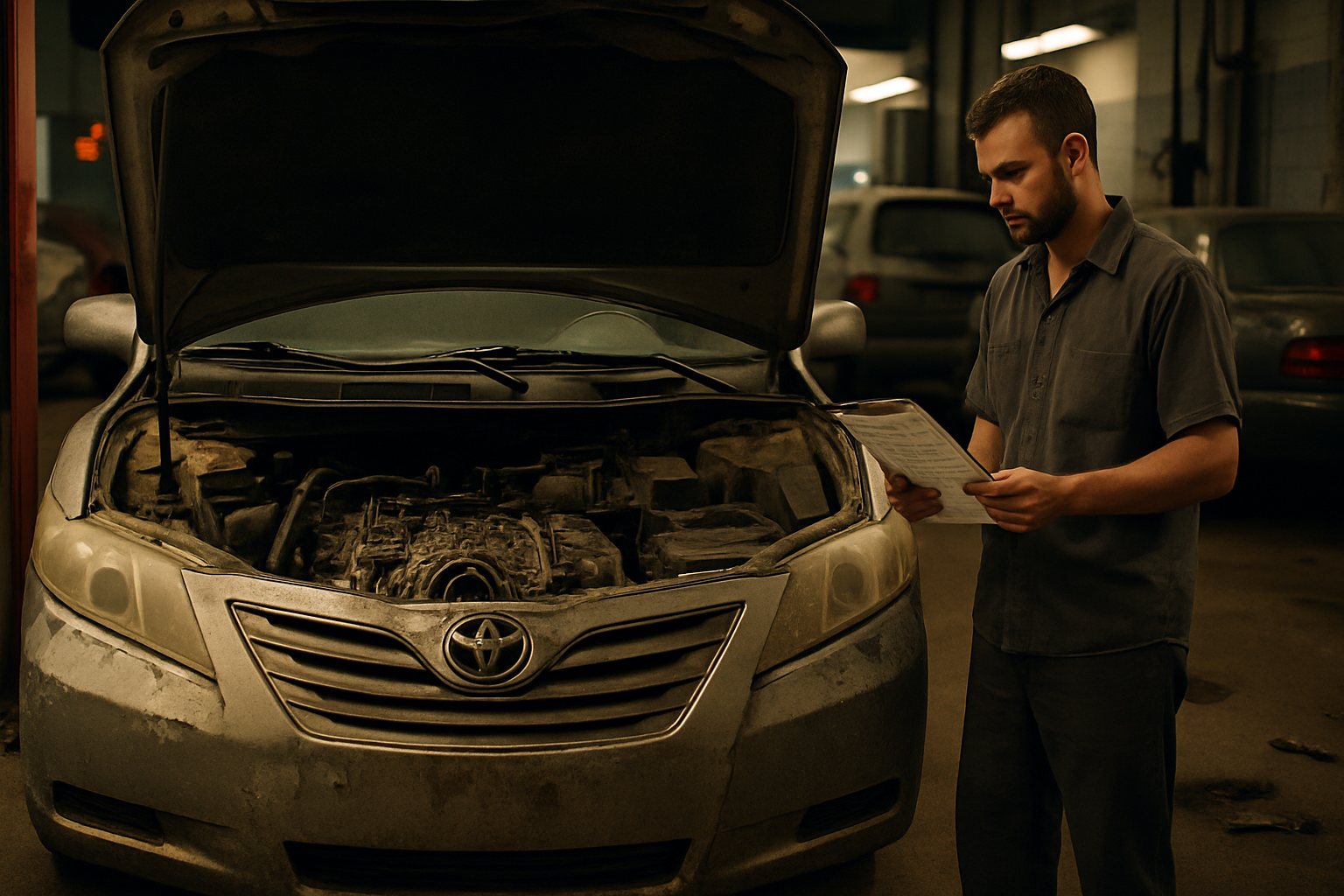
The 200,000-mile question comes up in every American repair shop, every week. Your car needs a big repair — $1,500 for a transmission, $2,200 for an engine mount job, $900 for a timing chain. The mechanic is honest and tells you the cost. Now you are standing in the waiting room doing math in your head.
Should I fix it, or trade it in?
There is a real answer. And it has almost nothing to do with the mileage.
The Real Math: Your Cost Per Month
Forget the mileage for a second. Here is what actually matters: how much does this car cost me per month, compared to the alternative?
Let us say you own a 2012 Toyota Camry with 205,000 miles. The transmission just went — $1,800 to fix. You also owe zero on the car. Your monthly cost right now is insurance ($80) + gas ($180) + maintenance ($40 average) = $300/month.
If you pay the $1,800 and the car lasts another 2 years (very realistic for a Camry), your all-in cost for those 2 years is: $1,800 transmission + $300/month × 24 months = $9,000. That is $375/month.
Now the alternative. Let us say you trade it in for $2,500, put $3,000 down, and buy a 5-year-old Camry for $18,000. Your new payment is $320/month for 60 months. Plus $120/month insurance (newer car, higher premium) + $180 gas + $40 maintenance = $660/month.
The $1,800 repair is not expensive. The $660 monthly alternative is expensive.
The Questions That Actually Matter
Before you decide, ask these five:
- Is this a one-big-repair situation, or a pattern? If the car has been reliable and this is the first major repair in 3 years, fix it. If you have put $2,000 into it over the last 12 months, it is telling you something.
- How is the body and frame? Rust in the frame rails or unibody = do not fix it. Body rust is cosmetic; frame rust is structural. A rust-free drivetrain is worth fixing; a rusty frame makes any engine/transmission repair pointless.
- How reliable is this make and model historically? Camry, Accord, Tacoma, Sienna, Highlander, Odyssey — these routinely go 300,000+ miles with normal maintenance. A Dodge Journey or early-2010s Escape with 200,000 miles is living on borrowed time either way.
- Can you afford to walk? If the repair fails in 6 months, are you going to be okay? If yes, repair. If one more surprise would wreck you financially, the predictable monthly cost of a newer car might be the right move.
- What does the rest of the car look like? If the transmission is dying but you also hear a wheel bearing, the exhaust is rusting through, the AC is weak, and the suspension is soft — that is not one repair. That is a cascade.
The "Cascade" Rule
Most American mechanics will tell you the same thing privately: there is a point where every repair triggers another repair because everything is worn at the same time. When you fix the transmission on a car with worn motor mounts, the new transmission puts different stress on the motor mounts and they fail next month. The fresh brake pads find the warped rotors. The new battery exposes the weak alternator.
If you see a cascade starting — meaning every repair in the last 6 months has been followed by another repair — you are on the wrong side of the curve. One big repair when everything else is solid? That is normal. Three big repairs in 8 months on a 200,000-mile car? That is goodbye.
The Math a Dealership Never Tells You
Dealerships and "we buy cars" ads love to quote you $2,800 for your old Camry and then sell you a new car payment. What they will not mention: the average new car loan in America is now 68 months at 7.1% APR. On a $35,000 car with 10% down, that is $624/month for 68 months — $42,450 total.
A $1,800 transmission repair on a paid-off car is not a financial crisis. Trading it in on a 68-month car loan can be.
When You Should Not Fix It
Be honest with yourself. Sometimes the answer is no:
- Structural rust in the frame or unibody
- Engine needs rebuild AND transmission is weak AND the body is rough
- You hate the car and have hated it for 2 years
- Your commute changed and you need something more fuel-efficient or more reliable for your new distance
- Your family changed (kids, elderly parents) and the car no longer fits your life
In those cases, selling a running car (even with a known issue) to a private buyer usually beats trading it in. Honest listing, fair price, fresh start.
Sources & Further Reading
- AAA — Your Driving Costs (annual report on US vehicle ownership cost)
- Cox Automotive — Manheim Used Vehicle Value Index (monthly wholesale used-car pricing) — coxautoinc.com
- Consumer Reports — Annual Auto Reliability Survey (Camry, Accord, Tacoma routinely top high-mileage rankings)
- iSeeCars — Longest-Lasting Cars Studies — iseecars.com/research
- Edmunds — Average new car loan term and APR data — edmunds.com
Why We Care
My Mekavo is free for American car owners because we think every driver deserves to know what their car has been through. When you track your service history, you stop guessing. You can see whether the last 6 months were a cascade or a one-off. You can show a buyer the 3 years of reliable records when it is time to sell. And you can hand your mechanic a full history instead of a shrug.
The 200,000-mile question gets easier when you can see the data.
Note on scenarios: The shops, names, addresses, and case reference numbers in this article are fictional and used solely to illustrate how the cited statutes operate in practice. Any resemblance to actual shops, owners, or events is coincidental. The statutes, regulations, and agency procedures cited are real and current as of publication.