English
 Español
 Deutsch
 FI
FI
 PT
PT
 BR
BR
 FR
FR
 AR
AR
 ZH
ZH
 UR
UR
 TL
TL
 TH
TH
 TR
TR
 PL
PL
 RO
RO
 BG
BG
 ID
ID
 MS
MS
 LT
LT
 IT
IT
 NL
NL
 CS
CS
 SK
SK
 SL
SL
 ET
ET
 SV
SV
 NB
NB
The Toyota Hilux dominates South African new-vehicle sales year after year, with the Ford Ranger second and the Mitsubishi Triton, Isuzu D-Max and Mahindra Pik-Up making up volume. The reason is simple: bakkies do everything South Africans need — work, weekend trips to the bushveld, school run, towing horseboxes and caravans, ploughing through Highveld winter potholes — and they hold their value better than almost anything else on SA roads.
The downside: the used bakkie market is full of vehicles that have been worked hard. A 2019 Hilux on AutoTrader ZA at R385,000 might be a beautifully kept private buy, or a battered ex-farm vehicle that has been steam-cleaned and listed.
Here are the 12 things to check before you commit, beyond the basic test drive.
1. The Service History — and Where the Services Were Done
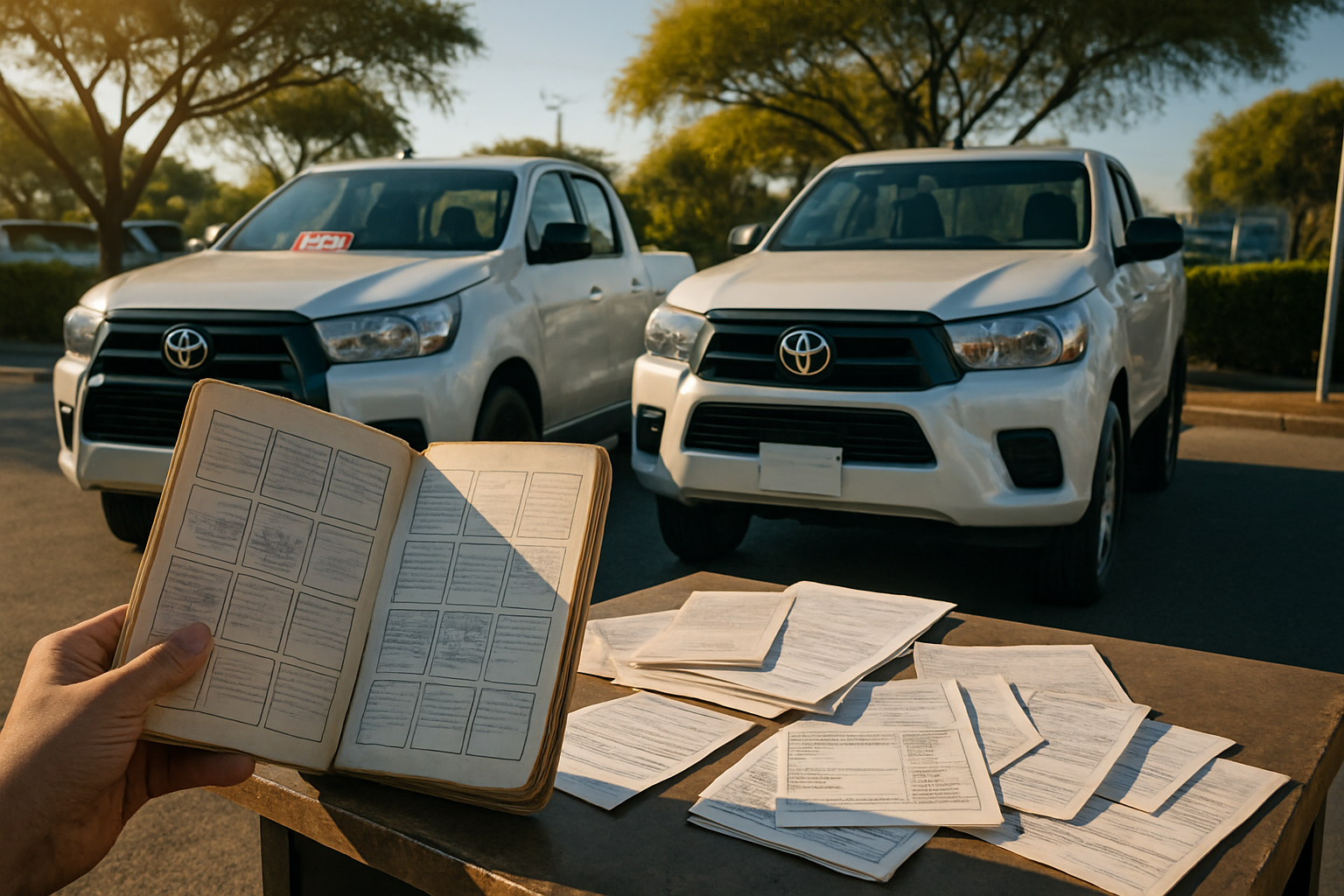
A logbook full of Toyota main dealer stamps on a Hilux is gold. A logbook with stamps from a single rural Limpopo or Mpumalanga town suggests the bakkie spent its life on dirt roads. A logbook with no stamps but a stack of independent garage receipts is fine if the receipts are detailed.
Missing logbook? That is a R30,000-R60,000 discount, easily.
Look specifically for:
- Diesel particulate filter (DPF) regeneration history — repeated DPF clogs suggest short-trip use, which destroys diesel bakkies over time
- Timing belt replacement at the manufacturer's recommended interval (varies by model)
- Diff oil and transfer case oil changes (especially if 4×4)
- Cambelt or timing chain status
2. Frame and Chassis Rust
Coastal-province bakkies (KZN coast, Western Cape coast, Eastern Cape coast) face salt-air rust. Look under the car with a torch:
- Chassis rails — should be solid, no flaking
- Around the rear leaf spring shackles
- Behind the front wheel arches
- Around the load bed mounting bolts
Surface rust is cosmetic. Bubbling, flaking, or holes you can punch through with a screwdriver is structural — walk away.
Highveld and Karoo bakkies usually have less rust but more sun damage to seals, dashboard plastics and tyre sidewalls.
3. The Load Bed
The load bed tells the truth about how the bakkie has been used:
- Light scratches and dings: normal wear, fine
- Heavy scoring across the floor: regularly hauled steel, gravel, building materials — ex-tradie or commercial vehicle
- Drilled holes from accessories: previous owner fitted a canopy, ladder rack, toolbox — ask why removed
- Permanent dents from heavy loads: regularly carried near or above payload
- Caustic stains (battery acid, fertiliser residue): ex-farm or ex-mining bakkie
- Rust around the bed-to-cab join: water ingress, sealing failure
4. Suspension Sag
Park the bakkie on level ground. Look at the rear ride height — does it sit lower than factory? Does the rear sit lower than the front? A heavily-loaded life means tired leaf springs.
Bounce each corner firmly. The suspension should rebound once and settle. Bouncing 2-3 times means worn shock absorbers — R3,000-R10,000 to replace all four for a Hilux or Ranger at typical SA prices.
5. The 4×4 System (if 4×4)
Most SA bakkies are 4×4 or have 4×4 variants. Check the 4×4 actually works — easily ignored, expensive to fix.
- Find a quiet road or empty parking area
- Engage 4H (high-range 4×4) — many models require you to be stationary or under 80 km/h
- Drive 50 metres in 4H — should engage smoothly, no clunking, no warning lights
- Engage 4L (low-range) — only at full stop. Should snap into place; gearing change should be obvious.
- Disengage and re-engage 2H — should return to 2WD cleanly
Common faults: stuck transfer case actuator, worn vacuum hub system on older Hiluxes, electronic 4×4 module failures on Rangers.
6. The Diesel Engine on Cold Start
Ask the seller NOT to start the bakkie before you arrive. A cold start tells you a lot:
- Glow plug warm-up: should be a brief amber dash light. Stays on too long = battery weak or glow plug fault.
- First 5 seconds of running: any white smoke past 30 seconds = potential head gasket or injector issue. Black smoke = fuel mixture, possibly clogged DPF or injector. Blue smoke = oil burning, expensive.
- Idle: should settle to smooth steady idle within 60 seconds. Rough hunting idle on a warmed engine = injector or sensor issue.
7. Towing Damage Indicators
Many bakkie owners tow caravans, boats, horseboxes — sometimes far over the rated limit. Towing damage shows up in:
- Towbar wear — chrome ball polished smooth = heavy use; deep scratches = towed regularly
- Transmission cooler — often added aftermarket on heavy-towing bakkies; ask why if present
- Diff oil colour — pull the diff plug; clear honey colour is good; black or burnt smell = abuse
- Brake pads worn unevenly front-to-rear = towing without proper trailer brakes
8. Off-Road Damage
Bushveld trips, dirt-road farms, 4×4 trails — SA bakkies often see real off-road use. Look underneath for:
- Bash plates dented or removed
- Diff housing scraped or punctured
- Exhaust pipe dented from rocks
- Sidewall damage on tyres (sidewalls do not fail from normal road use)
- Mud-caked drivetrain — a bakkie that has been rinsed clean for sale but has dried mud in suspension components has been off-road recently
9. Electrical Aftermarket Add-Ons
Light bars, dual battery setups, UHF radios, fridges, winches, tracker units — common on SA bakkies. Each is a potential source of:
- Wiring shortcuts (taped joints, scotchlocks, illegal main-feed taps)
- Drain on the starter battery (poorly-isolated dual battery setups)
- Voids on remaining factory warranty
- Insurance complications if not declared
Ask for documentation on every aftermarket fit. Ideally professionally installed with receipts. Tracker unit (Tracker, Netstar, Beame, Cartrack) — verify it is active and transferable to your name; many tracker contracts are tied to the seller and need re-registration.
10. Tyres — Brand, Age, and Match
- Tread depth: legal minimum 1mm; aim for 4mm+ on all four for safe SA conditions including Highveld winter
- DOT date code: 4-digit code on sidewall (e.g. "2422" = 24th week of 2022). Tyres over 6 years old harden and become unsafe even with tread.
- All four matching: mismatched brands or tread patterns front-to-rear (especially on 4×4 with full-time AWD systems) damages the centre differential
- Spare: condition matches the others? Tools and jack present?
11. The "Was It a Farm, Mining or Fleet Vehicle?" Question
Ask the seller directly: "Was this ever a farm bakkie, a mining contractor vehicle, or a company fleet vehicle?" Their reaction tells you a lot.
Farm bakkies often have brutal underbody wear from corrugated dirt roads, plus dust ingress wearing engines. Mining bakkies are often immaculate cosmetically but have high engine hours from constant idling. Fleet bakkies often had multiple drivers who did not own the asset.
The vehicle history report sometimes shows the previous owner as a mining contractor or farming operation. Always worth R600-R1,500 for a paid pre-purchase inspection from the Automobile Association of South Africa (AA SA), Dekra, or a trusted independent panel beater on any bakkie over R200,000.
12. The Test Drive — What to Listen For
- Cold start: covered above
- First 100m: any clunks from rear suspension over speed bumps = worn leaf shackle bushes
- 50 km/h dry road: wheel vibration through steering = wheel balance, bent rim, or worn front bearings
- Hard braking from 60 km/h: pulsing pedal = warped front rotors; pulling left/right = uneven pad wear or suspension issue
- Highway 100 km/h: cabin should be acceptably quiet (bakkies are not luxury cars but should not roar)
- Reverse uphill: gentle acceleration in reverse should be smooth — clunking is universal joint or transfer case issue
- Engine off cool-down: any creaking from front suspension as the car settles = ball joint or bush wear
The Safety Net: Pre-Purchase Inspection
Even after all 12 checks, pay R600-R1,500 for an independent pre-purchase inspection. Major SA providers include the Automobile Association of South Africa (AA SA), Dekra, MasterChecks, and many independent panel beaters that offer the service. They put the bakkie on a hoist, check what your eyes cannot see from the ground, and produce a written report. Best money you spend.
Sources & Further Reading
- Road Traffic Management Corporation (RTMC) — vehicle safety standards and registration
- Department of Transport — National Road Traffic Act and vehicle regulations
- Automobile Association of South Africa (AA) — pre-purchase inspection service and used-car buying guides
- South African Government services — vehicle registration and ownership transfer
- Dekra Automotive Services — vehicle inspection and certification — dekra.co.za
- AutoTrader ZA — pricing and listings for Hilux, Ranger, Triton, D-Max — autotrader.co.za
- Cars.co.za — model reviews and used-car listings — cars.co.za
- TransUnion Auto — wholesale vs private pricing benchmarks — transunion.co.za
Related Mekavo articles: NaTIS history check explained — always run this BEFORE viewing any used bakkie. Roadworthy certificate explained — what the RWC tests on a bakkie.
Why We Care
My Mekavo is free for South African car owners. Once you buy a used bakkie, log every service, every receipt, every kilometre, every off-road trip — so when you sell, the next buyer can see the full transparent ownership story. Builds resale value, protects you on warranty claims, ends the "I think I changed the diff oil last year" guesswork.
Note on scenarios: The shops, names, addresses, and case reference numbers in this article are fictional and used solely to illustrate how the cited statutes operate in practice. Any resemblance to actual shops, owners, or events is coincidental. The statutes, regulations, and agency procedures cited are real and current as of publication.