English
 Español
 Deutsch
 FI
FI
 PT
PT
 BR
BR
 FR
FR
 AR
AR
 ZH
ZH
 UR
UR
 TL
TL
 TH
TH
 TR
TR
 PL
PL
 RO
RO
 BG
BG
 ID
ID
 MS
MS
 LT
LT
 IT
IT
 NL
NL
 CS
CS
 SK
SK
 SL
SL
 ET
ET
 SV
SV
 NB
NB
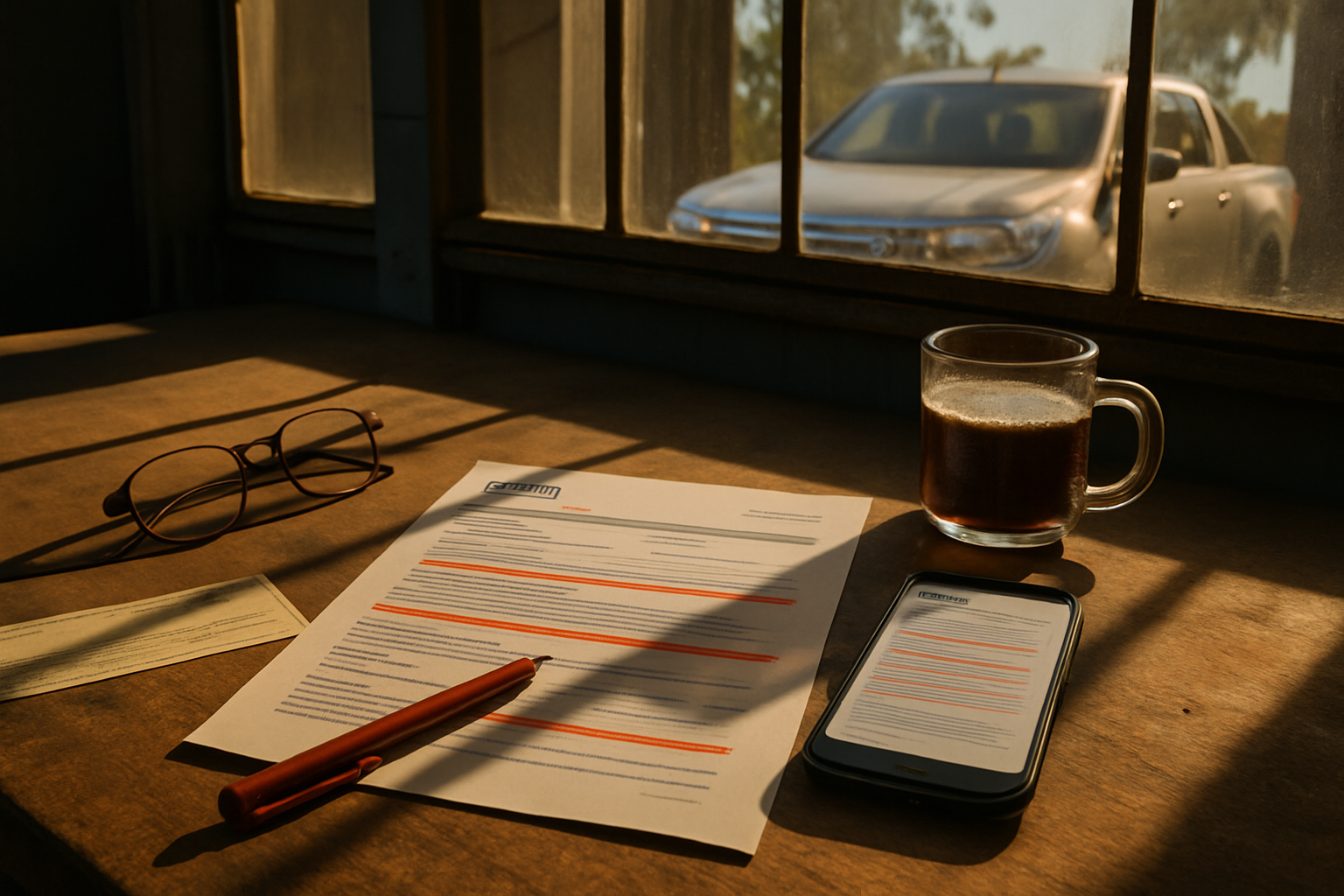
You found a 2019 Toyota HiLux on Carsales for $34,500 in Brisbane. Photos look right. Seller has had it 3 years. You are heading over Saturday with a bank cheque.
Spend $2 first. A PPSR check before buying any used car in Australia is the single highest-return thing you can do. Clean check = peace of mind. Dodgy check = the $5,000 disaster you swerved.
Here is what every line on a Personal Property Securities Register (PPSR) report actually means — plus the things PPSR does not catch and how to cover those too.
What PPSR Actually Is
The Personal Property Securities Register is a national online register run by the Australian Government. It records security interests over vehicles (and other valuable personal property) — most importantly, whether the car has finance owing on it.
You access it directly via ppsr.gov.au. A search costs $2 and runs in seconds. It returns:
- Any security interest currently registered against the vehicle (finance owing)
- The name of the secured party (usually a bank or finance company)
- The date the security was registered
That is it. PPSR alone does not tell you about theft, write-off, odometer history or recall status. For those you need additional checks (covered below).
The PPSR Findings That Matter
1. Active Security Interest (Finance Owing)
This is the single most common nasty surprise in Australian private used-car sales. The seller still owes a bank or finance company on the car. In Australia, most finance is "secured" — the financer can repossess the vehicle from you if the seller defaults, even though you bought it in good faith.
The "innocent purchaser" protection: Personal Property Securities Act 2009 has a defence for buyers who paid market value, did not know about the security, and bought from someone who held the asset apparently as their own. But proving "did not know" is hard if you skipped a $2 PPSR check. Courts have ruled that failure to do PPSR weakens the defence.
If a security interest shows on PPSR: do not buy unless one of the following:
- The seller pays off the loan and you see written confirmation from the finance company that the security has been discharged BEFORE you hand over money
- You pay the finance company directly to clear the loan, and any remainder to the seller (split the purchase amount)
- Walk away
Real cost of ignoring: the entire purchase price + legal fees if it goes to court. A $34,500 ute can become a $34,500 lesson.
2. Multiple Security Interests Registered
Sometimes you will see more than one secured party. This is unusual on a private vehicle. Common reasons:
- Refinancing where the old security was not properly discharged
- Business vehicle with chattel mortgage AND personal loan
- Genuine mistake by the lender(s)
Either way: every single registered security must be cleared in writing before you buy. Do not accept "the older one is just a paperwork thing" as an answer.
3. Recently Discharged Security
You may see a security that was recently discharged (released). This is fine — it means the loan was paid off. Just confirm the discharge date is BEFORE the date the seller is trying to sell to you.
Beyond PPSR — Other Checks Aussie Buyers Need
PPSR covers finance only. For the full picture, layer on these additional checks (some free, some $30-$60):
State Vehicle Registration / Status Check (Free)
Each state has a free online check showing:
- Current registration status (rego paid?)
- Compulsory Third Party (CTP) insurance status
- Sometimes: written-off status, stolen status
State systems:
- NSW: Service NSW free check via the registration number — service.nsw.gov.au
- VIC: VicRoads registration check
- QLD: Transport and Main Roads (TMR) registration enquiry
- WA: Department of Transport vehicle enquiry
- SA: Service SA vehicle history report (small fee, more comprehensive)
- TAS, ACT, NT: each has a similar online tool
Written-Off Vehicle Register (WOVR) Check
Australia has a national Written-Off Vehicle Register that records every insurance write-off. Categories:
- Statutory Write-Off: cannot be re-registered. If you see this on a car being sold to drive, the seller is committing fraud.
- Repairable Write-Off: can be re-registered after repair and inspection. Insurance is harder, value is 30-50% below clean equivalent. Buy only with detailed repair invoices and an independent pre-purchase inspection.
Some states include WOVR data in their free vehicle status check; others charge a small fee. Always check.
Stolen Vehicle Check
National database of stolen vehicles. If a vehicle is recorded as stolen, you cannot legally own it — police will seize it the moment they cross-reference the VIN at any registration, transfer or roadside stop. Most state vehicle status checks include this.
Commercial Vehicle History Reports ($30-$60)
Services like CarHistory, RedBook Inspect and CarFacts pull data from PPSR + WOVR + state registrations + insurance claims into a single combined report. Worth the $30-$60 if the car is over $20,000.
The Right 5-Minute Pre-Purchase Process
- Get the registration number AND VIN from the seller before you visit
- Run free state vehicle status check (rego, CTP, written-off, stolen) — 2 minutes
- Run paid PPSR check at ppsr.gov.au — $2, 30 seconds
- Optionally: paid combined commercial history report ($30-$60)
- Check open recalls at productsafety.gov.au/recalls — free
- If everything checks out, drive over and inspect the car physically
- If you are seriously interested, pay an independent mechanic for a pre-purchase inspection ($150-$300 — your local NRMA, RACV, RACQ, RAC WA or RAA all run a vehicle inspection service)
Total cost: $2-$360. Saved cost when something is wrong: $5,000-$30,000.
What PPSR Will NOT Tell You
- Mechanical condition (it is paperwork, not a wrench)
- Service history quality
- Repairs done outside insurance (privately repaired collisions)
- Future reliability
- Whether the car has been mostly driven on dirt roads (matters for utes — significant rust/wear)
- Whether the car was ever a mining or oil/gas industry fleet vehicle (often hard miles)
If You Discover Finance Owing AFTER Buying
- Stop driving the car
- Contact the finance company directly — explain the situation and ask for the settlement figure
- Contact your state consumer protection body: ACCC at the federal level, plus state Fair Trading bodies
- Consider speaking with a community legal centre or a consumer law specialist solicitor
- If you can demonstrate you took reasonable steps (proof of PPSR check showing clear at the time of purchase), the innocent purchaser defence under PPSA 2009 may protect you
- Report to police if there is evidence of fraud by the seller
Sources & Further Reading
- PPSR — Personal Property Securities Register (official, $2 per search, runs in seconds)
- Product Safety Australia — Vehicle Recall Database (ACCC-run, free, by VIN)
- ACCC — Australian Competition and Consumer Commission (used vehicle consumer rights, dealer obligations)
- NRMA — pre-purchase inspection service, used-car buying guides (NSW + ACT)
- RACV — vehicle inspection and used-car advice (Victoria)
- RACQ — vehicle inspection and Queensland-specific advice
- Service NSW — free vehicle registration status check (NSW)
- VicRoads — Victorian registration enquiry
- Transport and Main Roads Queensland — registration enquiry
- Carsales — primary national listing site (often pre-loads PPSR-clear notation) — carsales.com.au
- Gumtree Autos — private-sale listings (always run PPSR independently) — gumtree.com.au
- RedBook — vehicle pricing reference — redbook.com.au
Why We Care
My Mekavo is free for Australian car owners. Once you buy a car that passed PPSR cleanly, log every service, every receipt, every kilometre — so when you sell, the next buyer can run their own PPSR AND see your transparent ownership record. Trust both ways.
Note on scenarios: The shops, names, addresses, and case reference numbers in this article are fictional and used solely to illustrate how the cited statutes operate in practice. Any resemblance to actual shops, owners, or events is coincidental. The statutes, regulations, and agency procedures cited are real and current as of publication.