English
 Español
 Deutsch
 FI
FI
 PT
PT
 BR
BR
 FR
FR
 AR
AR
 ZH
ZH
 UR
UR
 TL
TL
 TH
TH
 TR
TR
 PL
PL
 RO
RO
 BG
BG
 ID
ID
 MS
MS
 LT
LT
 IT
IT
 NL
NL
 CS
CS
 SK
SK
 SL
SL
 ET
ET
 SV
SV
 NB
NB
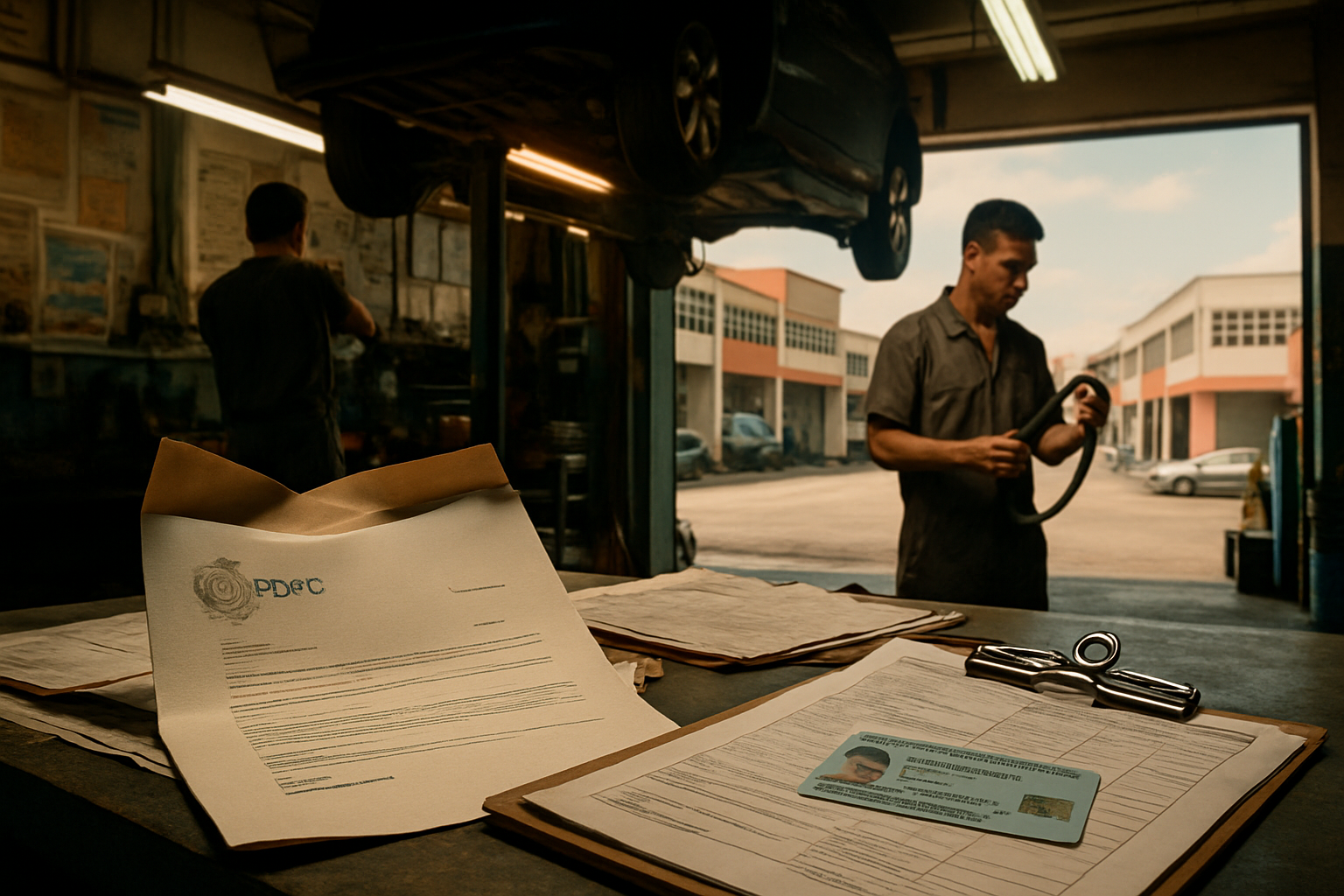
Kenneth has run the workshop on Sin Ming Drive for nineteen years, four technicians, around twelve cars through the bay on a busy day. Timing belts, clutches, suspension, diagnostics. Regulars from Bishan HDBs, private-hire drivers from the Sin Ming autocare cluster, a handful of grab-and-go fleet managers. Tuesday, 4:15 p.m. An email chimes on his phone while he's replacing a tensioner on a Hyundai Avante. Sender: [email protected]. Subject: «Small Claims Tribunal — Consultation Notice — Claim No. SCT/CS/0038471/2026 — Kenneth's Auto Services Pte Ltd — Consultation date in 10 working days».
He opens the attachment. A customer — Hyundai Avante, plate SGR 4729 X — filed the claim at the Small Claims Tribunal eight weeks after the initial breakdown. The filing landed last, not first. The customer went to CASE first, three days after the failure — standard Singapore complainant behaviour. CASE attempted mediation, realised Kenneth's workshop carried the CaseTrust-SVTA motoring accreditation, and referred the matter to MIDReC — the Motor Industries Dispute Resolution Centre. MIDReC mediation failed after two sessions. The customer filed at the SCT. Total elapsed: eight weeks.
Amount claimed: S\$8,000 — S\$1,950 paid for the timing belt and water pump, plus S\$6,050 paid at a manufacturer-authorised workshop in Ubi to repair bent valves when the replacement belt failed on the PIE near Toa Payoh. Grounds cited: "breach of implied term of reasonable care and skill under Consumer Protection (Fair Trading) Act, failure to conform to the Lemon Law provisions in Sections 13 to 18 of the CPFTA, and breach of workshop accreditation standards under CaseTrust-SVTA motoring scheme".
Kenneth has the job sheet on carbonless paper. He has a WhatsApp message where the customer wrote "ok go ahead boss". He has the tax invoice issued through his accounting software with GST registered at 9% and the UEN printed correctly. The invoice — with the company name, UEN, GST registration number, line items and total — satisfies IRAS on the tax front. It carries none of the five lines that CASE, MIDReC and the SCT work through when evaluating a workshop dispute under the CPFTA.
Here's the distinctive thing about Singapore: the complainant has three tiers before anything resembling a court appearance, and a well-advised complainant walks through all three. CASE mediates (mostly without cost to the consumer); CaseTrust membership commits the workshop to accept CASE mediation. If mediation fails and the business is motoring-industry accredited, MIDReC takes the file for adjudication. If that also fails, the SCT handles claims up to S\$20,000 (raised to S\$30,000 by memorandum of consent) with a two-year filing window, no lawyers permitted, consultation-first mediation before magistrate hearing. By the time a workshop sees the SCT filing, two other panels have already read the case — and the customer has had eight weeks to tighten the pleadings.
Before Kenneth's consultation, it's worth settling the Lemon Law confusion that shows up on almost every Singapore workshop complaint.
The Lemon Law trap — and why the real risk lies elsewhere
The Consumer Protection (Fair Trading) Act 2003 (CPFTA) had the Lemon Law provisions added via the 2012 amendment — Sections 13 to 18. They give consumers the right to repair, replacement, price reduction or rescission when goods do not conform to contract within six months of delivery. The operative word is "goods". The Lemon Law applies to motor vehicles, parts and consumer products. It does not apply to services — which means a workshop's labour is outside its scope, while parts supplied by the workshop are within it.
This is the split that most complainants (and many paralegals) miss. A belt that fails is a "goods" issue — potentially Lemon Law. The labour to install that belt is a "services" issue — governed by the ordinary implied term of reasonable care and skill at common law (preserved by the Supply of Goods Act and the CPFTA's unfair-practices provisions in Schedule 2, Part 1). The customer in Kenneth's file tries to pin the whole S\$8,000 claim on Lemon Law, which is technically incorrect for the labour component and the consequential damages.
That's good news and bad news. Good: a Lemon Law defence to the labour component is straightforward at the SCT — the magistrate will apply the correct legal framework regardless of what the complainant pleads. Bad: the reasonable-care-and-skill standard at common law + the CPFTA's unfair practice provisions + the CaseTrust accreditation conduct standards still put the workshop on the back foot if the documentation isn't there. The Lemon Law mistake doesn't save Kenneth; it just shifts the legal basis of the same fact pattern.
The real question at every tier — CASE, MIDReC, SCT — is whether the workshop documented the job adequately, exercised reasonable care and skill, and honoured any warranty offered. The five lines below answer all three.
The five lines every Singapore workshop's job sheet should already carry
1. Full business identification — UEN, GST registration, and any accreditations
Company name, UEN (Unique Entity Number), GST registration number (if GST-registered — mandatory above S\$1 million turnover), registered business address, BizSAFE level (if applicable for worker-safety accreditation), and — most important for motor disputes — CaseTrust-SVTA accreditation number with issue and expiry dates if the workshop is accredited. An accredited workshop that forgets to print the CaseTrust reference on the job sheet loses the reputational signal and the advantage of clear escalation path. A non-accredited workshop avoids the MIDReC step entirely (CASE still mediates, but SCT is the next stop if mediation fails) — which is not necessarily better, because MIDReC adjudication is often faster and more merchant-friendly than the SCT. Print the identification block once in the header and keep it current.
2. Written job quotation with scope, parts provenance and labour breakdown — before any work
Customer name, contact, vehicle make/model/plate/chassis/mileage at intake, detailed scope ("replacement of timing belt, tensioner, idler pulleys, water pump — OEM Hyundai or specified equivalent"), unit prices for parts, labour hours × hourly rate, total quoted amount, estimated completion date, quotation validity (7 or 14 days is standard in SG). Customer signature accepting the quotation. Any WhatsApp exchange can supplement the signed quotation as context but cannot replace it — the SCT and MIDReC both give decisive weight to a signed written quotation over screenshots. A text "ok go ahead boss" is evidence of the customer's approval of something; it does not tell the adjudicator what was approved. Print the quotation, get the signature, hand over a copy, start work.
3. Additional-work authorisation clause — written before execution
Fixed clause on every quotation: "Any additional parts or labour required beyond the scope of this quotation will be notified to the customer in writing (WhatsApp or email acceptable) with revised cost and, if applicable, revised completion date. The customer's written acceptance will be obtained before the additional work commences. No charges for unauthorised additional work will apply." When Kenneth opens the timing cover and finds the water pump weeping, he stops, photographs, sends the revised line item and cost on WhatsApp, receives "ok confirm" in writing, attaches the screenshot to the job sheet, then proceeds. Two minutes of process that convert an eventual CPFTA unfair-practices complaint into a documented authorised variation. The SCT magistrate reads the WhatsApp trail and the additional-work claim fails.
4. Workshop warranty — written, specific, no shorter than what is reasonable for the job
Singapore has no statutory minimum warranty period for workshop services. The common commercial standard in the industry is 3 months or 5,000 km, whichever is earlier, on parts and labour — mirroring the legal minimums of most jurisdictions we trade with (UK's Motor Ombudsman, Ontario CPA, Quebec LPC). CaseTrust accreditation imposes additional conduct standards but does not fix a universal warranty length. Printing a warranty that is shorter than the commercial standard — "30-day warranty", "parts warranty only" — is a mistake: the SCT magistrate may treat the unusually short period as evidence of unfairness and apply the implied reasonable-care-and-skill period instead (which, for a timing belt, is ordinarily expected to last at least 50,000 km or 4 years, whichever first). Write a clear warranty, meet the commercial standard, and state it on both the quotation and the tax invoice.
Suggested clause: "Warranty: 3 months or 5,000 km, whichever occurs first, on parts installed and labour performed by this workshop, effective from date of vehicle return. Warranty does not cover damage from abuse, modification by third parties, or continued use of the vehicle after a fault is noticed. Warranty claims to be directed to this workshop within warranty period; failure to notify within reasonable time may reduce coverage."
5. Customer sign-off at vehicle collection — with state photos and engine-running audio
Add a line to the tax invoice pickup copy: "I have collected the above vehicle in running condition consistent with the workshop services performed. I acknowledge the workshop warranty stated above and understand its conditions. Customer signature: ____________." Signature at collection does not waive warranty rights — the 3-month clock keeps running — but shifts the evidentiary posture from "defective delivery" (burden on the workshop) to "later failure" (analysis of causation on balance of probabilities). Back it up with two or three photos taken on the workshop phone (dashboard, odometer, engine bay area worked on), and a short audio clip of the engine starting and idling without abnormal noise. Upload to the customer's service record. Five seconds at collection that cover three months of dispute at MIDReC and the SCT.
What happens now in Kenneth's file
Consultation at the SCT at 1 Havelock Square in ten working days. Both parties attend in person (or by video-link for the customer if she applies for it). The registrar mediates first. The customer brings her tax invoice, the authorised workshop's invoice for S\$6,050, photos of the Avante on the PIE shoulder, the "ok go ahead boss" WhatsApp thread, a reply from Kenneth that says "come down I'll check" eleven days after the failure was reported (and after the customer had already recovered the vehicle from the authorised workshop). She also brings the CASE and MIDReC case closure letters — procedural but useful context at the SCT.
Kenneth brings the parts receipt from the supplier at Ubi, the paid tax invoice, and the handwritten job sheet. No signed written quotation under the standard the SCT expects. No written authorisation trail for the water pump that was added during the job. No documented warranty other than a verbal "three months" that no one else heard. No collection signature. The consultation fails to settle. The matter proceeds to a magistrate hearing in eight weeks.
The magistrate applies the implied term of reasonable care and skill at common law, finds on balance of probabilities that the belt failure was more likely caused by incorrect installation (based on the authorised workshop's diagnostic report that Kenneth cannot rebut without his own expert), and makes an order against the workshop for S\$6,200 — full refund of the original invoice plus a portion of the authorised workshop's invoice, apportioning some to the customer's choice of workshop. Costs are not generally awarded at the SCT, but the workshop pays the registry filing fee. MIDReC's failed mediation doesn't technically count against Kenneth in the SCT, but the file is on CaseTrust's record.
Direct cost: S\$6,200, one lost afternoon at consultation, one lost morning at the hearing, ten hours of preparation time. The CaseTrust accreditation review committee reviews the MIDReC file quarterly; a second matter within twelve months triggers an accreditation-status review. And Google indexes workshop names against SCT case references in the long tail — not as directly as Reclame Aqui or the Brazilian PROCON registry, but present enough that a motivated new customer can find it.
Cost of having printed the five lines on every quotation for the past nineteen years? Five minutes of template work. Once. For the next six thousand jobs.
The quotation and invoice you're already printing
Mekavo prints all of the above — full business identification with UEN and CaseTrust reference, quotation with scope and parts provenance and labour breakdown, additional-work authorisation clause, written workshop warranty with commercial-standard length, customer collection signature with timestamped photos — on every quotation and tax invoice, automatically. When the SCT consultation notice lands three months after the job, the paperwork the customer already has is the paperwork the workshop walks into the registry with. Nothing to reconstruct: it's printed with date, UEN, customer signature and the statutory framework that protects the workshop.
CASE mediates, MIDReC adjudicates, the SCT decides — three well-run tiers in sequence, each with a reasonable expectation that written documentation answers half the questions before they are asked. Nothing about the regulatory posture is softening. What a workshop can change is the face of the quotation and the tax invoice that leaves the counter. Five lines. Print once. Keep them on every job.
Official resources
- Consumer Protection (Fair Trading) Act 2003 — Singapore Statutes Online
- Small Claims Tribunals Act 1984 — Singapore Statutes Online
- Small Claims Tribunals — process and filing (State Courts)
- Consumers Association of Singapore (CASE)
- CaseTrust — Motoring Business Accreditation (SVTA partnership)
- CASE — Submit a complaint
- MTI — Advisory on CPFTA and Lemon Law scope
Last updated: April 2026. The statutes and procedural rules cited were in force at the date of publication. For an active SCT filing, MIDReC adjudication in progress, or CaseTrust accreditation review, consult a lawyer admitted to the Singapore Bar with consumer or commercial practice before making decisions that could affect proceedings already underway.
Note on scenarios: The shops, names, addresses, and case reference numbers in this article are fictional and used solely to illustrate how the cited statutes operate in practice. Any resemblance to actual shops, owners, or events is coincidental. The statutes, regulations, and agency procedures cited are real and current as of publication.