English
 Español
 Deutsch
 FI
FI
 PT
PT
 BR
BR
 FR
FR
 AR
AR
 ZH
ZH
 UR
UR
 TL
TL
 TH
TH
 TR
TR
 PL
PL
 RO
RO
 BG
BG
 ID
ID
 MS
MS
 LT
LT
 IT
IT
 NL
NL
 CS
CS
 SK
SK
 SL
SL
 ET
ET
 SV
SV
 NB
NB
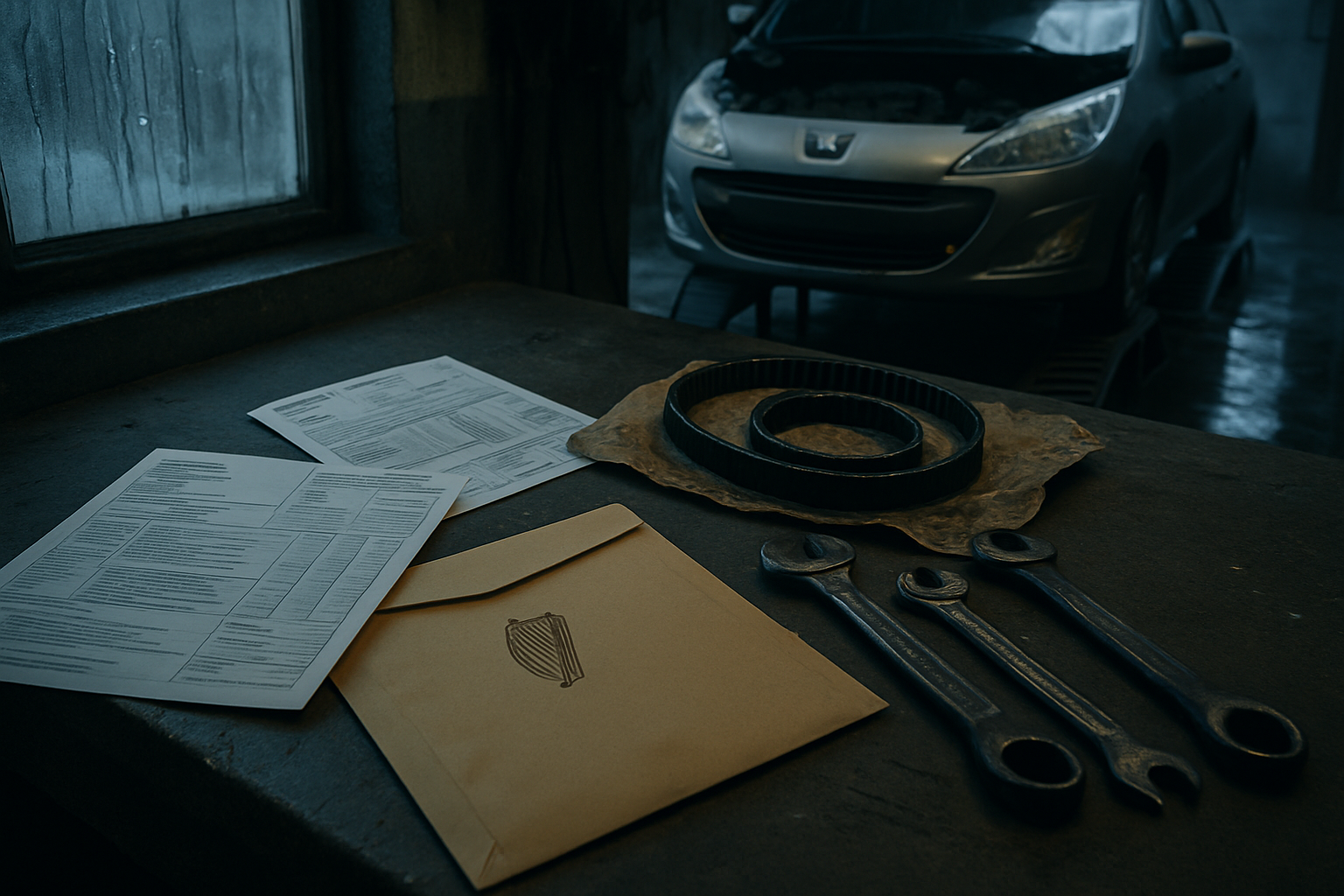
Eamon runs a three-bay workshop off the Tullow Road in Carlow. Timing belts, clutches, diagnostics — sixteen years at it, no fuss, a tight book of regulars. Tuesday morning, 9:20. The postman drops a manila envelope on the counter alongside the usual. Buff colour, State harp, typed address. An tSeirbhís Chúirteanna — Courts Service of Ireland. Small Claims Registrar, Carlow District Court.
Inside: a Small Claims application. Claim number S.C.R. 2026/C/0047. Applicant: a Peugeot 308 driver whose timing belt Eamon had done three months earlier. Claim amount: €1,600 — €900 the customer had paid Eamon, plus €700 she'd since paid another garage to "fix what he got wrong". Grounds cited: "service not carried out with due care and skill under Section 39 of the Sale of Goods and Supply of Services Act 1980".
Eamon has the job. He has the bill. He has the customer's mobile number and, somewhere, a WhatsApp chat where she said "grand, go ahead" to the quote. His invoice — printed clean, with the VAT number, the parts, the labour and the total — did a textbook Irish mechanic's job. It also carried none of the five lines the Registrar will lean on when the case is heard.
Under Small Claims Court procedure, cases up to €2,000 are decided on documents and a brief hearing. No barristers. No discovery. Decisions are binding. Registrars work fast because the list is long — median turnaround seven to twelve weeks. The Sale of Goods and Supply of Services Act 1980 does most of the talking. Here's what every Irish workshop should carry on the invoice before the next buff envelope lands.
The law, in one sentence
Every invoice a garage issues to a consumer in Ireland should carry five mandatory clauses that come from the Sale of Goods and Supply of Services Act 1980 (Section 39 in particular), the Consumer Protection Act 2007, the Consumer Rights Act 2022 (which brought Ireland closer to the EU directive regime), and the invoice-disclosure standards enforced by the Competition and Consumer Protection Commission (CCPC).
Three details that change the application:
- Section 39 of the 1980 Act is not negotiable. It implies into every contract for services an obligation that the supplier "has the necessary skill to render the service" and that the service "will be supplied with due skill, care and diligence". You cannot contract out of this with a customer. The burden of proving compliance, once a dispute is raised, shifts to you.
- The CCPC can audit independently. Under the Consumer Protection Act 2007, CCPC authorised officers can enter a trade premises during reasonable hours, require production of books and records, and issue fixed-penalty or prohibition notices. Fines under the Act can reach €60,000 per offence on indictment (section 79). Most independents never see CCPC — but when they do, it's because a complaint triggered it.
- Missing invoice clauses are an objective breach — they are not about whether your work was good. The Registrar or the CCPC officer does not reopen the technical question. They check whether the lines are there. Absent = breach — even if the Peugeot drove away perfectly.
The 5 clauses an Irish workshop invoice should already carry
1. Written quote and signed authorisation before work begins
There is no statutory threshold in Irish law that maps to a fixed euro amount (unlike France's €150). But the combined effect of Section 39 (service carried out with due skill) and the CCPC's motor-trade guidance is that a professional garage is expected to provide a written, signed estimate before work for anything beyond a trivial job (oil top-up, wipers, a bulb). Anything with parts changing or labour over an hour should have a signed quote.
What's usually missing from Irish workshop paperwork: the customer's signature. A WhatsApp "grand, go ahead" is evidence — but it is not a signed acceptance. Before the Small Claims Registrar, the absence of a signed estimate shifts the weight of Section 39 against you: you cannot easily show the scope was agreed, so you cannot easily show the work was carried out as instructed.
If the work runs over the estimate by more than a small margin — Irish caselaw treats 10-15% as the informal ceiling — you must get the customer's consent in writing before continuing. Without that consent, you cannot recover the excess.
2. Vehicle identified at intake: reg, make, model, mileage on arrival
Irish invoices routinely include the reg. They almost never include the mileage at the moment the car came in. That one missing line is the line that loses cases.
Here's why it matters: if the customer claims the fault recurred, the Registrar wants to know how far the vehicle was driven between your job and the second opinion. The intake odometer is the only objective data point that bounds this. Without it, the customer's word — "barely drove it" — sits unchallenged. With it, the job card shows 134,512 km at intake and the NCT-linked reading at the second garage shows 139,780 km, and suddenly the story changes.
This same reading also protects you against odometer-rollback allegations — a surprisingly common complaint in the used-car feeder market, and one where the CCPC has been active.
3. Parts itemised: reference, quantity, unit price ex-VAT, make
"Front brakes €240" is not a compliant line. The Sale of Goods and Supply of Services Act and the Consumer Protection Act 2007 both lean on the principle that the consumer can assess value for money. That requires:
- Reference number of the part (ATE 13.0460-2832.2, Ferodo FSL1083, Bosch 0986424628, etc.)
- Quantity (2 brake pads, 1 disc)
- Unit price excluding VAT
- Make and whether original-equipment (OE) or equivalent quality — this one is vital where you use adaptable parts that aren't from the vehicle manufacturer
The CCPC has taken action in the motor trade specifically around OE-equivalent pricing. A customer who paid what they thought was OE-part pricing for an aftermarket part has a cause of action under Section 43 of the Consumer Protection Act 2007 (misleading commercial practices) — and the fines on indictment run to €60,000, plus a named entry in the CCPC public enforcement record.
4. Labour: itemised hours at a published rate
Your hourly labour rate should be displayed visibly in the customer-facing area of the workshop. It should be on every invoice, multiplied out by the actual hours booked to each line of work. "Fitting fee €180" is not sufficient — the Registrar wants to see 2 hours × €90/hr = €180 and which job those 2 hours covered.
If you work to standard time-value units (like AW or SMP — standard maintenance procedures — from a DAT/Audatex-style system), the invoice should convert those time units to hours so that the customer can understand. The obligation derives from the general clarity principle that runs through Irish and EU consumer law, and from the CCPC's own published expectations.
5. Old parts: returned or waived — on paper, before disposal
The old parts you remove from a customer's car — the failed compressor, the worn bushings, the spent brake discs — remain the customer's property until they say otherwise. Ireland does not have a single codified article the way France's R224-23 or Germany's KrWG § 12 does, but the principle is established through the general property rules and the Waste Management Act 1996 (as amended), which requires the professional disposer to document the chain of custody for end-of-life vehicle parts.
Three options:
- Customer takes them back: invoice notes "old parts returned to customer at pickup" + list.
- Customer waives in writing: invoice notes "customer waived inspection, parts disposed of by garage under WMA 1996" + the customer's signature or a ticked acknowledgement on the job-in ticket.
- Not applicable: no parts replaced (service only).
Without this signed disposition, the classic complaint — "they kept my good part and put an old one back in" — runs unanswered. The onus is on you to show there was informed disposition of the old components. The 20-second question at intake is the thing that makes that proof.
What happens after the Small Claims notice
Eamon's first instinct is to ring the customer. That's a mistake, not because it's rude, but because the application has already been lodged — the Registrar is now a third party and calls between parties rarely change the outcome of a documents-driven process. The application enters the Small Claims list for hearing in 7-12 weeks.
The Registrar reads Eamon's submitted documents:
- If the invoice is complete — quote signed, intake km, itemised parts with references, itemised labour, old-parts disposition — the Registrar writes a narrative that leans on Section 39 and finds due skill and care was supplied. Case dismissed or settled at a small amount.
- If the invoice is missing three or four lines — as Eamon's is — the Registrar has little to lean on from the garage's side. The case tilts to the applicant. An award in favour of the customer for €1,000-1,500 is the typical outcome on a €1,600 claim, and the garage pays within 28 days or faces enforcement through the Sheriff.
Behind the Small Claims path is a second risk: the customer can take the same complaint to the CCPC. If the CCPC opens an investigation and concludes the invoice practices breach the Consumer Protection Act 2007 or the Sale of Goods Act 1980, the garage faces a compliance notice — and refusal to comply escalates to prohibition notices and prosecution. That is how the €60,000 statutory maximum becomes real.
The Motor Ombudsman pathway (often forgotten)
Garages that are members of SIMI (the Society of the Irish Motor Industry) can route disputes through the SIMI conciliation scheme and, where unresolved, to the Motor Ombudsman of Ireland. The Motor Ombudsman is binding on members, free to consumers, and — importantly — it expects members' invoices to comply with industry standards that mirror the five clauses in this article. A garage whose invoices fail the standard gets adverse findings whether or not the technical work was sound.
Non-SIMI garages have no equivalent scheme. The customer's path is Small Claims, then Circuit Court for larger amounts, then the CCPC for investigation of practice. Being outside SIMI is not shelter — it removes one mediation option but leaves the statutory backbone intact.
The VAT-and-receipts angle the CCPC now watches for
A newer enforcement theme from the CCPC, picked up in 2024-2025 case reports: the combined effect of the Consumer Rights Act 2022 and VAT Regulations means a VAT-registered trader must issue an invoice that carries (a) trader name, address and VAT number, (b) customer's name (if a business) or "cash customer" (for consumer), (c) itemised parts and labour, (d) VAT rate applied and VAT amount, and (e) total payable. Missing (d) or (e) on a consumer invoice is an offence under Revenue's invoice standards — separate from the consumer-law breach, and carrying Revenue's own penalty structure.
Garages running near the €37,500 services-turnover threshold should pay particular attention: crossing the threshold without registering, combined with non-compliant invoices, produces compound exposure.
How Mekavo carries the five clauses automatically
Mekavo is a workshop management tool built for mechanics, not solicitors. Because the Irish requirements overlap heavily with the equivalents in Britain, Spain, France and Germany, the invoice structure is right out of the box — then tuned to Irish specifics when the country is set to Ireland in settings.
On every invoice a Mekavo-connected Irish garage prints:
- The quote is a separate workflow step. Signature capture on the customer's phone (or the workshop tablet), timestamped and IP-logged — evidentially stronger than a WhatsApp chat under Irish Evidence Act principles.
- At intake, the reg, VIN and odometer reading are mandatory fields. The reading prints on the final invoice without extra work.
- The parts list carries reference, quantity, unit price ex-VAT, and make. Supplier catalogues can be imported (ATE, Bosch, Ferodo, Febi, NTN-SNR) so references autocomplete.
- The hourly rate is configured once in settings and applied to every labour line automatically, with hours shown.
- The old-parts question is a three-option answer (return / waive / not applicable) on the intake ticket, signed by the customer, printed on the final invoice with the chosen option.
- The VAT breakdown meets Revenue invoice standards, with the 23% services rate (or 13.5% reduced rate where applicable) itemised line-by-line.
The vehicle-intake document — the thing that closes cases — is signed on the customer's phone in 30 seconds, timestamped. It carries test-drive consent, old-parts disposition, and stays tied to the job file permanently.
We do not stop a customer from filing a Small Claims application. That happens — it is part of the trade. What we stop is the application turning into a €1,500 Registrar's award because a line was missing from the invoice.
If you run a workshop in Ireland, try Mekavo free. No card, no forced import, no lock-in. You can have it running before the next customer walks in. Worth more than a well-fought Small Claims hearing.
Frequently asked questions
Are all five clauses strictly required by a named statute?
The signed quote, intake identification, parts detail, labour detail and old-parts disposition are all supported by either the Sale of Goods and Supply of Services Act 1980 (Section 39), the Consumer Protection Act 2007, the Consumer Rights Act 2022, or the CCPC's motor-trade guidance. None is "optional" in the sense that omitting them is safe — the Registrar and CCPC will both lean on their absence if a dispute arises.
Does this apply to sole traders as well as Ltd companies?
Yes. The Consumer Protection Act 2007 and the Sale of Goods and Supply of Services Act 1980 both bind any "supplier of services" in trade to a consumer, regardless of legal form. The only differences are VAT registration thresholds and the corporate veil in enforcement — not the underlying invoice obligations.
What if my invoice is under €100 — do I still need all five?
The signed written quote is arguably disproportionate for trivial jobs (oil top-up, wiper blade). The other four — intake identification, parts detail, labour detail, old-parts disposition — apply at any amount. There is no statutory threshold that cancels them below a euro value.
The customer sent me a WhatsApp "grand go ahead" before I started. Is that enough?
It is evidence. It is not a signed authorisation in the sense the Registrar prefers. Under the Electronic Commerce Act 2000 and Irish evidence rules, a WhatsApp message has probative value — but a printable, timestamped, signature-capture document on a tablet has much stronger probative value and is what professional garages use. Get the signature.
I'm a SIMI member. Does that change things?
SIMI membership routes you through the Motor Ombudsman's conciliation before the customer can go to Small Claims for member-related complaints. It doesn't lower the invoice requirements — the Ombudsman expects the same five clauses. If anything, SIMI's code adds additional consumer-facing expectations on top of statute.
Can I appeal a Small Claims decision?
Yes, within 14 days, but the appeal goes to the Circuit Court — a more formal venue with full rules of evidence and the risk of substantially higher costs. In practice, appeals succeed only where the Registrar made a clear legal error. If the invoice is objectively missing required clauses, appealing rarely moves the needle.
What's the CCPC threshold before they get interested in a small garage?
The CCPC is resource-constrained and does not sweep every single-garage complaint. They are much more likely to act on (a) repeated complaints about the same trader, (b) patterns that suggest a practice rather than a one-off, or (c) complaints from multiple consumers. One Small Claims application rarely triggers CCPC action. Three or four about the same garage — almost always does.
Sources and references
- Irish Statute Book — Sale of Goods and Supply of Services Act 1980 (full text)
- Irish Statute Book — Consumer Protection Act 2007
- Irish Statute Book — Consumer Rights Act 2022
- Irish Statute Book — Waste Management Act 1996
- CCPC — motor-vehicles trader guidance
- Citizens Information — Small Claims Court procedure
- Courts Service of Ireland — Small Claims Court
- Revenue — VAT invoice and receipt obligations
- Motor Ombudsman of Ireland
- SIMI — Society of the Irish Motor Industry
Last updated: April 2026. Statutes cited were in force at date of publication. For a specific case — open Small Claims application, CCPC compliance notice, pending Circuit Court appeal — take advice from a solicitor who practises in consumer and commercial law before making decisions that could affect live proceedings.
Note on scenarios: The shops, names, addresses, and case reference numbers in this article are fictional and used solely to illustrate how the cited statutes operate in practice. Any resemblance to actual shops, owners, or events is coincidental. The statutes, regulations, and agency procedures cited are real and current as of publication.