English
 Español
 Deutsch
 FI
FI
 PT
PT
 BR
BR
 FR
FR
 AR
AR
 ZH
ZH
 UR
UR
 TL
TL
 TH
TH
 TR
TR
 PL
PL
 RO
RO
 BG
BG
 ID
ID
 MS
MS
 LT
LT
 IT
IT
 NL
NL
 CS
CS
 SK
SK
 SL
SL
 ET
ET
 SV
SV
 NB
NB
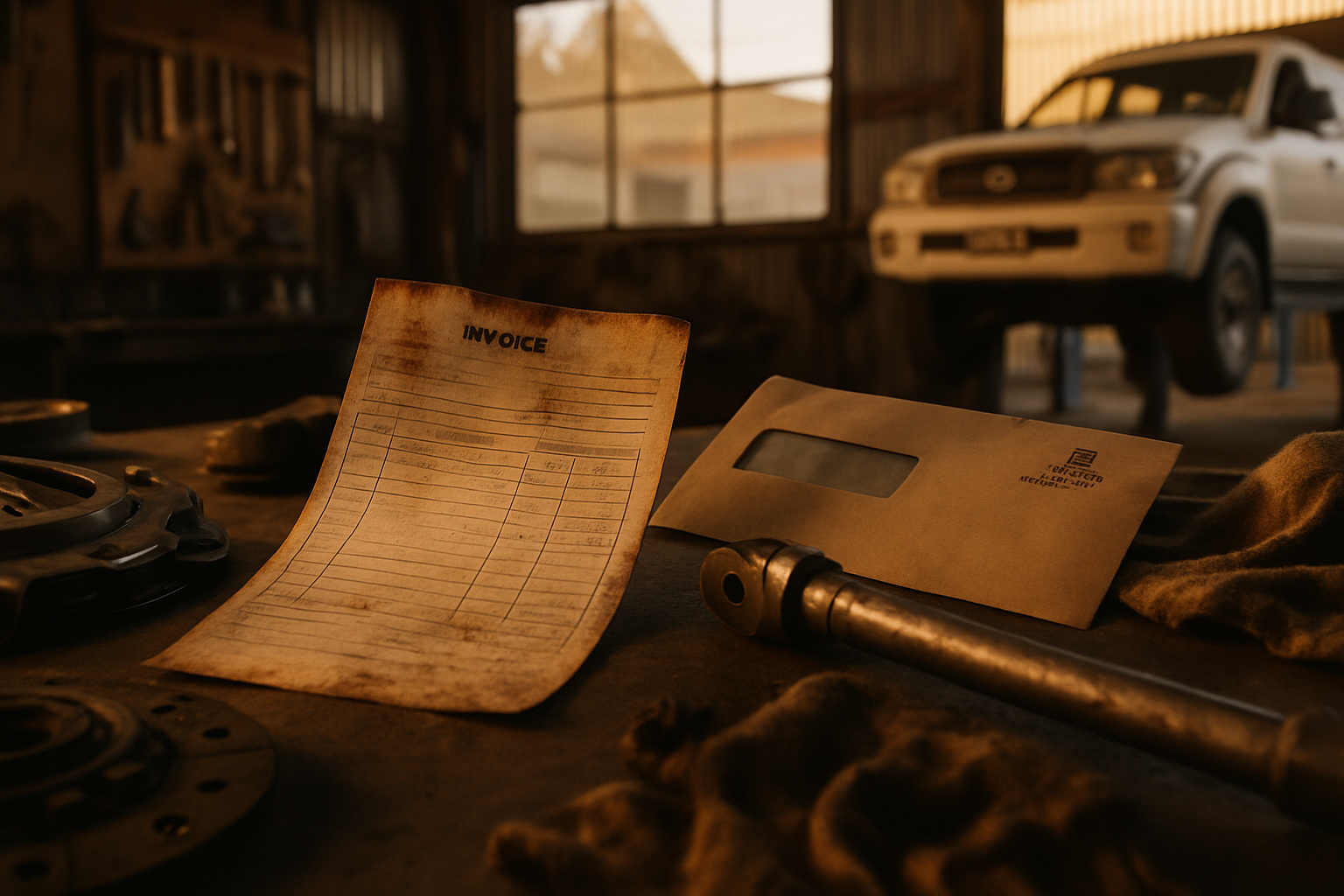
Dave has run the workshop in Frankton, Hamilton — ten minutes from the CBD, next to the industrial strip on Kahikatea Drive — for eighteen years. Repairs, servicing, tyres, and Warrants of Fitness. The workshop holds an Approved Vehicle Inspector (AVI) appointment from Waka Kotahi NZ Transport Agency — appointment number H3401, valid for light vehicle classes, renewed last June. The WoF business is a steady earner: NZ\$75 per inspection, three or four inspections a day on average, plus the pull-through revenue from the repair work that follows a "fail" sticker. Dave is both the owner and the principal vehicle inspector — two hats, one signature.
Wednesday, 2:50 p.m. An email arrives on the workshop's domain address. Sender: [email protected]. Subject: «NZTA Inspector Monitoring — Notice of Review — AVI Appointment No. H3401 — Response required within 15 working days».
Dave opens it. The letter is a monitoring review flag, not yet an enforcement action. NZTA's road crash data team ran its quarterly reconciliation and identified that a vehicle — a 2017 Mazda CX-5, registration MZR482 — had been involved in a single-vehicle crash on the Waikato Expressway on 7 March 2026. The crash report noted a reported loss of braking before the vehicle left the carriageway and hit a culvert. The vehicle's most recent WoF was issued by H3401 on 20 February 2026 — seventeen days before the crash. NZTA's audit flagged the WoF for review under the Vehicle Inspection Requirements Manual (VIRM): In-service certification. The letter asks Dave to provide: the inspection sheet for that WoF, any photographs or measurements taken at inspection, the brake pad and disc thickness readings recorded, the inspector's notes on the brake-fluid condition, and an account of the workshop's standard procedure for brake inspection under VIRM 4-1.
Dave had pulled the hydraulic lines off the CX-5 the previous December to do a brake-fluid flush and a rear-caliper service — a job the owner had booked separately from the WoF. Two weeks later, the owner booked the WoF. Dave did the WoF. It passed. Fifteen minutes, a tick across the sheet, a green sticker on the windscreen, NZ\$75 rung up on the till.
He pulls up the file. The inspection sheet exists — a one-page tick form, minimum information, no photos, no measurements. His handwritten brake notes say "pass" with no reading. The fluid-flush job from December has its own work order but is not cross-referenced with the later WoF. He has no record of whether the brake hoses were inspected for swelling, cracking or chafing — a VIRM 4-1 mandatory check — and no record of whether he pressure-tested the system after the December service.
This is the moment every AVI lives in fear of. The letter sits on Dave's desk and opens three fronts simultaneously.
Front one — NZTA inspector monitoring and the VIRM
The VIRM is not a guideline. It is the technical standard imposed on every AVI by Waka Kotahi and it governs how a WoF inspection must be conducted, what must be checked, what must be recorded, and how long the records must be retained. The introduction to VIRM: In-service certification section 3-1 duties and responsibilities sets out what is expected of a vehicle inspector and of an inspecting organisation: conduct every inspection in accordance with the manual, record the inspection outcome accurately, retain inspection records for the prescribed period, cooperate with NZTA monitoring, report faults promptly, and — critically — not issue a WoF unless the inspector is genuinely satisfied that the vehicle meets all the requirements.
When NZTA's crash-data audit flags a recent-WoF vehicle, the Agency has a ladder of responses. At the lightest end, a monitoring letter requests records and the inspector's account. If the records are adequate and the inspection was competently performed (and the failure was genuinely a post-inspection event — a stone chipped a hose, a caliper seized two weeks later), the matter closes with a file note. At the middle, NZTA issues a direction under its delegated power: the inspector must redo the inspection at the inspector's cost, issue a new WoF if the vehicle now qualifies, and refund the original fee if the vehicle does not. At the heavier end, NZTA moves to suspend or revoke the AVI appointment, either for that inspector individually or for the whole inspecting organisation. Suspension kills the WoF revenue stream immediately. Revocation is a permanent loss of the appointment — a new application must be submitted, with a fresh background review that the prior suspension/revocation will not help.
The Agency publishes its monitoring outcomes in summary on its inspector-performance portal. A suspension or revocation does not become a private matter; it appears in the inspector records accessible to NZTA-approved testing station networks and insurance partners. In a small regional centre like Hamilton, word travels inside the trade.
Front two — the owner's Consumer Guarantees Act claim
In parallel, the CX-5 owner has a separate claim against Dave's workshop under the Consumer Guarantees Act. Two candidate strands:
The December brake-fluid flush and rear-caliper service — service supplied under section 28 of the CGA (reasonable care and skill). If the subsequent brake failure was caused by a defect in how that work was performed (an air pocket in the hydraulic system, a caliper slider not correctly serviced, a seal left compromised), the owner can recover the cost of the second-tier repair, the consequential vehicle damage from the crash, and related losses. Under the Disputes Tribunal's new NZ\$60,000 jurisdiction (in force since 24 January 2026), a claim of that scale would almost certainly land at the Tribunal rather than the District Court.
The February WoF itself — supplied as a service to the owner, also subject to section 28 reasonable care and skill. A WoF inspection that missed a brake-system defect which a competent inspector should have detected is a breach of section 28 in its own right. The workshop's defence is usually that a WoF is a point-in-time assessment and cannot guarantee the vehicle's safety forward in time — a proposition correct in principle but increasingly weighed against the inspector's documentation. If the inspector recorded no measurements, no visual check of the hoses, no fluid-condition note, the Tribunal referee may conclude that the WoF was simply not performed to the standard of a competent AVI and may award damages that overlap with the NZTA's position.
Dave's workshop is effectively defending the same facts in two venues simultaneously — NZTA at the regulatory front, and (likely, once the owner's lawyer processes the facts) the Disputes Tribunal at the consumer-law front. The evidence produced to one venue is usually discoverable by the other.
Front three — the insurance and reputational layer
The CX-5's comprehensive insurer has already paid out for the crash damage and has subrogation rights. The insurer's recoveries team will receive NZTA's audit outcome and the Tribunal decision and — if either suggests inspector or repairer fault — will pursue the workshop for the payout. A workshop with a suspended or revoked AVI appointment also typically loses its approved-repairer status with insurance panels, which in a smaller city is a material revenue hit.
And the broader reputational layer: the Motor Trade Association code of ethics and the AA Auto Centre affiliation terms both include clauses allowing de-accreditation following a regulatory finding of inspector misconduct. For a workshop that relies on AA or MTA branding for consumer trust, a single bad WoF can cascade into the loss of multiple affiliations.
The five lines every Hamilton workshop holding an AVI should already carry
1. Business identification that distinguishes the repair work from the WoF work
Company name, Companies Office number, IRD and GST numbers, workshop address, phone, email. Plus — critically for an AVI workshop — a separate identification block for the inspection activity: "Approved Vehicle Inspector Appointment No. H3401 — Light Vehicle Classes — issued under the Land Transport Rule: Vehicle Standards Compliance". The two blocks should appear differently on paperwork: repair invoices carry the repair-business block; WoF inspection sheets carry the AVI block. This separation matters later when NZTA and the Disputes Tribunal both review the same file — each should see what relates to their mandate without having to cross-reference.
2. WoF inspection sheet that records measurements, not ticks
A bare tick sheet is the single biggest compliance weakness in the independent-workshop AVI sector. VIRM 4-1 requires specific checks; a tick does not record the measurement or observation that supported the pass. For brakes specifically: brake-pad thickness (front and rear, left and right — four numbers), brake-disc thickness (four numbers), brake-fluid condition (colour and moisture percentage if the workshop has a boiling-point tester), brake-hose condition (visual inspection outcome noted for swelling, cracking, chafing, corrosion), handbrake travel (number of clicks before lock). Similar specificity applies to tyres, suspension, lighting, glass and body. VIRM: In-service WoF general reference is the authoritative source.
A photograph of the brake hose, the brake-fluid reservoir, and a measurement reading stored with the job — fifteen seconds — converts a tick into evidence. NZTA monitoring closes with a file note when the inspector can produce that evidence. Without it, the inspector is defending the tick.
3. Cross-referencing of repair work to subsequent WoFs
When the same workshop performs a repair and later issues a WoF on the same vehicle, the two job records should cross-reference each other. If Dave's December fluid-flush job had been flagged in the February WoF file as "brake work performed at this workshop Dec 2025, system tested on completion, no subsequent brake complaints noted", a later audit would read the workshop as aware of the full service history and satisfied at each stage. Without the cross-reference, NZTA's file reviewer has to reconstruct the sequence from two separate documents — and any gap (did the December job leave an air pocket?) becomes the inspector's to disprove.
4. Written warranty on repair work + WoF limitations disclosure
On the repair invoice: the CGA-standard warranty statement already covered in NZ-2 (parts and labour 3 months or 5,000 km, CGA statutory guarantees preserved, first-instance contact under section 32). On the WoF receipt, a separate disclosure: "This Warrant of Fitness has been issued in accordance with VIRM: In-service certification and represents a point-in-time assessment that the above vehicle met all WoF requirements at the time of inspection. A WoF does not guarantee the vehicle's continued mechanical condition or safety. Any subsequent fault should be referred to this workshop or another qualified repairer; see below for emergency contact." This disclosure does not limit the CGA — it cannot — but it makes clear to the customer that the WoF is an inspection, not a guarantee forward in time, which supports the workshop's defence in both NZTA review and Tribunal proceedings.
5. Mandatory inspector diary + photo archive retained for seven years
VIRM requires inspector records be retained for a prescribed period (currently aligned with NZTA's audit horizon). A separate digital folder per vehicle inspected — containing the full inspection sheet, any measurement readings, at least one photograph of a critical-safety component (brakes being top of the list), and the inspector's signed attestation — is the evidentiary bedrock. The folder is produced on request in a NZTA monitoring review and as discovery in a Tribunal proceeding. Inspectors who can produce this routinely survive monitoring reviews without incident; those who cannot are steadily attrited out of the AVI network.
What is happening now in Dave's file
Dave has 15 working days to respond to NZTA. With the benefit of an advisor or a consultant familiar with the VIRM (MTA Workshop Advisory is the standard resource; some technical consultancies offer specific AVI compliance support), Dave compiles: the inspection sheet, the available photos (few), the December fluid-flush work order, his brake-inspection procedure documented in general terms, and an account of what he observed and measured on the day. The absence of specific measurements for the CX-5's brakes will be adverse; the absence of the brake-hose photograph will be adverse; the absence of a cross-reference between the December and February jobs will be adverse.
NZTA's reviewer concludes, on the material before them, that the inspection was not documented to the VIRM standard and issues a direction requiring redo-inspection at the workshop's cost and a monitoring intensification: the next twelve WoFs issued by H3401 will be audited by NZTA, with any gap in recorded evidence triggering an immediate escalation to suspension consideration. Dave's AVI appointment is not suspended or revoked at this stage but is now under heightened surveillance for twelve months — enough that any second flagged inspection in that period is likely to end the appointment. The outcome is not published publicly, but it is recorded in his inspector record and affects his renewal reviews.
In parallel, the CX-5 owner files at the Disputes Tribunal under the new NZ\$60,000 jurisdiction. The Tribunal claim includes the repair cost of the brake system post-crash, the vehicle damage as consequential loss, and an amount for loss of use. The referee is likely to find that the December brake-service work was the proximate cause if the expert evidence supports that view, and the workshop will owe the repair and consequential amounts — typically NZ\$12,000 to NZ\$25,000 on comparable fact patterns.
Total direct cost: monitoring-response preparation (NZ\$3,000 to NZ\$8,000 in consulting and time), redo-inspection cost absorbed (NZ\$150), Tribunal award (NZ\$12,000 to NZ\$25,000), insurance subrogation contribution (variable), and twelve months of intensified monitoring. Had the inspector documentation been in order — measurements on the sheet, photographs of brakes, cross-reference between December and February jobs — the monitoring file would likely have closed without a direction, and the Tribunal proceeding would have turned on whether the December service itself was negligently performed rather than on an undefended-inspection narrative.
The AVI life is documentation or it is nothing
Mekavo captures WoF inspection sheets with measurement fields pre-populated per VIRM category, photo-attachment points at every critical-safety item, cross-referencing between repair work orders and subsequent WoFs on the same vehicle, and retention rules aligned with NZTA's inspector-record horizon. The repair invoice and the WoF receipt carry their own identification blocks and their own warranty/disclosure language, so an NZTA monitoring letter and a Disputes Tribunal notice arriving on the same week each receive the correct paperwork without the inspector having to disentangle the two trades.
Holding an AVI appointment in 2026 is a privilege that the Transport Agency can withdraw if the records do not meet the VIRM. The 2026 transitional reduction in light-vehicle inspection frequency means the inspections still issued matter more — fewer touch points with the customer, higher scrutiny per inspection, lower tolerance for documentation gaps. The five lines above are the price of keeping the green sticker and the green light from Waka Kotahi both.
Official resources
- Waka Kotahi NZ Transport Agency — Warrant of Fitness overview
- VIRM: In-service certification (WoF and CoF) — inspector manual
- VIRM 3-1 — Duties and responsibilities of vehicle inspectors
- NZTA — 2026 changes to light vehicle inspection frequency
- Consumer Guarantees Act 1993 — legislation.govt.nz
- Disputes Tribunal of New Zealand
- Motor Trade Association NZ — workshop advisory and AVI support
Last updated: April 2026. The regulatory framework cited was in force at the date of publication; the light-vehicle inspection frequency transition begins 1 November 2026 and phases through to 1 November 2027. For an active NZTA monitoring review, a pending direction under delegated powers, or a parallel Disputes Tribunal proceeding, consult the MTA Workshop Advisory or a legal advisor familiar with transport regulatory practice before responding to the Agency — while the response is not adversarial in form, its content determines the monitoring outcome.
Note on scenarios: The shops, names, addresses, and case reference numbers in this article are fictional and used solely to illustrate how the cited statutes operate in practice. Any resemblance to actual shops, owners, or events is coincidental. The statutes, regulations, and agency procedures cited are real and current as of publication.