English
 Español
 Deutsch
 FI
FI
 PT
PT
 BR
BR
 FR
FR
 AR
AR
 ZH
ZH
 UR
UR
 TL
TL
 TH
TH
 TR
TR
 PL
PL
 RO
RO
 BG
BG
 ID
ID
 MS
MS
 LT
LT
 IT
IT
 NL
NL
 CS
CS
 SK
SK
 SL
SL
 ET
ET
 SV
SV
 NB
NB
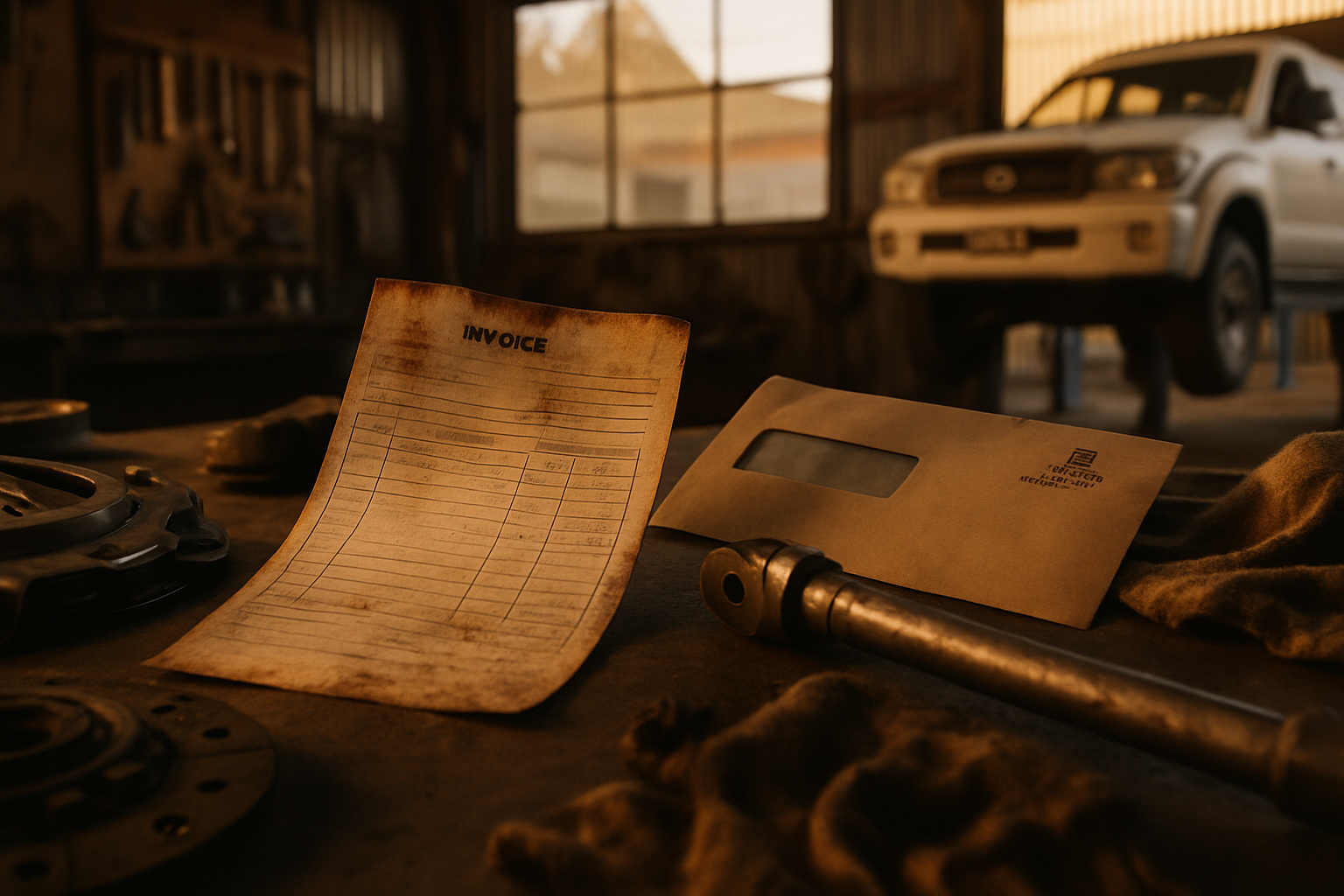
Greg has run the workshop off Great South Road in Manukau — south of Auckland CBD, near Hunters Corner — for fourteen years. Timing belts, brakes, clutches, suspension, air-conditioning. Regulars from Papakura and Papatoetoe, a steady stream of Uber drivers working the airport line, a few fleet cars from a small caterer in Onehunga. Tuesday, 9:25 a.m. A letter arrives in the post: Disputes Tribunal of New Zealand — Auckland Hearing Centre — Hearing Notice, Claim No. 2026/AUK/DT/00418. Hearing date in six weeks. Referee-led. No lawyers.
A customer — Toyota Hilux, registration NGF492 — has claimed NZ\$38,000. Breakdown: NZ\$2,700 paid to Greg's workshop three months earlier for a timing belt, tensioner, idler and water pump replacement, plus NZ\$7,800 paid at a Toyota dealership in Botany to rebuild the cylinder head after the replacement belt slipped on the Southern Motorway, plus NZ\$27,500 claimed as the diminution in value of the vehicle (it was a 2019 Hilux SR5 with a clean history until the incident, and the rebuild does not restore resale value). The statutory basis cited: "breach of the guarantee of reasonable care and skill under section 28 of the Consumer Guarantees Act 1993, breach of the guarantee of fitness for particular purpose under section 29, breach of the quality guarantee attaching to the goods (parts) supplied under section 18, and recovery under section 32 of all reasonable costs of having the failure remedied elsewhere together with foreseeable consequential loss."
Greg has the handwritten job sheet. He has a text from the customer saying "yeah sweet, do the belt thanks". He has the tax invoice printed on NCR duplicates with GST broken out at 15% and his IRD number in the footer. The invoice meets Inland Revenue for GST purposes and nothing else. It carries none of the five lines the Disputes Tribunal referee will work through at the hearing.
Here is what most New Zealand workshop owners have not yet absorbed: from 24 January 2026, under the Disputes Tribunal Amendment Act 2025, the Tribunal's jurisdictional limit doubled to NZ\$60,000. Until that date, a NZ\$38,000 claim would have headed to the District Court, meaning: a lawyer for the plaintiff, a lawyer for the workshop in response (NZ\$6,000 to NZ\$15,000 easily), filing fees, a discovery phase, court hearings. The cost to defend would have been significant enough that workshops often settled quietly at 50-70% of the claim to avoid the defence spend. Those days are over. The same claim now lands at the Disputes Tribunal: the consumer pays a NZ\$468 filing fee (for claims over NZ\$30,001), attends a hearing with an impartial referee, and walks away with a binding decision in about eight to twelve weeks. No lawyers on either side. No costs order. Just a reasoned decision based on the documentation each party brings in.
The Tribunal is not easier on workshops because it is cheaper for consumers. If anything, the referee's scrutiny of documentation is sharper than a District Court judge's — the referee specialises in fact-finding under the CGA and the Fair Trading Act, sees a hundred workshop disputes a year, and knows where the evidentiary weak points sit. The workshop arrives at the hearing with whatever paperwork it has. Whatever is missing is missing.
Here is what every Auckland workshop — and by extension, every workshop in New Zealand — should already have on the job sheet before the next Tribunal hearing notice arrives in the post.
What the CGA actually says — and what it means at the counter
Three sections carry most of the weight when a service fails.
Section 28 — Guarantee as to reasonable care and skill. "Where services are supplied to a consumer there is a guarantee that the service will be carried out with reasonable care and skill." The standard is that of a competent tradesperson in the relevant field — what another experienced mechanic would achieve on the same job. Cutting corners on installation torque, skipping a specified alignment, or failing to test-drive after a complex job all fall short of reasonable care and skill, even if the parts themselves were fine.
Section 30 — Guarantee as to time of completion. Where no time is fixed by contract, the service must be completed within a reasonable time. Reasonable time is decided on the facts — an urgent road-trip job before Easter is a different reasonable time to a fleet service scheduled a month out. If the customer was told "ready by Friday" and the vehicle is still in the workshop the following Thursday, section 30 is implicated even if the eventual work is competent.
Section 32 — Options of consumer where service does not comply with guarantee. This is the teeth. Where a service fails to meet one of the CGA guarantees, the consumer's options depend on whether the failure can be remedied. If it can be remedied, the consumer must first require the supplier to remedy it within a reasonable time. If the supplier refuses or neglects, or does not succeed within a reasonable time, the consumer can have the failure remedied elsewhere and recover all reasonable costs from the original supplier, or cancel the contract. If the failure is of substantial character, the consumer can cancel immediately without first giving the original supplier the opportunity to remedy. And the consumer can claim damages for any loss that was reasonably foreseeable from the failure — in Greg's customer's case, the cylinder-head rebuild cost and (potentially) the diminution in value.
On top of the CGA, the goods component of the service (parts supplied and installed) carries section 18 acceptable-quality guarantees, and the Fair Trading Act 1986 — particularly section 9 (misleading or deceptive conduct) — is routinely pleaded alongside CGA claims when the workshop is alleged to have represented work as done to a standard that was not met. The referee applies both statutes in parallel at the hearing.
The five lines every Auckland workshop's job sheet should already carry
1. Full business identification — including IRD, GST registration and any accreditations
Registered business name, company number (Companies Office NZ 7-digit reference), IRD number, GST registration number (mandatory above NZ\$60,000 turnover per the IRD), physical workshop address, phone, email, and — where applicable — Motor Trade Association (MTA) membership number, AA Auto Centre affiliation, or approved-repairer status with insurance panels. The referee reads the header to confirm formality and industry standing; missing GST or company details can make the Tribunal wonder whether the workshop was operating off-book. Print once in the header and keep it current.
2. Written job card with scope, parts provenance and labour — signed by the customer
Customer name and contact, vehicle registration / VIN / year / make / model / odometer at intake, specific scope of work ("replacement of timing belt, tensioner, idler pulley, water pump — OEM Toyota or equivalent approved by manufacturer specification"), parts with unit prices, labour hours × rate, sub-totals, GST at 15%, total, estimated completion date and validity of the quotation. Customer signature acknowledging the scope and price. A text message "yeah sweet, do the belt thanks" is context, not a signed job card. The referee treats a signed document as definitive about what was agreed; a text message as secondary, useful-but-not-decisive evidence.
If additional work is needed during the job, you stop, photograph, text the revised scope and price, receive written acceptance, attach the thread to the job sheet, and proceed. No additional charges without the authorisation trail.
3. Reasonable-care-and-skill documentation — photos, torque records, test drive
The CGA's central question under section 28 is whether the work was done to the standard of a competent mechanic. Documentation builds the answer: a photo of the old and new parts side-by-side, a photo of the installed part in place, a torque-wrench reading photo for any critical fastener (camshaft caps, main caps, head bolts — where specifications matter), a test-drive note confirming no fault codes after reset, an audio clip of the engine running smoothly at operating temperature. The referee, or the referee's technical support if expert evidence is called, reads this evidence as the best available answer to whether reasonable care was taken. Undocumented work — "I did it properly, trust me" — loses in the face of a dealership's later diagnostic report.
4. Written warranty and first-instance complaints process — section 32 foothold
Add to the job sheet and the tax invoice: "Warranty: parts and labour are covered by the acceptable-quality and reasonable-care-and-skill guarantees of the Consumer Guarantees Act 1993. In addition to the Act, this workshop offers 3 months or 5,000 km (whichever occurs first) of direct remedial cover on the specific work performed above. If a fault develops within the warranty period, please contact the workshop first on [phone] or [email]. Under section 32 of the CGA, the opportunity to remedy must be offered to the original supplier before remedy is sought elsewhere unless the failure is of substantial character."
The final sentence is the one that shifts the damages analysis at the hearing. When a customer takes the vehicle straight to a dealership for NZ\$7,800 of remedial work without contacting the original workshop first, the referee will ask whether the failure was of "substantial character" (which bypasses the first-instance opportunity). If it was not, the original supplier's right to remedy was not respected, and the consumer's recovery under section 32 may be limited to what would have been reasonable had the original workshop fixed it. A printed notice of the workshop's first-instance contact details on the invoice goes a long way to preserve this defence.
5. Customer sign-off at pickup — with odometer, test-drive note and photos
Add a line to the pickup copy: "I have collected this vehicle in running condition consistent with the work performed. I acknowledge the warranty set out above and the first-instance contact details. Customer signature: ____________." Signature at pickup does not waive the CGA — statutory guarantees cannot be contracted out — but it shifts the evidentiary posture from "defective delivery" to "later failure" and gives the referee a dated reference point for the condition of the vehicle leaving the workshop. Record the odometer at pickup. Add three or four photos of the state on collection and a short engine-running audio. Upload to the customer's service record. Ten seconds at pickup that cover three months of contested fact at the hearing.
What happens now in Greg's file
Greg attends the hearing in six weeks at the Manukau District Court building (where the Disputes Tribunal sits for South Auckland claims). He brings the handwritten job sheet, the parts receipts, the tax invoice, the text exchange, and photos he took when he remembered to — which is two of the four critical points (old vs new belt, installed belt). He has no torque record. He has no test-drive note. He has no written warranty statement. He has no collection signature.
The referee opens with the statutory framework, then invites each side to describe the work and the failure. The customer presents the Toyota dealership's diagnostic report which states that the timing belt was installed without the tensioner being torqued to manufacturer specification, that the belt subsequently tensioned itself against the idler in a way that caused premature wear, and that the resulting slip at speed caused the valve-to-piston contact that destroyed the head. The report is signed by a Toyota master technician and stamped with the dealership's diagnostic equipment date-stamp.
Greg disputes the diagnosis: the tensioner was torqued, he remembers it, but he has no photograph or written record. The referee weighs the documented dealership diagnosis against Greg's oral recollection. On the balance of probabilities, the referee finds for the customer on section 28 (reasonable care and skill not proven), section 32 recovery of the dealership's NZ\$7,800 invoice (though reduced by NZ\$1,500 because the customer did not give Greg the opportunity to inspect before engaging the dealership — the referee accepts it was arguably of substantial character but considers the partial deduction fair), and does not award the diminution-in-value claim (too remote, not proven to Tribunal standard without an independent valuer's report).
Final order: Greg's workshop to pay the customer NZ\$8,900 (refund of NZ\$2,700 original invoice + NZ\$6,300 of the NZ\$7,800 dealership work + NZ\$0 diminution) within 28 days of the decision. The Tribunal does not order costs in the usual sense (no party has legal costs because lawyers are not permitted), but the filing fee of NZ\$468 is added to Greg's liability. Total direct cost: NZ\$9,368, plus the afternoon spent at the hearing. Compared to a District Court claim with lawyers on both sides, this is cheaper for both parties by a significant margin — which is exactly why Parliament raised the Tribunal's limit to NZ\$60,000.
If Greg had produced a torque record, a test-drive note signed by himself or his foreman, the four photos of the job in sequence, a written warranty on the invoice, and a collection signature — the hearing might have gone the other way on the key factual question. The referee can only weigh what is put before her.
Cost of putting the five lines on every job sheet for the next three years? Five minutes of template work. Once. For the next four thousand jobs. And under the new NZ\$60,000 Tribunal limit, the exposure from bad documentation is now twice what it used to be.
The job sheet and tax invoice you are already printing
Mekavo prints all of the above — full business identification with IRD, GST and MTA (if applicable), CGA-compliant written job card with scope and signature, parts provenance captured in the line item, photo and audio attachment points per job stage, warranty statement with section 32 first-instance language, and customer pickup signature with odometer and photo capture — on every job sheet and tax invoice, automatically. When the Tribunal hearing notice arrives three months after the job, the documentation the workshop walks into the hearing with is the documentation the customer already has. Nothing to reconstruct.
The Disputes Tribunal is now the default venue for any workshop dispute up to NZ\$60,000. It is designed to be accessible to consumers and unforgiving of undocumented workshops. What a workshop can change is the shape of the job sheet and the pickup invoice that leaves the counter. Five lines. Print them once. Keep them on every job.
Official resources
- Consumer Guarantees Act 1993 — full text on legislation.govt.nz
- MBIE Consumer Protection — CGA guidance
- MBIE — Business obligations under the CGA
- Disputes Tribunal of New Zealand — official site
- MBIE — Making a claim through the Disputes Tribunal
- McVeagh Fleming — analysis of the new NZ\$60,000 Tribunal limit
- Motor Trade Association NZ — industry code of practice and membership
Last updated: April 2026. The statutes and jurisdictional limits cited were in force at the date of publication (the Disputes Tribunal Amendment Act 2025 took effect on 24 January 2026). For an active Disputes Tribunal hearing notice with a hearing date approaching, consult a community law centre, the MBIE Consumer Protection advisers, or a lawyer admitted in New Zealand before the hearing — while lawyers cannot represent a party at the hearing itself, advance advice on preparation and evidence is permitted and often decisive.
Note on scenarios: The shops, names, addresses, and case reference numbers in this article are fictional and used solely to illustrate how the cited statutes operate in practice. Any resemblance to actual shops, owners, or events is coincidental. The statutes, regulations, and agency procedures cited are real and current as of publication.