 English
 Español
 Deutsch
 FI
FI
 PT
PT
 BR
BR
 FR
FR
 AR
AR
 ZH
ZH
 UR
UR
 TL
TL
 TH
TH
 TR
TR
 PL
PL
 RO
RO
 BG
BG
 ID
ID
 MS
MS
 LT
LT
 IT
IT
 NL
NL
 CS
CS
 SK
SK
 SL
SL
 ET
ET
 SV
SV
 NB
NB
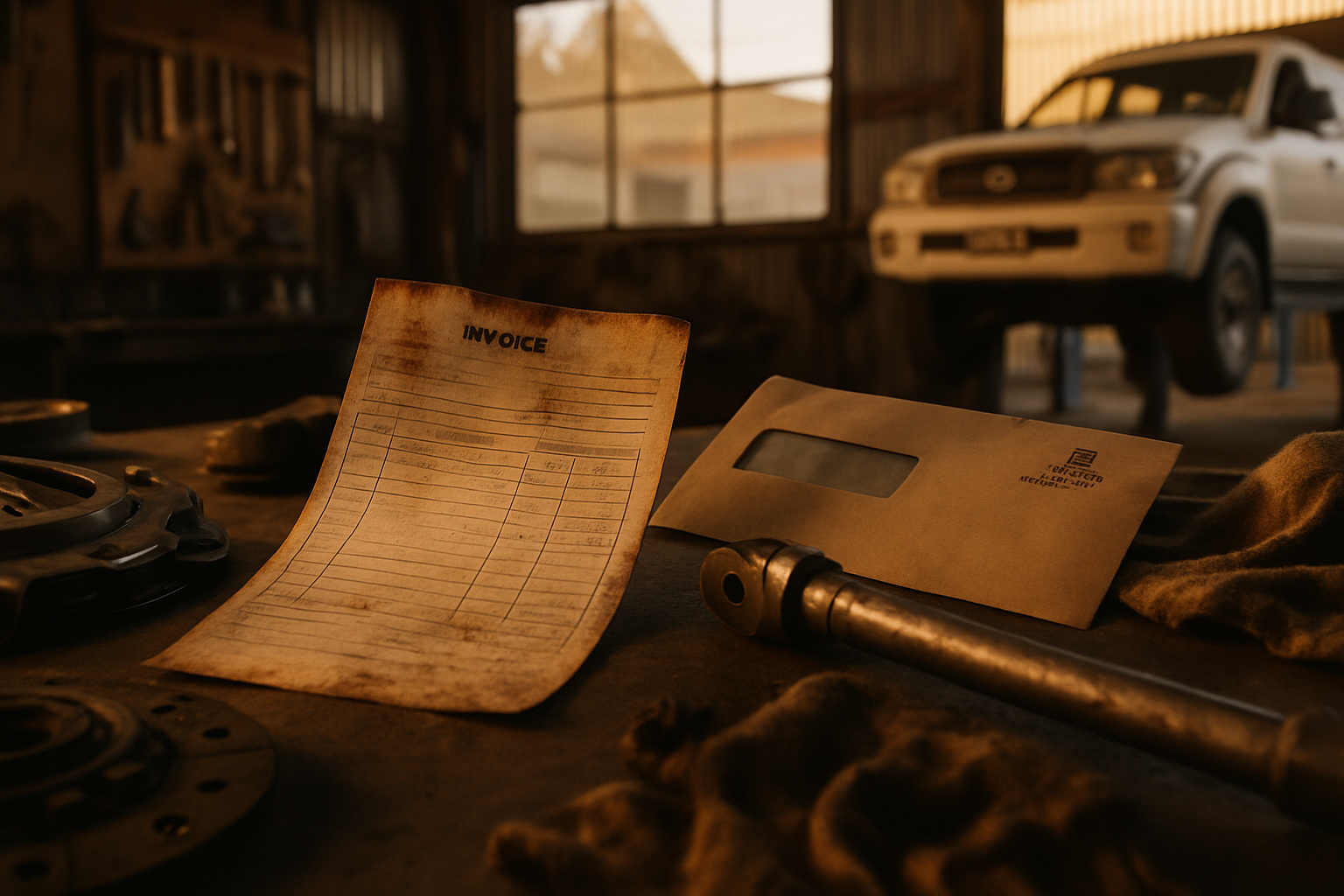
Brian runs a three-bay workshop in Tauranga. Fifteen years on his own account, WoF sticker on the window, regulars who bring their Corollas and Hilux utes in every six months. No website, no Facebook, word of mouth. It works.
On a Thursday morning in March, a windowed envelope turned up in his post. Ministry of Justice watermark. Inside: a notice that a customer had filed a claim against him at the Tauranga Disputes Tribunal. The claim: $3,200. The reason: a clutch job Brian had done two months earlier for $1,400. The customer had driven 2,800 km, felt the clutch slipping under load, taken the car to a main dealer, and been told the pressure plate had been left in place when Brian replaced the clutch disc. The main dealer's bill was $1,800 to do it properly. The customer wanted Brian's original fee back plus the main dealer's bill.
Brian pulled his filing system — a shoebox. Found the original invoice. It had:
- His business name, GST number, and address
- The customer's name and rego
- "Clutch replacement — $1,400"
- GST
- Total
It did not have a single line about what exactly was replaced. No written quote agreed before the job. No warranty clause. No acknowledgment the customer had accepted the scope. Not even a note that the pressure plate was inspected and deemed fine (if Brian had inspected it, which he said he had, but had no way to prove).
Brian had 15 working days to respond to the Tribunal. He couldn't send a lawyer — the Disputes Tribunal doesn't allow legal representation at hearings. He'd represent himself, he'd get one shot in front of a Referee, and the decision would be binding.
Here's what happens next in that room, what the Consumer Guarantees Act 1993 actually requires of a workshop invoice, and the five lines that would have changed Brian's afternoon.
The law that runs the room — it isn't on Brian's side by default
New Zealand doesn't have a garage-specific regulation like Spain's RD 1457/1986. What it has is the Consumer Guarantees Act 1993, which applies to every service provided to a consumer — including your repair work. The Act is written from the consumer's point of view, which means the default framing in any Tribunal hearing is "did the service comply with the guarantees, and if not, what does the consumer get."
The four service guarantees you need to know:
- Reasonable care and skill — the service must be carried out with the skill expected of a competent trader in that field. If a clutch fails at 2,800 km, the presumption leans toward the work not having been done with reasonable care and skill. You rebut it with evidence.
- Fit for purpose — if the customer told you what they wanted the service to achieve (a working clutch for 80,000 km, a WoF pass, the brakes not to squeal), you're on the hook for delivering that.
- Reasonable time — the job has to be done in a reasonable time for work of that kind. If you said "Tuesday afternoon" and the car wasn't ready until Friday, that's a s.29 breach even if the work was perfect.
- Reasonable price — when no price was agreed in writing, the customer only has to pay a reasonable price. What "reasonable" means is what the Referee thinks it means, with reference to what other garages charge.
When the service fails any of these guarantees, the customer has three remedies available, in order: repair or repeat the service at your cost, claim compensation for reduction in value, or if the failure is substantial, cancel and seek a full refund plus damages.
Brian's customer was asking for the third remedy: the full $1,400 back plus the $1,800 she'd had to pay the main dealer to redo the job properly. Under the Act, that's legitimate if the Tribunal finds Brian's service failed the "reasonable care and skill" guarantee.
Alongside the CGA 1993, the Fair Trading Act 1986 covers misleading and deceptive conduct. Telling a customer "the pressure plate is fine" when it wasn't, or charging $1,400 for a job a reasonable mechanic would have quoted $1,900 for (because it needed the pressure plate), opens a parallel line under the Fair Trading Act. The Commerce Commission is the enforcement body for serious or systemic breaches — they don't usually come for a single invoice, but a Disputes Tribunal decision against a trader creates a paper trail.
What the Tribunal process actually looks like
The Disputes Tribunal handles claims up to $30,000 as standard and $60,000 by agreement of both parties. Application fees scale with the claim size but stay small by court standards — at the $3,200 level Brian's customer was looking at about $59 to $179 to file. That's how cheap it is to drag you in.
Once a claim is filed:
- You're notified by post with a copy of the claim and a hearing date, usually 4–8 weeks out
- You have 15 working days to file a response (the "Notice of Investigation")
- If you don't respond, the hearing proceeds in your absence — you don't get a default judgment like the UK, but the Referee decides with only the claimant's story to go on, which is as good as losing
- Hearing lasts 30–60 minutes, both sides speak in turn, Referee asks questions
- Decision is issued within 5 working days after the hearing, in writing
- It's binding and enforceable. No right of appeal on the merits — only on procedural error, and only to the District Court
If you lose and don't pay, the claimant can register the decision with the District Court and pursue recovery through a bailiff, wage attachment, or bank attachment. Disputes Tribunal judgments don't hit a centralised credit register the way UK CCJs do, but they appear in company searches and show up on the Tribunal's decisions database, indexed by respondent name, for at least five years.
For a small workshop where word-of-mouth is the business, that online record matters more than a credit score. A future customer Googling "Brian's Auto Tauranga" and finding a Disputes Tribunal ruling — that's the kind of trust damage that's hard to reverse.
Five lines Brian's invoice should have carried
1. A written quote accepted before work starts
This is the single biggest gap on every Kiwi workshop invoice we see. The CGA 1993 reasonable-price guarantee (s.31) only bites when no price was agreed. If you and the customer agreed $1,400 in writing for a clutch replacement before you started, the customer can't argue the price was unreasonable in a Tribunal. If you didn't, you're arguing reasonable-price from zero evidence.
A written quote doesn't need to be a fancy document. A text message with an itemised price counts. A quote link sent from workshop software the customer accepts by clicking counts. What doesn't count at the Tribunal: "we had a chat at the counter." The Referee wants evidence of agreement, and your memory of the counter conversation is not evidence.
While you're quoting, include the scope. If the quote says "clutch disc replacement (pressure plate not included)," and the customer accepts it, you've already told her the pressure plate isn't part of the deal. Her argument in Brian's hearing evaporates.
2. Labour warranty stated explicitly on the invoice
Kiwi garages typically offer 3 months or 5,000 km. That's the industry standard, informally. Legally, it's only binding if it's on the invoice. If the invoice is silent, the customer can argue for whatever "reasonable" means — and increasingly in the Tribunal, "reasonable" for a labour-intensive job is being argued upward of 6 months.
Stock wording: "Our labour and workmanship is warranted for 3 months or 5,000 km, whichever comes first. This warranty is in addition to your rights under the Consumer Guarantees Act 1993."
That final sentence matters. It signals to the customer (and to any future Referee) that you're aware of the CGA and aren't trying to contract out of it. Trying to contract out is itself an offence under section 43 of the Act — strict liability, up to $30,000 in fines for the company or $10,000 for an individual.
3. A parts warranty pointer (manufacturer-owned)
New parts fitted carry the manufacturer's warranty, not yours. A Valeo clutch kit is warranted by Valeo, typically 12 months or 20,000 km. A Bosch pump is warranted by Bosch. Your invoice should state this explicitly so a customer knows where to claim when a part itself fails, rather than defaulting to "the garage owes me everything."
Sample: "New parts fitted carry the manufacturer's standard warranty, typically 12 months. Defective parts will be replaced under the manufacturer's warranty subject to their terms. Our labour warranty applies in addition."
4. Customer-supplied parts marked and disclaimed
This one saves you repeatedly. Customer brings a set of pads from AliExpress, you fit them, 2,000 km later they squeal. Customer claims the fit was poor. If your invoice has the line clearly marked "Customer-supplied — excluded from workshop warranty," the Referee treats your fit and the part as two separate questions. Your labour warranty still holds; the part claim is between customer and manufacturer (or AliExpress, good luck).
Without the disclaimer, you're defending the quality of a part you didn't choose. Not a position you want at a hearing where you're representing yourself.
5. Dispute authority footer
One line at the bottom: "Disputes: Motor Trade Association (mta.org.nz) or Disputes Tribunal (disputestribunal.govt.nz)."
Practical effect: it shows the customer you're aware of the proper channels, which often stops a small grievance from escalating to a Tribunal claim — she tries the MTA or rings you first. If it does escalate, the Referee sees you pointed her at the right place. It's a small thing that signals professionalism and legal awareness at the same time.
Why most Kiwi workshops lose Tribunal cases they should have won
We've watched enough Disputes Tribunal decisions (they're all public) to see the pattern:
- The workshop is usually technically right. The mechanic did the job the customer agreed to. But the customer is arguing over what was agreed — and the mechanic has no paperwork to rebut.
- The Referee defaults to the claimant. Not because the Tribunal is biased, but because the CGA is written to protect consumers. The burden shifts to the trader to show the service met the guarantees.
- Verbal agreements count for very little. "We talked about it at the counter" is the most common losing argument. The Referee wants a written quote, a signed reception, an itemised invoice — that's the evidence she can weigh.
- The mechanic walks in thinking it's a courtroom fight. It isn't. It's a problem-solving session in front of a Referee. The mechanic who brings organised paper and a calm explanation wins. The mechanic who brings frustration and missing documents loses.
Why we built Mekavo
Mekavo is workshop management software designed for independent Kiwi garages. We built the five lines above into the invoice template by default, not as an upgrade you have to find — because no NZ workshop should lose a Disputes Tribunal hearing for missing sentences.
Every Mekavo invoice carries automatically:
- The labour warranty clause — "3 months or 5,000 km" with the CGA 1993 reference
- The parts warranty pointer (manufacturer-owned)
- A customer-supplied parts disclaimer when you tick a box on any cost line — excluded from your warranty, labour warranty still applies
- The dispute authority footer pointing to the MTA and Disputes Tribunal
- A separate public quote URL the customer accepts by clicking — timestamp, IP, and signature captured automatically — that's the evidence of "price agreed in writing before work" the Referee asks for
The reception document, signed on the customer's phone in 30 seconds, records the scope of work and the parts decision. That's the evidence Brian didn't have. It's what ends a Tribunal hearing with the Referee saying "the service was carried out with reasonable care and skill, claim dismissed" instead of "insufficient evidence of scope agreed, order to refund."
If you run a workshop in New Zealand, try Mekavo free. No card, no upfront commitment, you can have your first invoice out before the next car comes up on the hoist. It's worth more than an afternoon at the Tauranga District Court learning this the hard way.
Frequently asked
I've run a workshop for 20 years and never been to the Tribunal. Is this scaremongering?
Probably doesn't apply to your business directly — but the Disputes Tribunal handles around 50,000+ claims a year across all categories, and motor trade is consistently in the top 5 by volume. It's cheap, quick, and has no lawyer barrier. More customers are using it, and the average trade respondent has about a 40% success rate — the 60% who lose usually lose on missing evidence, not bad workmanship.
Can I ignore a Tribunal claim and hope it goes away?
No. If you don't file a response, the hearing still proceeds in your absence and the Referee decides with only the claimant's story in front of them. A judgment goes against you, it gets enforced through the District Court, and you'll see it in your mail as an enforcement notice eventually. Ignoring the claim is the fastest way to lose it.
If I lose, can I appeal?
Appeals go to the District Court but only on grounds of procedural error or the Referee being biased or acting beyond jurisdiction. You cannot appeal because you disagree with the Referee's finding on the facts. That's the point of the Tribunal — quick, binding, no endless appeals. Your one shot is the hearing itself.
Is MTA membership required?
No. Motor Trade Association membership is voluntary but gives you access to a pre-Tribunal mediation service, trade standards, and an industry code that Referees treat as "industry best practice" when assessing reasonable care and skill. Worth the fee for most workshops serious about reducing Tribunal exposure.
What's the difference between a Disputes Tribunal claim and a Consumer NZ complaint?
Consumer NZ is an advocacy body — they publish reviews and can't force anything. The Commerce Commission investigates systemic Fair Trading Act breaches. The Disputes Tribunal is the legal path for a single dispute and is the one most likely to actually cost you money. All three can be running in parallel for the same issue, which is the worst outcome.
Sources and references
- NZ Legislation — Consumer Guarantees Act 1993 (full text)
- NZ Legislation — Fair Trading Act 1986
- Disputes Tribunal — official site
- Ministry of Justice — Disputes Tribunal decisions database
- MBIE Consumer Protection — Consumer Guarantees Act overview
- Commerce Commission — consumer law enforcement
- Motor Trade Association (MTA) — industry code of practice
- Community Law — Consumer rights and obligations manual
Published April 2026. Consumer Guarantees Act 1993, Fair Trading Act 1986, and Disputes Tribunal fees current at date of publication. If you have been served with a Disputes Tribunal claim, get advice from the Motor Trade Association or a community law centre before the 15-working-day response window closes. This article is not legal advice and doesn't cover every situation — it's a starting point.
Note on scenarios: The shops, names, addresses, and case reference numbers in this article are fictional and used solely to illustrate how the cited statutes operate in practice. Any resemblance to actual shops, owners, or events is coincidental. The statutes, regulations, and agency procedures cited are real and current as of publication.